
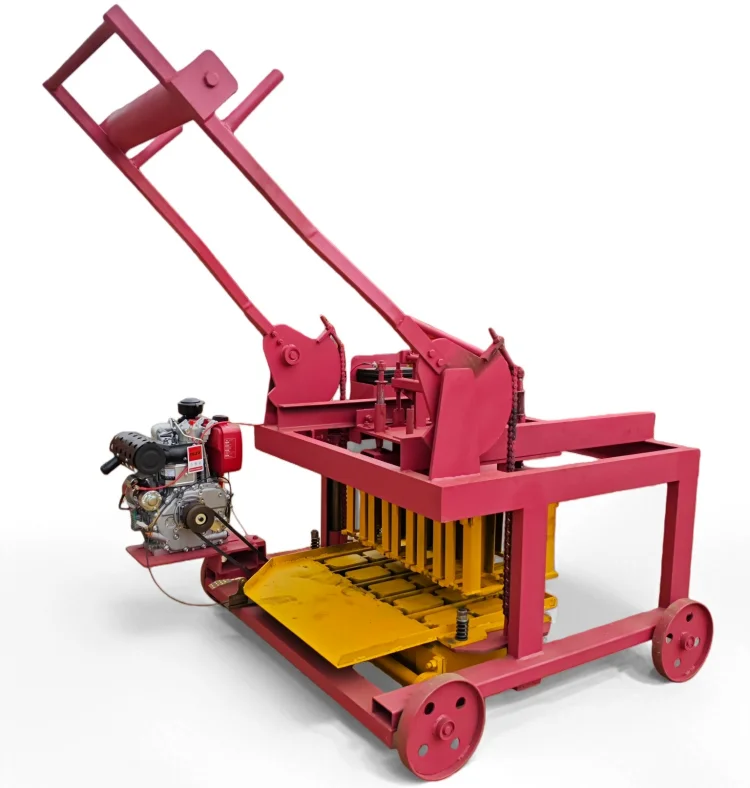
Matched System Supply — diesel press, mixer, and trolley specified together so every station in the mobile block making machine production line keeps pace without material bottlenecks or idle curing space.
Technical Specifications
| Parameter | Value |
|---|---|
| Model | QMR4-45 |
| Product Type | Mobile Block Making Machine |
| Power Source | Diesel |
| Rated Power | 8 hp |
| Molding Cycle | 45 s |
| Molding Form | Vibration and Pressure |
| Vibration Force | 60 kN |
| Total Weight | 800 kg |
| Overall Dimensions | 2420 × 1320 × 1650 mm |
| Pallet Requirement | No pallet required (egg-laying type) |
| Automation Level | Manual / semi-mobile with trolley |
| Basic Equipment Included | JZC350 Diesel Concrete Mixer or JQ350 Diesel Concrete Mixer (with Electric Generating Unit); Trolley |
| Block Formats | Paver brick, hollow block, concrete block, solid brick, fly ash brick (basis not stated in source) |
| Voltage & Frequency | Not stated in source (basis to be confirmed) |
| Output Capacity | Not stated in source (basis to be confirmed) |
Application Suitability
| Application | Material or Output |
|---|---|
| On-site hollow block production for building contractors | Crushed stone, river sand, cement blends |
| Small-scale solid brick plants | Fly ash, sand, and lime mixes |
| Remote housing project block supply | Local aggregate with diesel-only power access |
| Paver brick production for walkways and yards | Fine aggregate and cement with vibration compaction |
What a "45-Second Cycle" Really Means on a Job Site
Cycle time only holds when the mixer, trolley, and curing ground are timed to the same beat.
A 45-second molding cycle sounds straightforward until the mixer cannot discharge fast enough, or the trolley operator is still repositioning while the press sits idle. On several sites I have walked, the stated cycle was achievable on clean sand in a factory test, but local aggregate with high clay content slowed compaction and forced the operator to extend the cycle manually. The mobile block making machine production line only delivers its rated rhythm when every upstream and downstream station is specified for the same tempo [NEED_CITE: effect of aggregate clay content on vibration compaction time].
Keeping the Mixer and Press in Step
The QMR4-45 is paired with either a JZC350 or JQ350 diesel concrete mixer, both sized so that one batch fills the press hopper before the next molding cycle begins. When the entire mobile block making machine production line runs on diesel, there is no dependency on grid power, which matters on remote housing developments where electricity is unreliable or absent. The mixer discharge height and the press hopper opening must align so that material flows by gravity without manual shoveling.
The Curing Ground as Part of the Line
Egg-laying design means the press deposits blocks directly onto a prepared flat surface and advances forward on its trolley. There are no pallets to feed, collect, or store, which removes an entire handling loop from the layout. The trade-off is that the curing area must be level, swept, and long enough for a full day of output before the press reaches the end and loops back. Planning that ground space is as important as sizing the mixer [NEED_CITE: curing area planning for egg-laying mobile block machines].
Reading the Specs That Matter
The 60 kN vibration force works together with mechanical pressure to compact the mix into the mold cavity. Higher vibration alone will not produce a dense block if the pressure stage is too short, and the 45-second cycle divides its time between filling, vibrating, pressing, and demolding. The 800 kg total weight of the QMR4-45 gives the frame enough mass to resist bouncing during vibration, which keeps the block dimensions consistent from the first piece to the last. An 8 hp diesel engine drives both the vibration and the hydraulic pressure stage, so fuel consumption tracks directly with cycle count rather than running idle between batches.
The Cost of Skipping the Line Layout
Buyers who order the press alone and source a mixer locally often find the mixer batch size is too small, forcing two batches per press cycle and doubling the mixing labor. Others discover that their curing ground slopes slightly, causing freshly laid blocks to slump on one side before they set. These mismatches do not show up in a catalog comparison but appear on the first production day when the crew is standing around waiting [NEED_CITE: common line mismatch issues in small-scale block production].
Why Procure the Full Setup Here
Block machinery is our single focus, so the QMR4-45, its mold, and the matching mixer are specified as one system rather than assembled from separate vendors. We set the configuration against your actual mix design and local aggregate, not a default catalog recipe. Molds are supplied for the block formats your market sells, and custom drawings are accepted when a non-standard format is needed. The automation level is selectable, meaning you can start with manual trolley operation and add automatic features later if volume grows. Installation support includes operator training at your site so the crew understands cycle timing from day one.
Documentation & Verification
- Line layout drawing showing mixer, press, and trolley positions with curing area dimensions
- Capacity calculation sheet stating the block format assumed for the 45-second cycle
- Mold drawing and format list confirming which block shapes ship with the line
- Diesel mixer batch size matched against press hopper demand per cycle
- Voltage and generating unit rating confirmation for the JQ350 electric variant
- Factory test record on your specified aggregate blend before dispatch
Installation, Commissioning & Support
- Level concrete curing ground prepared to the dimensions shown in the line layout before the QMR4-45 arrives
- Diesel fuel supply and storage sized for 8 hp continuous operation across an eight-hour shift
- JZC350 or JQ350 mixer assembled and positioned at the hopper discharge height specified in the drawing
- First-run molding test on your local aggregate to verify cycle timing and block density
- Operator training covering mold change, vibration adjustment, and daily greasing points
- Wear parts list for mold liners and vibration mounts with recommended reorder intervals
Before You Send an Inquiry
Tell us the block format and dimensions your market requires, the local aggregate type and source, and the daily volume you need to hit. We also need to know whether your site has grid power or runs entirely on diesel, and the size of the flat curing area you can prepare. With those details we can confirm whether the QMR4-45 and its matching mixer cover your output target or whether a larger tier in the range is a better fit.
Frequently Asked Questions
Q: How is the 45-second cycle verified across different block formats?
A: The cycle is tested in our factory using the specific mold and a representative mix. Hollow blocks with thin walls may compact faster, while tall solid blocks can require longer vibration. We document the tested cycle per format so your daily output estimate is based on the block you actually produce, not a generic figure.
Q: What mixer batch size keeps the press running without idle time?
A: The JZC350 and JQ350 mixers are matched to the QMR4-45 hopper volume so one full batch fills the press for the next series of cycles. If you substitute a different mixer, its discharged volume must equal or slightly exceed one hopper load to prevent the press from waiting.
Q: How does egg-laying affect curing area planning?
A: Blocks are placed directly on the ground, so you need a flat, swept surface long enough for a full day of production. A forklift is not needed for pallet handling, but the area must be protected from rain and traffic until the blocks reach initial set.
Q: What generating unit rating is needed for the JQ350 electric mixer?
A: The generating unit must cover the mixer motor starting current, which is higher than the running load. We confirm the exact kW rating against your site altitude and ambient temperature before dispatch to avoid under-sizing the generator.
Q: Can the line be expanded as production volume grows?
A: Yes. The QMR4-45 setup can be supplemented with additional mixers or replaced by a higher-tier automatic press while retaining the same mold formats. The diesel mixer and trolley remain usable as support equipment on secondary sites.


