
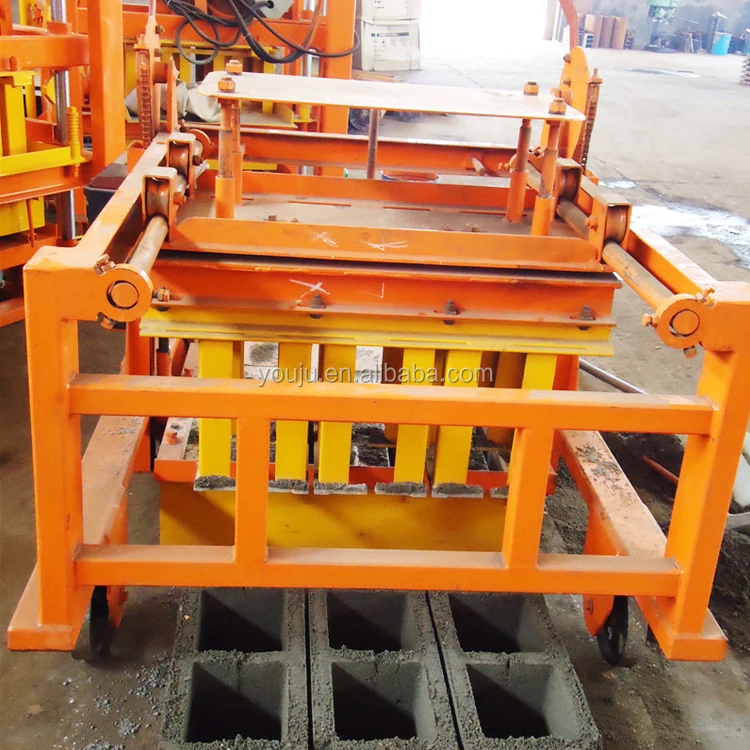
Integrated Line Matching — the QMR4-45 mobile block machine production line is specified around your actual mix and site conditions, not a generic catalogue layout, so every upstream station keeps pace with the press.
Technical Specifications
| Parameter | Value |
|---|---|
| Model | QMR4-45 |
| Product Type | Mobile Egg Laying Block Making Machine |
| Overall Dimensions (L×W×H) | 2420×1320×1650mm |
| Net Weight | 810kg |
| Moulding Cycle | 40-45s |
| Rated Power | 6kW |
| Diesel Engine Option | 6kW or 6-8HP |
| Voltage & Frequency | 220V / 380V / Custom (frequency to be confirmed) |
| Control System | Manual / Semi-automatic operation |
| Pallet Requirement | None (egg-laying type, product directly on ground) |
| Mould Format | Hollow block (400×200×200mm, 400×150×200mm, 400×120×200mm) |
| Output Capacity | 3000 pcs/day (based on 400×200×200mm, 4 pcs/mould, 8-hour shift) |
| Output Capacity | 3500 pcs/day (based on 400×150×200mm, 5 pcs/mould, 8-hour shift) |
| Output Capacity | 4500 pcs/day (based on 400×120×200mm, 6 pcs/mould, 8-hour shift) |
| Assembly State | Fully assembled |
| Warranty | One year |
Application Suitability
| Application | Material or Output |
|---|---|
| Small-scale on-site hollow block production | Crushed stone, cement, and local aggregate without fixed plant infrastructure |
| Off-grid construction sites | Diesel-powered pressing with limited or unreliable electricity supply |
| Entrepreneur and contractor local production | Hollow block formats on existing cement working yards without pallet inventory |
| Remote housing project supply | Egg-laying operation directly on ground, eliminating curing rack constraints |
What "3000 Pieces per Day" Leaves Out in a Mobile Setup
A daily output figure is meaningless if the mixer batch size and feed rate cannot deliver fresh material within the 40-45 second press cycle.
Many suppliers quote a mobile block machine production line based on ideal conditions, ignoring whether the upstream mixing station can actually sustain the pace. If the pan mixer takes longer to prepare a batch than the press takes to consume it, the machine sits idle, and real throughput drops. Sizing the mixer and conveyor to match the press beat is the only way to reach the stated capacity [NEED_CITE: principles of line balancing in small-scale concrete production].
Upstream Stations Sized to the Press Cycle
The QMR4-45 mobile block machine production line requires a mixing and feeding setup that delivers a consistent batch every 40 to 45 seconds. A mixer with too small a capacity forces the operator to wait between cycles, while a feed conveyor that is too slow creates gaps in the hopper. We calculate the batch volume against the specific hollow block format you intend to run, ensuring the upstream equipment never becomes the bottleneck.
Eliminating Pallet Handling from the Line Layout
Because this egg-laying machine deposits blocks directly onto the ground, the line layout removes pallet feeding, return conveyors, and pallet storage racks entirely. This reduction in station count shrinks the equipment footprint and lowers the capital required for a first plant. The trade-off is that the ground surface must be level and cured properly, but the overall line complexity is significantly reduced compared to stationary press configurations.
Power Supply Coordination Across Stations
When the press runs on a diesel engine, the upstream mixer and conveyor still require electrical power unless they are also fitted with independent diesel drives. Planning the mobile block machine production line means confirming whether your site has enough grid capacity for the auxiliary stations or if a generator set is necessary to support the entire material handling flow [NEED_CITE: power distribution requirements for off-grid construction sites].
Specifying the Hydraulic and Vibration Balance
The hydraulic pressure and vibration force must be matched to your specific aggregate gradation and cement ratio. A mix that is too dry or contains oversized stone will not compact correctly under standard settings, leading to weak blocks. We adjust the vibration frequency and pressure duration based on sample materials before the line is finalized, ensuring density remains consistent across an eight-hour shift.
The Cost of Ignoring Site Ground Conditions
If the production yard is not flat and compacted, the egg-laying machine will settle unevenly as it moves forward, causing blocks to crack or deform at the base. Fixing the ground after the line is installed disrupts production and wastes material. Proper site preparation is a fixed requirement for this type of mobile setup, not an optional extra [NEED_CITE: ground bearing capacity for mobile concrete block laying].
Why Sourcing the Line as a Matched System Matters
We specify the QMR4-45 and its upstream stations as a single package rather than assembling them from separate suppliers. This approach ensures the mixer discharge height matches the press hopper, the conveyor speed aligns with the cycle time, and the control logic communicates between stations. Buying a press alone and adding random auxiliary equipment often results in mismatched interfaces and constant stoppages to clear blockages.
Documentation & Verification
- Line layout drawing showing mixer placement and conveyor routing relative to the press
- Capacity calculation sheet stating the assumed block format and shift duration
- Factory test record on your specific mould and material sample
- Voltage and frequency confirmation document for all line motors
- Operation manual covering mould change and daily maintenance checks
Installation, Commissioning & Support
- Site preparation guide specifying ground flatness tolerance for egg-laying operation
- Electrical schematic showing wiring between the 6kW press and upstream mixer
- On-site commissioning to adjust vibration force against your local aggregate
- Mould change training to minimize downtime when switching block formats
- Spare parts list for hydraulic seals and vibration motor components
Preparing Your Line Inquiry
To receive a complete mobile block machine production line proposal, provide your target hollow block dimensions, the specific stone and sand types available locally, and the daily volume you need to reach. We also require your site voltage, frequency, and the total area available for the mixing and production yard to ensure the layout fits.
Frequently Asked Questions
Q: What supporting equipment does the QMR4-45 need upstream, and how is it sized?
A: The line requires a pan mixer and a raw material feeding system sized to deliver a fresh batch within the 40-45 second moulding cycle. We calculate the mixer capacity based on the volume of the specific hollow block format you are running to prevent the press from idling while waiting for material.
Q: How is daily capacity calculated for different hollow block formats?
A: The output figures are based on an eight-hour shift using specific moulds: 3000 pieces for 400×200×200mm blocks, 3500 for 400×150×200mm, and 4500 for 400×120×200mm. Changing the mould alters the pieces per cycle, which shifts the daily total accordingly.
Q: Can the entire line run on diesel power?
A: The QMR4-45 press offers a diesel engine option for the hydraulic drive, but the upstream mixer and conveyors typically require electricity. If your site has no grid connection, the auxiliary stations must also be configured with diesel power sources to maintain continuous operation.
Q: What site conditions are required for an egg-laying machine line?
A: The ground must be flat, compacted, and level to support the machine’s weight and ensure blocks are deposited evenly without cracking. Since no pallets or curing racks are used, the production yard itself serves as the curing area, requiring sufficient space for blocks to set in place.


