
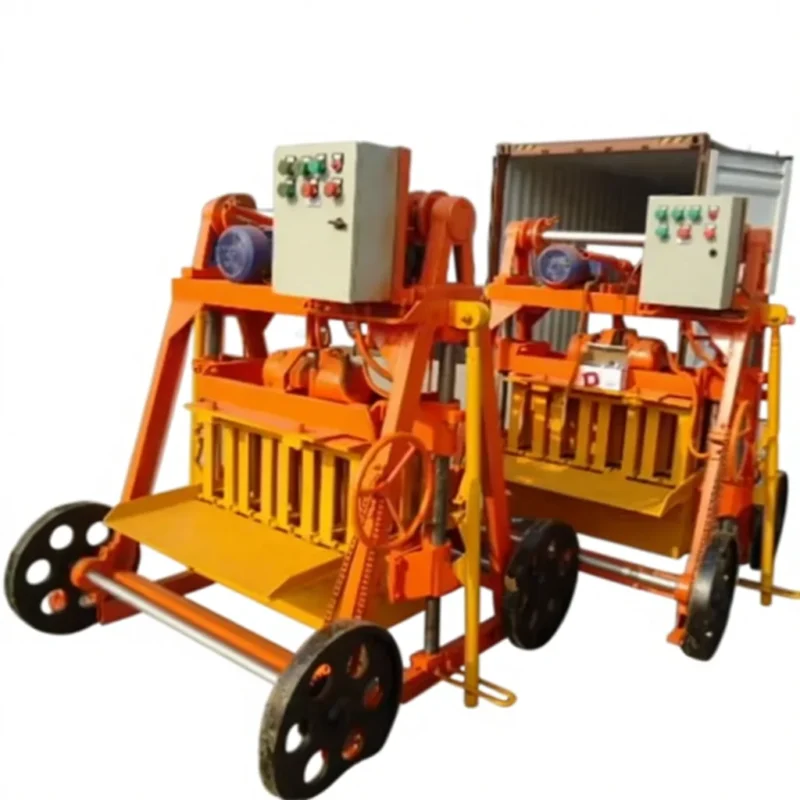
Line-Level Integration — the QMJ4-45 is mapped as the press node within a mobile, pallet-free production line, where mixer discharge rate and curing area layout must match the 45-second egg-laying cycle to prevent bottlenecks.
Technical Specifications
| Parameter | Value |
|---|---|
| Model | QMJ4-45 |
| Product Type | Mobile Egg-Laying Concrete Block Making Machine |
| Rated Power | 7.4 kW |
| Molding Cycle | 45 s |
| Output Capacity | 2400 pcs / 8 h (based on 400×200×200 mm hollow block, 4 pcs/mould); 3200 pcs / 8 h (based on 400×150×200 mm block, 5 pcs/mould) |
| Pallet Requirement | None (egg-laying / pallet-free) |
| Raw Materials | Concrete, sand, cement, fly ash, lime, gypsum |
| Machine Weight | 1 T |
| Overall Dimensions (L×W×H) | 1550×1335×1580 mm |
| Control System | Manual force control and jog control |
| Orientation Mechanism | Four-pole guide with ultralong orientation bearing |
| Electrical Components | Imported electrical appliances, sealing parts, hydraulic components |
| Voltage | Configurable to buyer’s local grid (rating to be confirmed) |
| Mould Compatibility | Multi-format: road blocks, curb stones, hollow bricks, interlock, pavers |
Application Suitability
| Application | Material or Output |
|---|---|
| On-site housing project block production | Hollow blocks from local sand and cement without a fixed plant |
| Small-scale paver and interlock manufacturing | Paving blocks and interlocking bricks from fly ash or crushed stone |
| Remote development site construction | Curb stones and solid blocks laid directly on prepared ground |
| Entrepreneurial first block plant | Entry-level output from cement, sand, and lime mixes |
Why "2400 Blocks per Shift" Can Mislead Your Crew Planning
The capacity figure only holds true when you name the exact block format the mould is producing.
Quoting a mobile block machine production line at its maximum shift output without stating the assumed block dimensions is one of the most common ways buyers end up short-staffed or over-scheduled. The 2400 pieces per 8 hours applies specifically to 400×200×200 mm hollow blocks at 4 per mould; switch to a smaller solid format and the number changes entirely. On site, where crews are paid by the day and concrete trucks arrive on a schedule, knowing the real cycle-to-output relationship for your specific format is what determines whether the line runs smoothly or leaves workers standing idle. [NEED_CITE: block format impact on daily output calculations]
Feeding the Press: Mixer Output Must Track the 45-Second Cycle
A mobile block machine production line only moves as fast as its slowest station. The QMJ4-45 completes a moulding cycle every 45 seconds, which means the upstream mixer must discharge a fresh batch into the feed hopper at least that frequently. If a pan mixer is undersized or the raw material feed interval is too long, the press sits empty between cycles and daily output drops below what the moulding cycle alone would suggest. Matching mixer drum capacity and discharge speed to the press rhythm is a line-level decision, not a press-level one.
Curing Area Layout When Pallets Are Removed From the Equation
The egg-laying design eliminates pallets entirely, removing the need for pallet feeding, return conveyors, and pallet storage racks. However, blocks are laid directly onto the ground, so the curing area must be prepared with a flat, compacted surface and enough space to hold a full shift’s output before blocks are moved or sold. Planning the curing zone dimensions, protection from rain, and the path for manual or forklift movement of cured blocks is part of the overall mobile block machine production line layout — not an afterthought once the press arrives. [NEED_CITE: on-site curing area requirements for pallet-free block machines]
Reading the Specs That Actually Shape Your Line
The 7.4 kW rated power tells you the generator or grid connection the site needs; undersizing the power supply causes voltage drops that affect the vibration motor and compromise block density. The four-pole orientation mechanism with ultralong bearings maintains mould alignment over thousands of continuous cycles, which directly influences dimensional consistency and reduces reject rates in downstream handling. The manual force and jog control system means an operator is present at every cycle, so labour planning must account for continuous attendance rather than automated batch running. Mould compatibility across road blocks, curb stones, hollow bricks, interlock, and pavers means one machine can serve multiple product lines, but each format change requires line downtime that must be scheduled into shift planning.
What Happens When the Line Is Specified Press-Only
Ordering a mobile egg-laying machine without confirming the mixer feed rate, curing area layout, or local voltage creates a cascade of on-site problems. The press arrives and runs, but output falls below the project schedule because the mixer cannot keep up. Blocks cure unevenly because the ground was not prepared, and dimensional variation increases because the generator supplying power is too small, causing inconsistent vibration force. These are not machine defects — they are line integration gaps that surface only after installation. [NEED_CITE: common on-site block machine commissioning issues]
Why Buyers Source the Full Line Here
Block machinery is our single focus, so the QMJ4-45 is never specified as a standalone press; the mixer, raw material feed, and curing handling are discussed as part of one system. We set the configuration against your actual mix design and local aggregate, not a catalogue default, which means the vibration force and cycle timing are matched to what your site can actually produce. Mould design covers the formats your local market demands, including custom drawings when standard options do not fit. Automation level is selectable, so you can start with the manual jog system and plan an upgrade path later. Installation support includes operator training focused on your specific block format and raw material behaviour.
Documentation & Verification
- Line layout drawing showing mixer, press, and curing area positions for your site footprint
- Capacity calculation sheet stating the exact block format and cycle time assumed
- Factory test record using your specified raw material mix before dispatch
- Voltage and frequency confirmation document matching your on-site power source
- Mould drawing and format list for every block type included in the order
Installation, Commissioning & Support
- Foundation requirement: compacted and level ground surface matching the 1550×1335 mm machine footprint for stable egg-laying operation
- Power connection: 7.4 kW supply at your confirmed voltage and frequency, with dedicated circuit breaker sizing provided before shipment
- Assembly on site: machine arrives as a single unit weighing 1 T, requiring only forklift or crane placement onto prepared ground
- Commissioning scope: vibration force and cycle timing adjusted against your local aggregate sample during on-site startup
- Operator training: covers jog control operation, mould change procedure, and daily maintenance for the four-pole orientation bearings
- Spare parts list: hydraulic sealing parts and electrical components itemised with part numbers for local sourcing or direct reorder
What to Include With Your Inquiry
Send us the block format and dimensions you plan to produce, along with a photo or description of your local aggregate so we can match the machine settings to your actual material. Confirm your on-site power supply voltage and frequency, and let us know the available curing area dimensions so the mobile block machine production line layout we propose accounts for ground space from day one.
Frequently Asked Questions
Q: How do I verify the real daily output for the block format I need?
A: We provide a capacity calculation sheet that states the exact block dimensions, number per mould, and 45-second cycle time assumed. This document lets you cross-check the projected shift output against your project schedule before the machine is ordered, so there is no gap between quoted capacity and actual production on your site.
Q: What supporting equipment do I need upstream of the QMJ4-45?
A: A mixer sized to discharge a full batch every 45 seconds is essential to keep the press fed. Raw material storage and a manual or belt-fed hopper complete the upstream station. We specify the mixer capacity and feed interval as part of the line layout, not as an isolated machine recommendation.
Q: How should the curing area be planned for a pallet-free line?
A: Since blocks are laid directly on the ground, you need a flat, compacted surface large enough to hold a full shift’s output. The curing zone must be accessible for water sprinkling and protected from heavy rain. We include curing area dimensions in the line layout drawing based on your chosen block format and daily output target.
Q: Can I run the QMJ4-45 from an on-site generator?
A: Yes, provided the generator is sized to handle the 7.4 kW rated power with adequate headroom for motor startup surge. We confirm your required voltage and frequency before production so the electrical components match your site supply, avoiding commissioning delays when the machine arrives.


