
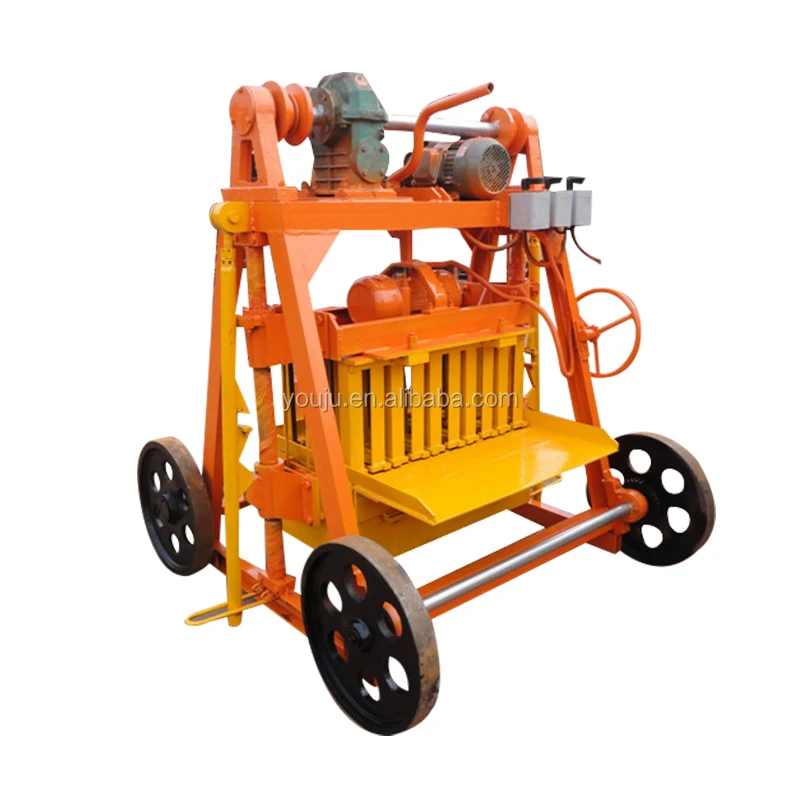
Matching the press to the line — Every station from mixer to curing area is paced against the QMJ4-45’s 45-second cycle so the machine never sits idle waiting for material.
Technical Specifications
| Parameter | Value |
|---|---|
| Model | QMJ4-45 |
| Product Type | Mobile Egg Laying Block Making Machine |
| Molding Capacity | 4 pcs/mould |
| Vibration Frequency | 2400 r/min |
| Vibration Method | Mold vibration |
| Molding Cycle | 45 s |
| Demold Method | Manual |
| Turning Method | Manual |
| Total Power | 6 kW |
| Power Source | Diesel / Petrol engine |
| Pallet Requirement | None (egg laying type) |
| Automation Level | Manual |
| Hollow Block Output (400×200×200 mm) | 4 pcs/mould, 40–45 s cycle, approx. 3000 pcs/day (8 hours) |
| Hollow Block Output (400×150×200 mm) | 5 pcs/mould, 40–45 s cycle, approx. 3500 pcs/day (8 hours) |
| Hollow Block Output (400×120×200 mm) | 6 pcs/mould, 40–45 s cycle, approx. 4500 pcs/day (8 hours) |
| Productivity | 2600–4000 pcs/day (basis to be confirmed — depends on block format, material and shift length) |
| Warranty | 1 year |
| Certification | CE (verify specific certificate availability) |
Application Suitability
| Application | Material or Output |
|---|---|
| On-site hollow block production at housing project sites | Crushed stone, sand, cement and water mix |
| Remote or rural construction without grid power | Diesel or petrol engine driven block laying |
| First block production operation with minimal infrastructure | Hollow blocks in 400×200×200, 400×150×200, 400×120×200 mm formats |
| Building material distributors serving dispersed customer locations | Mobile production moved between job sites |
Why "3000 Blocks a Day" Can Mean Nothing Without the Rest of the Line
A mobile block making machine production line only holds its cycle pace when the mixer, material feed and curing area are all sized to the press.
I have watched contractors buy a mobile egg layer, get it on site, and then realize the mixer batches too slowly to feed the hopper between 45-second cycles. The press idles, workers stand around, and the daily count drops to half what the brochure promised. Others skip planning the curing area entirely, laying blocks across whatever ground is available, only to find the forklift cannot turn in the space left between rows. The mobile block making machine production line is not just the press — it is every station that keeps it running without interruption [NEED_CITE: block production line pacing and material flow requirements].
Engine Power and the Sites That Have No Grid
The QMJ4-45 can run on a diesel or petrol engine, which removes the single biggest constraint on remote project sites: the absence of stable grid electricity. Construction contractors working on housing developments in areas where power is unreliable or unavailable can still maintain a steady block output without waiting for temporary generators or transformer installations. This engine-driven configuration also simplifies the mobile block making machine production line because the same power source can be matched to the mixer and feeder units, keeping the electrical setup to a minimum.
Pacing Every Station Around a 45-Second Molding Cycle
The press completes one molding cycle every 45 seconds, and that number sets the rhythm for everything upstream and downstream. The mixer must deliver a fresh batch to the hopper before the next cycle starts, the raw material feed must keep the mixer supplied, and the curing area must be large enough to hold the blocks the machine lays over an eight-hour shift. When any one of these stations falls behind, the press waits. Planning the mobile block making machine production line around this fixed cycle time is how a buyer avoids the gap between quoted capacity and actual output [NEED_CITE: mobile block machine cycle time and supporting equipment coordination].
What Vibration Frequency and Mold Design Mean for Block Density
The QMJ4-45 uses mold vibration at 2400 r/min rather than table vibration, concentrating the compaction force directly on the block inside the cavity. This approach improves density uniformity, especially for hollow blocks where wall thickness is narrow and uneven compaction shows up as weak corners. The vibration frequency works together with the manual demold and turning method: the operator controls how long the mold vibrates, allowing adjustment for different mix designs and aggregate sizes. When the vibration force is matched to the buyer’s local aggregate and cement ratio, block strength stays consistent across the production run. The total power draw of 6 kW across the vibration motor and drive components means the engine or electrical supply must be sized with enough headroom to prevent voltage drop during startup, which is where undersized power sources cause the most problems on site.
When Supporting Equipment Is Left Off the Quotation
Buyers who receive a quotation for the press alone often discover after delivery that the mixer, material conveyor and curing racks were never included. The machine arrives, gets bolted to the floor, and then someone has to figure out how to feed it and where to put the output. Material gets hand-fed into the hopper from wheelbarrows, blocks get stacked manually on whatever ground is flat, and the cycle time stretches because no one planned the material flow. These gaps do not show up in the machine specifications — they show up in the daily count and the labor bill [NEED_CITE: hidden costs of incomplete block production line quotations].
Why Buyers Source the Line from a Single Supplier
The QMJ4-45 works as one element in a coordinated block production setup, and specifying the press, mixer, pallet handling and curing layout from one source means the cycle times, power requirements and physical dimensions are checked against each other before the order is placed. The supporting equipment is configured against the buyer’s actual mix design and local aggregate rather than a catalogue default, so the material flow matches what the machine was set up to produce. Mould drawings and format lists are confirmed before production, matching the hollow block sizes that sell in the buyer’s market. The voltage, frequency and engine type are confirmed for the target site, avoiding the motor burnouts and control cabinet swaps that happen when power specifications are assumed rather than verified [NEED_CITE: industrial equipment voltage and frequency verification for export markets]. Installation and commissioning support includes operator training on the specific line configuration delivered.
Documentation & Verification
- Line layout showing mixer, feeder and curing area positions relative to the QMJ4-45
- Capacity calculation stating the block format and shift length assumed for daily output
- Mould drawing and format list for each hollow block size confirmed before production
- Voltage, frequency and engine type confirmation sheet signed before assembly
- Factory test record on the buyer’s specified block format before dispatch
- Operation and maintenance manual covering mold vibration adjustment and engine servicing
Installation, Commissioning & Support
- Prepared level floor required; the QMJ4-45 lays blocks directly on concrete without pallets
- Diesel or petrol engine setup includes fuel line routing and exhaust clearance planning
- 6 kW total power draw confirmed against local supply or engine alternator rating before energizing
- Mixer batch size and discharge rate matched to the 45-second press cycle during commissioning
- Operator training covers mold change procedure and vibration frequency adjustment for different mixes
- Wear parts list includes mold liners and vibration eccentric blocks for first replacement planning
Before You Request a Quote
To size the complete line around the QMJ4-45, we need the hollow block formats your market sells, the daily output target and shift length, the local aggregate and cement availability, and whether the site has grid power or requires engine-driven operation. If you already have a mixer or curing racks on site, share their specifications so the new equipment can be paced to match.
Frequently Asked Questions
Q: How is the daily output verified, and which block format does the capacity calculation assume?
A: Daily output figures are calculated per block format, assuming an eight-hour shift and a 45-second molding cycle. The 400×200×200 mm format yields approximately 3000 pieces per day, while narrower formats produce more per cycle. The line layout document states which format was assumed so you can cross-check against your production target before ordering.
Q: What supporting equipment is needed to keep the QMJ4-45 running without idle time?
A: A mixer sized to deliver a fresh batch within the 45-second cycle, a raw material feed system to keep the mixer supplied, and a curing area large enough to hold the full shift output laid on the ground. Each station’s capacity and physical position are planned in the line layout so material flows continuously to and from the press.
Q: Can the line be configured for diesel or petrol engine to match sites without reliable grid power?
A: Yes. The QMJ4-45 is available with diesel or petrol engine drive, removing the need for grid electricity. The engine specification is confirmed for the site’s altitude and ambient temperature range before assembly, and the same power configuration is extended to the mixer and feeder so the entire mobile block making machine production line runs from a single fuel source.
Q: What is the recommended curing area and layout for blocks laid directly on the ground?
A: The curing area must be a level concrete floor large enough to hold the full shift output with walking space between rows for manual turning and water spraying. The line layout document includes the calculated floor area based on your selected block format and daily output, along with the recommended spacing for air circulation and curing water access.
Q: How do I match the mixer batch size and cycle to the 45-second press cycle so material flow is continuous?
A: The mixer must complete one batch and discharge it into the press hopper within 45 seconds. We calculate the required batch volume from the mold cavity count and block density, then select a mixer drum size and motor rating that meets that timing. The material feed rate into the mixer is set so the next batch is ready by the time the previous one discharges.


