
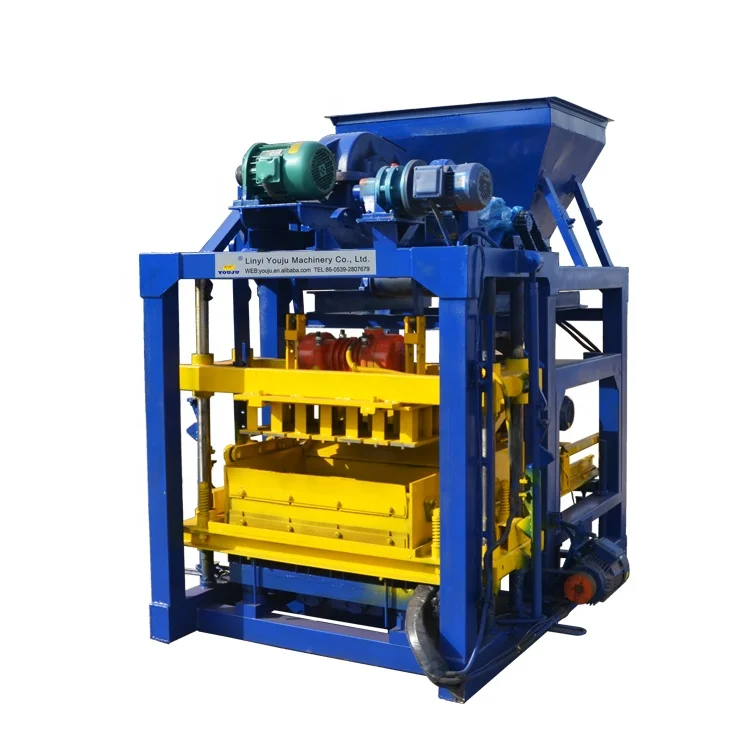
Balanced Cycle Timing — Every station from the JQ350 mixer to the manual trolley is sequenced around the 25-second moulding cycle so the press never sits idle waiting for material or pallets.
Technical Specifications
| Parameter | Value |
|---|---|
| Product Type | Semi-Automatic Concrete Block Making Machine |
| Model | QTJ4-25 |
| Automation Level | Semi-automatic |
| Forming Method | Hydraulic pressure with vibration |
| Vibration Force | 60 kN |
| Vibration Frequency | 2800 r/min |
| Moulding Cycle | 25 s |
| Pallet Size | 850 × 550 × 20 mm |
| Output Capacity | 960 pcs/h based on 400×200×200mm hollow block (4 pcs/mould); daily figure basis not stated in source |
| Block Formats Supported | Hollow, solid, paver, curbstone (mould change required) |
| Rated Power | 17.9 kW |
| Overall Dimensions (L×W×H) | 6400 × 1500 × 2700 mm |
| Net Weight | 2500 kg |
| Configuration Included | Host machine, 1 set block mould, JQ350 mixer |
| Stacking Method | Manual (pallet + trolley) |
| Control System | Motor-based (PLC presence not stated in source) |
| Voltage & Frequency | Configurable to target market (to be confirmed) |
| Hydraulic Pressure | To be confirmed |
| Mould Change Time | To be confirmed |
Application Suitability
| Application | Material or Output |
|---|---|
| Hollow block production for building walls | Crushed stone, sand, cement, fly ash |
| Solid block production for load-bearing structures | Gravel, sand, cement blends |
| Paving block production for walkways and yards | Fine aggregate with cement binder |
| Kerbstone production for road edges | Coarse aggregate with high-cement mix |
| On-site block production for housing projects | Locally sourced aggregate and cement |
What "960 Pieces per Hour" Leaves Out About Your Semi-Automatic Block Machine Production Line
A cycle rate only matters when every upstream and downstream station can keep the same rhythm.
I have watched plant owners celebrate a fast press only to discover the mixer cannot feed material quickly enough, or the pallet station runs dry before the operator finishes wheeling the last batch to the curing area. The press then sits idle, and the real daily output drops well below the brochure figure. When a semi-automatic block machine production line is quoted as a single matched system rather than a collection of separate items, those timing gaps disappear before the machine ships [NEED_CITE: cycle time balancing in block production lines].
How Each Station Feeds the Next
The JQ350 mixer is sized to deliver a fresh batch within the 25-second moulding window, so the hopper never starves the press. Material flows by gravity into the host machine, eliminating a separate conveyor that would add footprint and maintenance. This tight coupling is what keeps a semi-automatic block machine production line running at its stated cycle rate instead of drifting into stop-start operation.
Pallet Flow and Curing Area Alignment
The 850 × 550 × 20 mm pallet is selected to match both the press bed and the trolley that carries wet blocks to the curing zone. If the curing racks or forklift at your site expect a different pallet dimension, every transfer point becomes a manual rehandling step. We confirm pallet size against your existing layout before the order goes to production [NEED_CITE: pallet dimension standards in block curing yards].
Reading the Numbers That Actually Matter
Vibration force at 60 kN paired with 2800 r/min frequency determines how densely the concrete settles inside the mould cavity. Higher frequency alone will not compensate for low force when the mix contains coarse aggregate. The hydraulic pressure, once confirmed for your target block strength, works together with vibration to close voids and produce a consistent face finish across hollow, solid, paver and kerbstone formats.
Rated power of 17.9 kW covers the host machine and the JQ350 mixer together. Knowing the combined draw lets your electrician size the supply cable and breaker correctly before the container arrives, avoiding a last-minute panel rebuild. Overall dimensions of 6400 × 1500 × 2700 mm define the floor space needed for the press and mixer only; add pallet storage and curing rack rows to plan the full footprint.
The Cost of Ignoring Station Timing
When the mixer is undersized or the pallet station is omitted from the quotation entirely, operators end up shovelling material by hand and stacking fresh blocks on the floor. The press still cycles at 25 seconds, but effective throughput falls because the operator cannot clear the output fast enough. I have seen lines where adding a simple trolley and re-sequencing the feed recovered a full shift’s worth of lost capacity [NEED_CITE: manual handling bottlenecks in small block plants].
Why Source the Full Line from One Supplier
Block machinery is our single focus, so the press, mould, pallet and trolley are specified as one matched system rather than assembled from unrelated vendors. Configuration is set against your actual mix design and local aggregate, not a catalogue default. Mould design covers the formats your market sells, and custom drawings are accepted. Automation level is selectable, so you can start with manual pallet handling and add automatic stacking later. Installation support includes operator training so your crew understands the timing logic from day one.
Documentation & Verification
- Line layout showing mixer, press and trolley positions with cycle time at each station
- Capacity calculation stating the 400×200×200mm hollow block format and shift hours assumed
- Pallet specification matched to your curing rack spacing and forklift tine width
- Hydraulic and electrical schematic with voltage, frequency and control language confirmed
- Factory test record covering press, mixer and pallet station running together before dispatch
Installation, Commissioning & Support
- Foundation pad sized for 6400 × 1500 mm footprint and 2500 kg static load
- Dedicated 17.9 kW circuit with breaker rating confirmed against your local voltage and frequency
- Machine shipped dismantled with pallet station and mixer packed for container loading
- On-site commissioning includes timing adjustment across all stations to match your mix
- Operator training covers mould change procedure and daily vibration bed inspection
- Wear parts list with hydraulic seal and vibration spring part numbers for local sourcing
What We Need to Size Your Line Correctly
Share the block format you plan to run most often, the daily output you need, and the raw materials available at your site. Let us know the voltage and frequency at the plant, the language your operators prefer on the controls, and whether you already have curing racks or forklifts that the pallet must fit. With those details we can lay out the full semi-automatic block machine production line and confirm realistic capacity before any metal is cut.
Frequently Asked Questions
Q: How is daily output verified, and which block format is the figure based on?
A: The 960 pcs/h rate is measured on 400×200×200mm hollow blocks at four pieces per mould with a 25-second cycle. Daily output depends on shift length and the actual format you run, because smaller pavers or solid blocks change the pieces-per-mould count. We provide a capacity table listing each format you plan to produce.
Q: Is the mixer, pallet and trolley included in the quotation, or only the press?
A: The QTJ4-25 package includes the host machine, one mould set and the JQ350 mixer. Pallets and the manual trolley are listed separately so you can match the quantity to your curing area and shift pattern. The quotation clearly separates each item so nothing arrives missing.
Q: How is pallet size selected to match my existing curing area and forklift?
A: We confirm the 850 × 550 × 20 mm pallet dimension against your curing rack spacing and forklift tine width before production starts. If your site requires a different size, the mould and press bed are adjusted accordingly so the pallet moves smoothly from press to trolley to rack without manual rehandling.
Q: How do cycle times at each station align so the press is not left waiting?
A: The JQ350 mixer batch volume and discharge speed are calculated against the 25-second moulding cycle. Pallet feed rate and trolley clearing speed are sequenced so the operator can remove a finished pallet and load an empty one within the same window. The line layout document shows the timing at every station.
Q: What voltage, frequency and control language are confirmed before shipment?
A: We record your site voltage, frequency and preferred control language on the order confirmation. The electrical schematic is then drawn to those values, and the factory test runs the machine on a matching supply so no rewiring or reprogramming is needed when the container is opened at your plant.


