
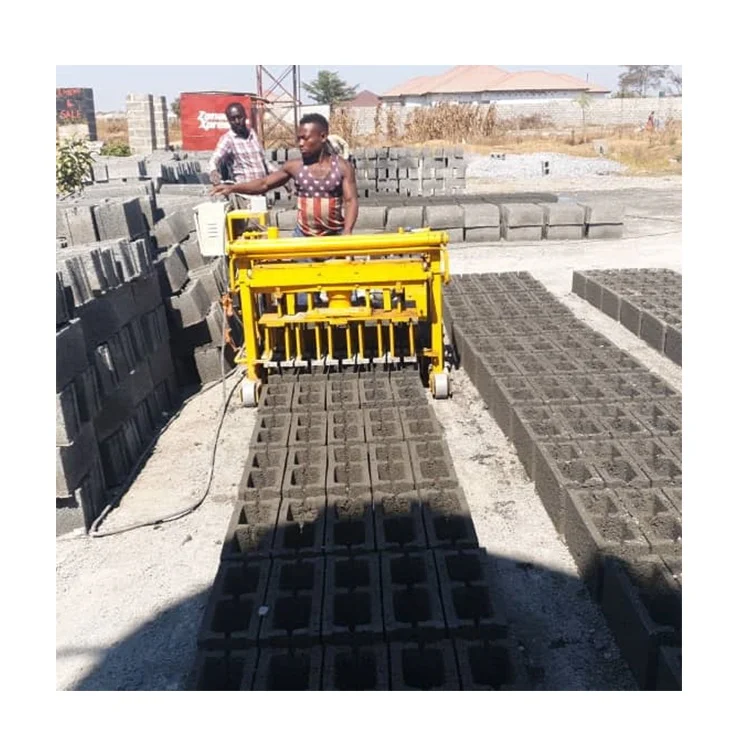
Mould and Press Matched — The QMY4-30 mobile block making machine ships as a verified machine-mould-material combination rather than a standalone press, with cycle times stated per block format.
Technical Specifications
| Parameter | Value |
|---|---|
| Model | QMY4-30 |
| Product Type | Mobile Concrete Block Making Machine |
| Rated Power | 5 kW |
| Cycle Time | 30 seconds |
| Overall Dimensions | 1200 × 1200 × 1100 mm |
| Net Weight | 950 kg |
| Raw Materials | Cement, sand, crushed stones, slag |
| Production Capacity | 480 pcs/hour (based on 400×200×200mm hollow block, 4 pcs/mold) |
| Production Capacity | 600 pcs/hour (based on 400×150×200mm hollow block, 5 pcs/mold) |
| Production Capacity | 840 pcs/hour (based on 400×100×200mm hollow block, 7 pcs/mold) |
| Daily Output (8-hour shift) | 3,840 pcs (400×200×200mm) / 4,800 pcs (400×150×200mm) / 6,720 pcs (400×100×200mm) |
| Mould Format | Hollow block and solid brick standard sizes |
| Automation Level | Manual / semi-automatic operation |
| Stacking Method | Manual handling |
| Warranty | One year |
Application Suitability
| Application | Material or Output |
|---|---|
| On-site block production for building contractors | Hollow blocks from cement, sand, and crushed stone without fixed plant infrastructure |
| Small-scale block manufacturing for first-time plant owners | Solid bricks and hollow blocks using locally sourced aggregate and slag |
| Housing project block supply at remote locations | Mobile production of 400×100×200mm to 400×200×200mm formats directly at the construction site |
What "840 Pieces per Hour" Actually Means on Site
Capacity numbers only matter when the block format is named alongside them.
A mobile block making machine manufacturer quoting a single hourly figure creates a false baseline. The QMY4-30 cycles every 30 seconds, but the piece count shifts entirely depending on whether the mould produces four, five, or seven blocks per stroke. A buyer planning around the highest number will face a shortfall the moment the site requires a larger format. I have watched project timelines slip because the daily target was set against the smallest block the machine could make, not the one the building design actually called for [NEED_CITE: block format assumptions in capacity quotations].
Raw Material Feeding and Mixing Around the Press
A mobile block making machine manufacturer must address what happens before and after the press stroke. The QMY4-30 requires a steady supply of mixed material at the correct moisture content, yet the machine itself does not include a mixer or feeder. For on-site production, contractors typically pair it with a small pan mixer and manual wheelbarrow feeding. The critical point is matching the mixer batch size and cycle to the 30-second mould cycle so the operator is never waiting for material or letting mixed concrete sit too long before pressing.
Supporting Equipment and the Curing Gap
Once the block leaves the mould, it must be moved to a flat curing area without vibration or impact. Mobile production means the curing zone is whatever ground the contractor clears on site. Pallet selection, if used, should match the forklift or hand cart available at the location. Without planning the curing and stacking logistics, a mobile block making machine manufacturer delivering only the press leaves the buyer to improvise the most labour-intensive part of the process [NEED_CITE: curing and handling requirements for mobile block production].
How Cycle Time, Mould Cavity, and Power Interact
The 5 kW rated power on the QMY4-30 drives both vibration and hydraulic compaction within a 30-second window. Vibration force consolidates the mix around the aggregate particles while hydraulic pressure sets the final density. If the local sand is fine-graded and low on coarse fraction, the vibration must work harder to eliminate air pockets, and the 30-second cycle may need adjustment at the operator level. The mould cavity count — four for 400×200×200mm, seven for 400×100×200mm — directly determines output per stroke, making mould selection the single largest variable in daily throughput.
When the Wrong Configuration Follows You to Site
Choosing a machine without confirming local voltage and frequency is one of the most common failures I have seen arrive on a job site. The entire crew stands around while an electrician sources a transformer that was never included in the project budget. A control panel labelled in a language the operator cannot read adds another layer of delay, turning what should be a first-day commissioning into a multi-week standstill [NEED_CITE: voltage and frequency standards by export market]. These are not machine faults — they are specification gaps that surface only after the container is opened.
Why This Source Over a Catalogue Order
The QMY4-30 is specified as a matched system: machine, mould, and raw material compatibility are verified against the buyer’s local aggregate before dispatch, not assembled from separate supplier catalogues. Mould design covers the formats the buyer’s market actually sells, with custom drawings available when standard sizes do not match local building codes. Voltage, frequency, and control language are confirmed and photographed before the machine leaves the factory. Capacity calculations state the exact block format assumed, so the buyer can plan shifts and curing space against real numbers rather than optimistic single-figure claims.
Documentation & Verification
- Capacity calculation sheet naming the block format for each output figure
- Mould drawing and format list covering all available hollow and solid sizes
- Factory test record run on buyer-specified raw materials before dispatch
- Voltage, frequency, and control panel language confirmation with photo archive
- Operation and maintenance manual with wear parts and mould replacement schedule
Installation, Commissioning & Support
- Ground preparation for 1200 × 1200 mm footprint requiring level, compacted surface
- Electrical supply matching confirmed voltage and frequency with dedicated circuit for 5 kW load
- Machine arrives assembled; operator verifies vibration motor rotation direction before first run
- Mould changeover procedure with tool list provided for format switching on site
- One-year warranty covering vibration motor, hydraulic components, and mould wear defects
What to Include in Your Inquiry
Provide the block formats your local market demands, including exact dimensions and daily volume targets. State your site voltage and frequency supply, along with the aggregate types available locally — cement grade, sand source, and crushed stone size range. If you already have a mixer or curing area in place, describe the capacity so the supporting equipment can be matched to the QMY4-30 cycle time.
Frequently Asked Questions
Q: How is daily output calculated and what block format does each figure assume?
A: Each output figure on the QMY4-30 is tied to a specific mould cavity count and block dimension. The 480 pieces per hour rating assumes a 400×200×200mm hollow block with four cavities per mould, while 840 pieces per hour assumes a 400×100×200mm format with seven cavities. Daily figures multiply the hourly rate across an eight-hour shift. No single universal output number applies across all formats.
Q: What raw material specifications work with this mobile block making machine?
A: The QMY4-30 processes cement, sand, crushed stones, and slag. The mix must be proportioned to the local aggregate gradation, and fine sand may require adjusted water content to achieve proper compaction within the 30-second cycle. Providing your local material samples or sieve analysis allows the mix to be verified before the machine ships.
Q: How do you confirm voltage and frequency compatibility before shipment?
A: Voltage, frequency, and control language are confirmed during the quotation stage and documented with photographs before dispatch. I have seen machines sit idle for weeks on site because the local supply did not match the factory default, so this step is treated as a hard gate before the machine is crated.
Q: What supporting equipment is needed to complete a mobile production setup?
A: The QMY4-30 requires a mixer for raw material preparation and a flat, cleared curing area for finished blocks. Manual wheelbarrow feeding is typical for mobile sites. The supporting equipment must deliver mixed material at a rate that keeps pace with the 30-second mould cycle to avoid operator idle time between strokes.


