
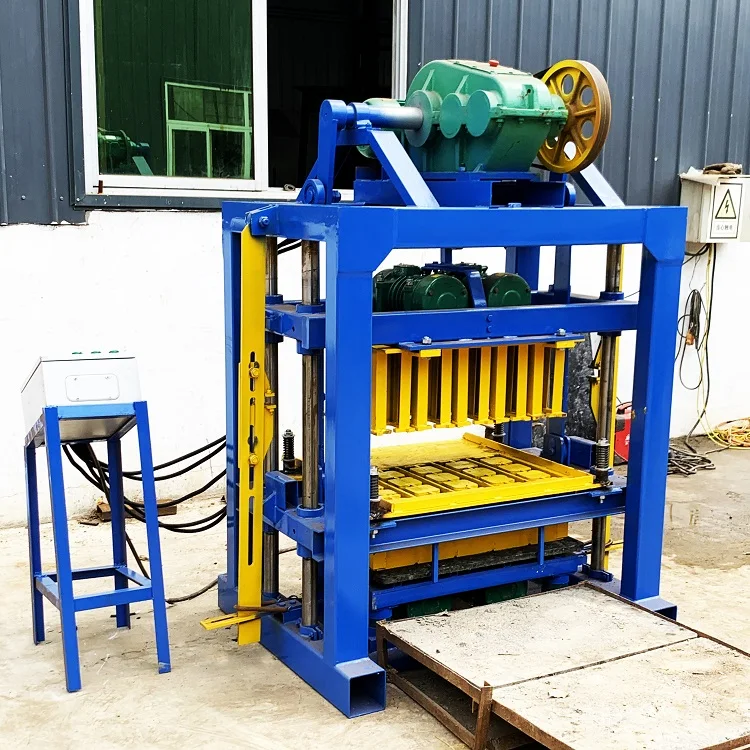
Stationary block machine production line integration — every upstream and downstream station specified so the QTJ4-40 press cycle time is never compromised by mismatched feeding or pallet handling equipment.
Technical Specifications
| Parameter | Value |
|---|---|
| Product Type | Stationary Concrete Block Making Machine |
| Model | QTJ4-40 |
| Vibration System | Platform Vibration at 2800 r/min |
| Pallet Size | 850 × 450 mm |
| Overall Dimensions (L × W × H) | 1350 × 1460 × 1800 mm |
| Machine Weight | 1 T |
| Factory Area | 200 m² |
| Worker Requirement | 1–3 people |
| Motor Type | Diesel and electric motor options available |
| Raw Material | Concrete, cement, fly ash, crushed stone, sand, dust, gravel, slag |
| Applied Products | Hollow/solid blocks, pavers, interlocking blocks, curbstone, colored pavers |
| Output (400 × 200 × 200 mm block) | 4 pcs/mould, 360 pcs/h, 2880 pcs/day |
| Output (400 × 150 × 200 mm block) | 5 pcs/mould, 500 pcs/h, 4000 pcs/day |
| Output (225 × 112.5 × 60 mm block) | 9 pcs/mould, 900 pcs/h, 7200 pcs/day |
| Control System | Manual or semi-automatic operation available |
| Standard | CE compliant |
Application Suitability
| Application | Material or Output |
|---|---|
| Small to medium block production plants | Daily output of hollow and solid concrete blocks using local crushed stone and sand |
| Construction contractors producing on-site | Diesel motor configuration for locations without stable grid power |
| Entrepreneurs setting up a first block plant | Semi-automatic operation with a small worker footprint |
| Building material producers expanding product formats | Pavers, interlocking bricks, and curbstones using the same 850 × 450 mm pallet |
Why the Stationary Block Machine Production Line Must Be Quoted as a Whole
A press rated for a given cycle time becomes a bottleneck if the mixer, feeder, and pallet return system are not matched to it.
I have seen block plant owners invest in a press that cycles fast, only to find the output stacked by hand because no pallet handling or curing rack was included in the quotation. The daily throughput then depends on how many workers you have moving wet blocks, not on the vibration frequency. When planning a stationary block machine production line, the scope of supporting equipment defines whether the press runs at its rated rhythm or sits idle between cycles. [NEED_CITE: block plant layout and station synchronization standards]
Upstream Matching: Mixer and Raw Material Feed
The QTJ4-40 completes a vibration cycle at 2800 r/min on the platform. If the upstream mixer takes longer than the press cycle to prepare the next batch, the press waits. For a stationary block machine production line, the mixer capacity and discharge rate must be calculated against the press output per format. A 400 × 200 × 200 mm hollow block at 4 pieces per mould means the mixer must deliver enough concrete for the next mould before the current cycle ends.
Downstream Matching: Pallet Return and Curing
After pressing, the 850 × 450 mm pallet carries a wet block to the curing area. If pallets are not returned to the press station in time, production stops. The curing rack layout, forklift travel path, and pallet collection point must all be designed around this pallet size. A stationary block machine production line that ignores the return loop creates a manual bottleneck that no amount of press automation can solve.
Specification Impact on Line Design
The 850 × 450 mm pallet size determines the curing rack spacing and the forklift tine width the buyer already has on site. A pallet chosen without checking existing handling equipment means buying new forklifts or building new racks. The platform vibration at 2800 r/min requires a stable concrete foundation to prevent resonance transfer to adjacent stations. The semi-automatic control option means the operator manually moves pallets at certain points, which affects station spacing and worker movement paths. The diesel motor option removes dependence on grid voltage, but fuel supply logistics become part of the line plan.
The Hidden Cost of Uncoordinated Stations
When the mixer, feeder, and pallet handler are sourced separately, each supplier quotes their own capacity without reference to the press cycle. The result is a line where the fastest station waits for the slowest. I have seen projects where the curing area was designed for a different pallet size, forcing the plant to replace hundreds of pallets before the first production run. [NEED_CITE: common causes of block plant downtime in first year of operation]
Why This Line Is Specified as One System
The QTJ4-40 is offered as the center of a matched stationary block machine production line, not as a standalone press. The mixer, raw material feeder, pallet feeder, and curing rack handling are specified together so cycle times align across every station. The pallet size of 850 × 450 mm is confirmed against the buyer’s existing forklift and curing area before the quotation is finalized. The control system language and voltage are confirmed before production, preventing commissioning delays on arrival. Moulds and hydraulic wear parts are listed with the initial order so the first replacement does not halt the line.
Documentation & Verification
- Line layout drawing showing station positions and pallet flow path for the QTJ4-40
- Capacity calculation sheet stating the block format assumed at each station
- Pallet specification confirming 850 × 450 mm dimensions and material grade
- Voltage, frequency, and control language confirmation document before shipment
- Factory test record with the buyer’s target block format and local aggregate mix
- Wear parts and mould list with part numbers for reordering
Installation, Commissioning & Support
- Foundation plan based on the QTJ4-40 platform vibration at 2800 r/min and 1 T machine weight
- Electrical connection diagram confirming diesel or electric motor wiring and local voltage
- Pallet feeder alignment check against 850 × 450 mm pallet tolerance
- First-run commissioning with the buyer’s target block format and local raw material ratio
- Operator training covering mould change, pallet handling, and semi-automatic control sequence
- Wear parts list with reorder intervals for hydraulic seals and vibration pads
How to Request a Line Quotation
To receive a complete line proposal, provide the target block format and daily output requirement, along with the local raw material type and mix ratio you can source. Include the curing area dimensions and forklift specifications already on site so the pallet system is matched. State the local voltage, frequency, and preferred control language to avoid delays during commissioning.
Frequently Asked Questions
Q: How are cycle times matched between the QTJ4-40 press and upstream mixing stations?
A: The mixer capacity and discharge rate are calculated against the press output for your specific block format. The line proposal states the assumed block size at each station so you can verify that the mixer delivers the next batch before the press cycle completes. This prevents the press from waiting between moulds.
Q: Which supporting equipment is included in the line quotation and which is optional?
A: The quotation lists every station from raw material feeding through pallet return and curing rack handling. Each item is marked as included or optional, so you know exactly what arrives on site. Items like automatic stacking can be added later if you start with semi-automatic pallet handling.
Q: How does pallet size selection affect curing area layout and forklift compatibility?
A: The 850 × 450 mm pallet size is confirmed against your existing forklift tine width and curing rack spacing before the order is finalized. If your current equipment does not match, the proposal includes the adjustments needed so the line integrates without replacing your handling fleet.
Q: What is the realistic daily output for my target block format within the full line?
A: The capacity calculation in the proposal states daily output based on your specific block dimensions, such as 2880 pieces per day for 400 × 200 × 200 mm hollow blocks. This figure accounts for the press cycle, pallet return time, and curing rack capacity, not just the press speed alone.
Q: How is the line configured for local aggregate and mix design?
A: The raw material ratio you provide, typically cement 8–10%, sand 30–40%, and stone 50–60%, is used to set the mixer batching and vibration parameters. The factory test is run with your aggregate specification before shipment to confirm block strength meets your market requirement.


