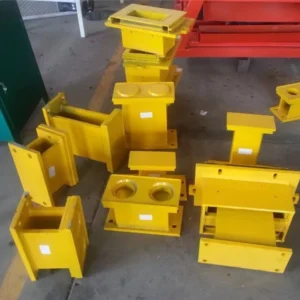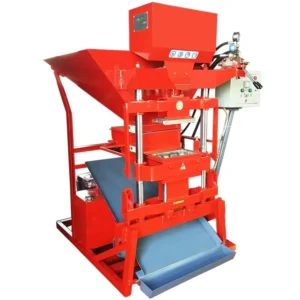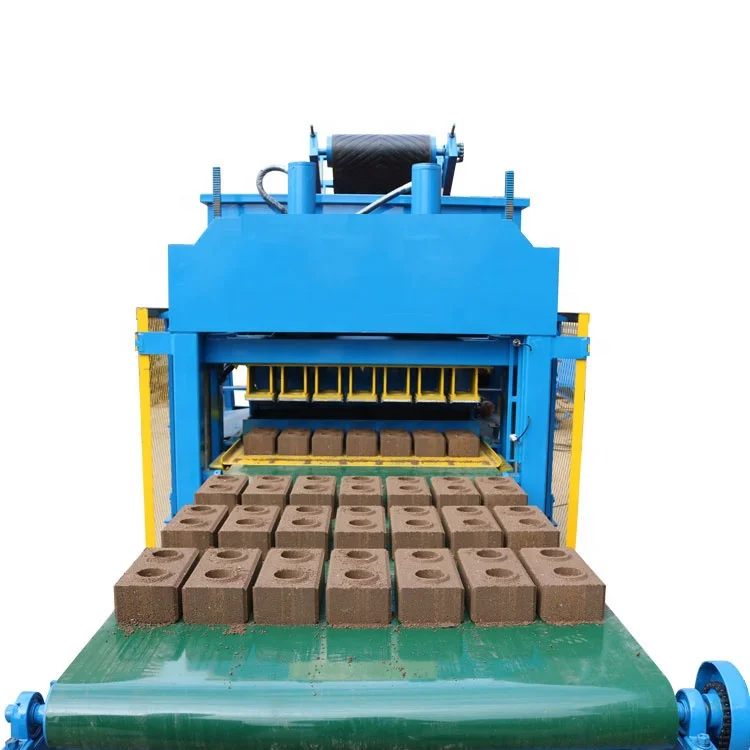
Matched Line Throughput — Every station from soil proportioning to pallet stacking is timed to the LY7-10 molding cycle so the press never waits for upstream feed or downstream clearance.
Technical Specifications
| Parameter | Value |
|---|---|
| Model | LY7-10 |
| Product Type | Automatic Clay Interlocking Brick Making Machine |
| Rated Power | 18.5 kW |
| Hydraulic Pressure | 25–32.5 MPa |
| Molding Cycle | 10–15 s |
| Output Capacity | 20,160 pcs/day (basis: 300×150×100 mm interlocking block, 7 pcs/mould, 2,520 pcs/hour) |
| Raw Materials | Laterite, yellow or red soil, sand, cement, water |
| Machine Weight | 1,600 kg |
| Overall Dimensions (L×W×H) | 2,260 × 1,500 × 2,380 mm |
| Worker Requirement | 1–2 workers |
| Mould Format | 300×150×100 mm interlocking block (7 pcs/mould); other formats available by mould change |
| Automation Level | Automatic (material feeding, mould pressing, mould lifting) |
| Control System | Available with PLC or MCC control (basis to be confirmed) |
| Voltage & Frequency | Configurable to site supply (basis to be confirmed) |
| Pallet Size | Matched to mould format and curing rack layout (basis to be confirmed) |
| Certification | CE declaration where applicable |
Application Suitability
| Application | Material or Output |
|---|---|
| Interlocking clay brick production for housing projects | Laterite or red/yellow soil stabilised with 6–10% cement |
| Compressed stabilised earth block manufacturing | Soil-cement mix with controlled moisture for load-bearing walls |
| Full-clay brick production for non-load-bearing use | 90–95% clay with no cement, lower compaction pressure |
| On-site block production by contractors | Local soil with portable mixer and temporary curing yard |
| Multi-format block and paver production | Mould change to produce solid blocks, paving units, or kerbstones |
Why the Supporting Line Decides Your Actual Daily Output
A clay interlocking brick press rated at a 10–15 second molding cycle is only as productive as the slowest station feeding or clearing it.
Buyers often focus on the press itself, comparing hydraulic pressure and cycle times across quotations, while the mixer, pallet circuit, and stacking station remain loosely specified or left out entirely. When the automatic clay interlocking brick making machine production line arrives and starts running, the press completes a cycle and then sits idle because the mixer has not delivered the next batch, or the curing racks are still occupied and the pallet cannot advance. The quoted daily output never materialises, and the owner assumes the press is underperforming when the real bottleneck is upstream or downstream. [NEED_CITE: production line bottleneck analysis in block manufacturing]
Synchronising Every Station to the Molding Cycle
The LY7-10 completes a moulding cycle every 10–15 seconds, which sets the pace the entire automatic clay interlocking brick making machine production line must sustain. The mixer batch size and discharge interval are calculated so that a fresh batch arrives at the press hopper before the previous one runs out. Pallet feed timing is set so that a clean, cured pallet is in position the instant the press lifts, eliminating the seconds of dead time that accumulate into thousands of lost blocks over a shift.
Upstream Material Preparation and Proportioning
Consistent block density starts long before the material reaches the press. Raw soil, sand, and cement must be proportioned by weight or volume with enough accuracy that moisture content and cement ratio stay within a narrow band across every batch. A pan mixer or twin-shaft mixer is selected based on the clay plasticity and the target mix design, and its discharge rate is matched to the LY7-10 hopper capacity. When the soil is high in clay content and tends to clump, a soil crusher or screen is added ahead of the mixer to break lumps and remove oversize stones, preventing blockages that would starve the press. [NEED_CITE: soil preparation requirements for compressed earth block production]
Downstream Pallet Circulation and Curing Layout
Once a pallet of freshly pressed interlocking blocks leaves the LY7-10, it enters the curing circuit. The number of pallets in circulation, the curing rack capacity, and the forklift or chain conveyor speed must all be sized so that a pallet is always available to return to the press station. For a line producing over 20,000 blocks per shift, this means several hundred pallets moving through curing racks that may be arranged in a straight line, a U-shape, or a multi-tier rack system depending on yard space. The automatic clay interlocking brick making machine production line layout accounts for the curing duration required by the specific mix design — cement-stabilised blocks typically need several days of moist curing, while full-clay blocks follow a different drying schedule.
Reading the Specifications That Matter on Site
The hydraulic pressure range of 25–32.5 MPa defines the compaction force available at the mould, but that force only translates into uniform block density if the material arriving at the press has consistent moisture and gradation. A batch that is too dry will not consolidate fully under pressure, leaving weak edges; a batch that is too wet will stick to the mould and slow demoulding. The 18.5 kW rated power drives both the hydraulic pump and the vibration system, and the electrical supply must provide stable voltage to maintain consistent pressure across every cycle — fluctuations common on temporary site generators can cause the hydraulic system to underperform without triggering an alarm. The 1,600 kg machine weight provides a stable base during pressing, but the foundation must be level and rigid enough to absorb vibration without transferring it to adjacent stations. Mould change between the standard 300×150×100 mm interlocking format and other block types requires the line to accommodate different pallet sizes and curing rack spacing.
What Happens When the Line Is Not Specified as a System
When the press is purchased separately and the supporting equipment is sourced later or assembled from whatever is available locally, stations rarely match. A mixer that is too small forces the press to pause between batches. Pallets that are the wrong thickness jam in the return conveyor. Curing racks built without calculating the daily pallet volume fill up by midday, and blocks are stacked on the ground where they cure unevenly and crack. These problems do not show up in the quotation stage because each supplier only guarantees their own station. [NEED_CITE: common causes of block production line downtime]
Why Buyers Specify the Full Line Here
The LY7-10 is positioned as the centre of a matched production line rather than a standalone press — material preparation, mixing, pallet circulation, stacking, and curing are all sized to its cycle time so no station becomes a bottleneck. Every configuration is set against the buyer’s actual soil sample, local aggregate, and target block format, not a catalogue default, which means mixer type, moisture addition, and cement ratio are confirmed before the line is built. Mould design covers the interlocking format the buyer’s market sells, with custom drawings available for non-standard sizes. The automation level is selectable so a buyer can start with manual pallet handling and add automatic stacking later without replacing the press. Installation support includes operator training on the actual mix design so the crew knows how to adjust moisture and pressure when the soil source changes.
Documentation & Verification
- Line layout drawing showing station positions, pallet flow direction, and curing rack footprint matched to the LY7-10 cycle time
- Capacity calculation sheet stating the block format, mould cavity count, and cycle time assumed for the quoted daily output
- Machine specification sheet listing hydraulic pressure, power, and dimensions alongside pallet and mould specifications
- Hydraulic and electrical schematic confirming mixer controls and stacking sensors are wired into the press control architecture
- Voltage and control language confirmation document signed before production begins
- Factory test record on the buyer’s soil sample with block density and compressive strength results
Installation, Commissioning & Support
- Foundation plan specifying level concrete pad dimensions to support the 1,600 kg LY7-10 and absorb vibration during pressing
- Electrical supply requirements listing the 18.5 kW load, dedicated circuit, and confirmed voltage and frequency for the site
- Machine arrives partially assembled with mould and hydraulic system pre-fitted; on-site assembly covers pallet conveyor and curing rack connections
- First-run commissioning includes adjusting hydraulic pressure within the 25–32.5 MPa range to match the buyer’s actual soil-cement mix
- Operator training covers mould change procedure, daily maintenance of hydraulic seals, and mix moisture adjustment for different soil batches
- Wear parts list identifies hydraulic seals, mould liners, and pallet surfaces with recommended replacement intervals
What We Need to Size Your Line
Send us a sample of the soil or laterite you plan to use, along with the target block format and daily output you need. Let us know your available yard space for the curing area and whether you already have a mixer, forklift, or pallet inventory on site. Confirm your local voltage, frequency, and the control language your operators prefer so we can build the automatic clay interlocking brick making machine production line around your actual conditions.
Frequently Asked Questions
Q: How is the daily output verified, and which block format does it assume?
A: The stated capacity of 20,160 pieces per day is based on the 300×150×100 mm interlocking block at 7 pieces per mould with a 10–15 second cycle. If you switch to a larger or smaller format, the output per cycle changes. We provide a per-format capacity table so you can see exactly what each mould produces and confirm that your mixer and curing space support that volume.
Q: How are the mixer, pallet feeder, and stacking station timed to the press cycle?
A: Each station has its own operating cycle. The mixer batch interval, pallet travel time, and stacking speed are all calculated against the 10–15 second molding cycle of the LY7-10 so the press never waits. The line layout drawing shows these timings, and during commissioning we fine-tune the intervals on your actual material.
Q: What changes in the line when switching between cement-stabilised and full-clay blocks?
A: Different mix designs affect material flow, moisture content, and demoulding behaviour. Cement-stabilised mixes need precise water addition and longer curing, while full-clay mixes may require lower hydraulic pressure and a different drying schedule. The mixer settings, pallet surface, and curing rack plan may all need adjustment, which we account for in the line design.
Q: How are raw materials proportioned for laterite, soil, sand, and cement?
A: The proportioning system delivers consistent batches matching your confirmed mix design. Feeder type, hopper capacity, and weighing accuracy are selected based on your material characteristics. We test your soil sample before building the line so the feeding and mixing stations are configured for your actual clay content and gradation.
Q: What curing area and pallet inventory does this line require at full capacity?
A: Producing over 20,000 blocks daily means hundreds of pallets circulating through curing at any time. The curing rack layout, pallet count, and forklift plan are all sized to your actual production volume and available yard space. We include these calculations in the line layout so there are no surprises when the line starts running.