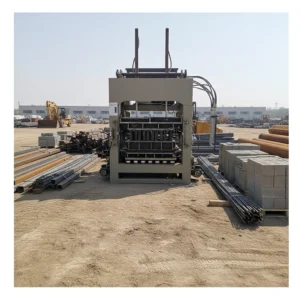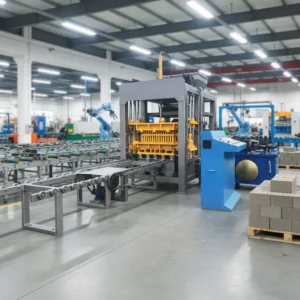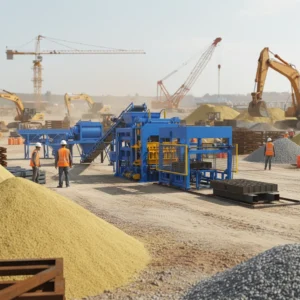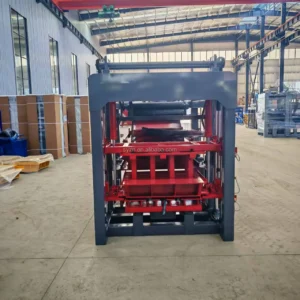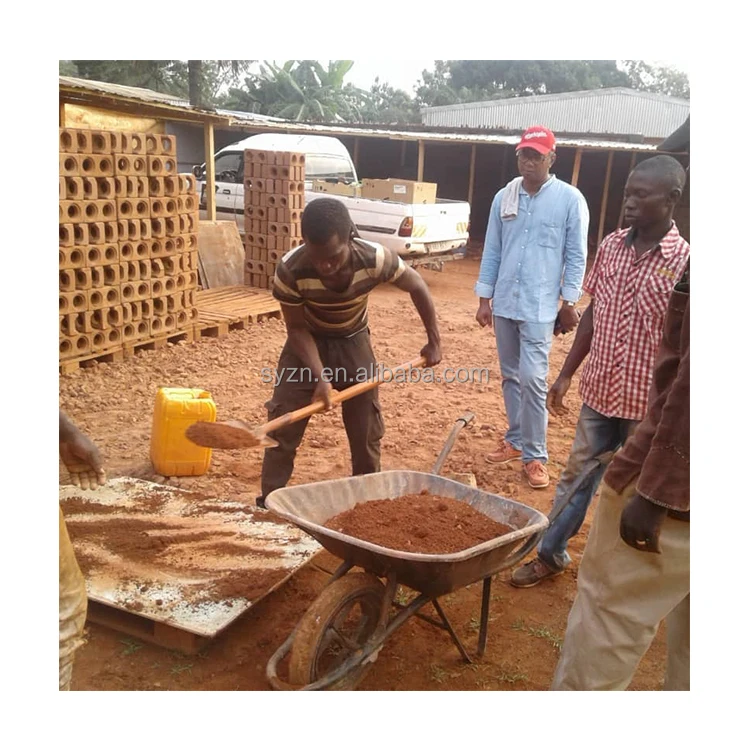
Semi-Automatic Clay Block Machine Production Line — The LY2-10 operates as the centre of a coordinated system where raw material feeding, mixing, pallet handling, and curing stations are specified to match the press cycle so throughput remains consistent across formats.
Technical Specifications
| Parameter | Value |
|---|---|
| Model | LY2-10 |
| Product Type | Clay Interlocking Block Making Machine |
| Machine Type | Semi-automatic clay and cement interlocking brick making machine |
| Rated Power | 7.5 kW |
| Molding Cycle | 10 s per stroke |
| Output Capacity | 750 pcs/h (basis: single interlocking block format per mould, 1 pc/mould — confirm exact block dimensions for capacity claim) |
| Daily Output | 6000 pcs/8 hours (basis not stated in source — confirm block format / material / thickness) |
| Raw Materials | Clay, soil, earth, mud, concrete, cement, fly ash |
| Overall Dimensions | 1300 × 1800 × 2400 mm |
| Mould Format Options | 300×150×100 mm (1 pc/mould), 250×125×75 mm (1 pc/mould), 230×220×115 mm (1 pc/mould) |
| Automation Level | Semi-automatic |
| Standards | CE declaration available where applicable |
Application Suitability
| Application | Material or Output |
|---|---|
| Small-scale interlocking block production | Clay, soil, and cement mixes for housing projects |
| On-site or workshop block manufacturing | Earth and mud blends for local construction contractors |
| First block plant setup with low investment | Concrete, cement, and fly ash combinations |
| Adding clay interlocking formats to existing range | Integration with current curing and handling infrastructure |
What the Daily Output Figure Leaves Out
Real line throughput depends on how every station around the press is configured, not the press cycle alone.
The clay block machine production line might quote a 10-second molding cycle, but if the mixer cannot deliver material within that window or pallets are not staged in time, the press sits idle between strokes. Many quotations list the press output without stating which block format that figure assumes or what supporting equipment is included. A buyer taking delivery often discovers that raw material feeding, stacking, and curing were never part of the package, leaving workers to handle output manually. [NEED_CITE: typical block production line station synchronization requirements]
Raw Material Feeding and Mixing Station Alignment
The LY2-10 processes clay, soil, earth, mud, concrete, cement, and fly ash, but each material demands different feeder and mixer behaviour. A clay-soil-cement blend requires thorough blending at specific moisture levels, while fly ash mixes need precise cement ratios for interlocking block strength. The clay block machine production line must have feeding and mixing capacity that delivers a fresh batch before the 10-second cycle completes, otherwise the press waits and daily output drops below expectation.
Pallet Handling and Curing Rack Coordination
Three mould formats — 300×150×100 mm, 250×125×75 mm, and 230×220×115 mm — mean pallet size and curing rack dimensions must accommodate all three without constant reconfiguration. The semi-automatic configuration allows starting with manual pallet handling and upgrading to automatic stacking and curing rack handling as volume grows. Pallet material must also match the curing environment; bamboo pallets behave differently from steel or PVC in humid conditions, and choosing wrong causes warping that jams the feeder. [NEED_CITE: pallet material selection criteria for interlocking block curing]
Interpreting the 7.5 kW Power Rating
The rated power of 7.5 kW indicates the electrical supply requirements for the entire LY2-10 station, including vibration and hydraulic functions. This figure determines transformer sizing, cable gauge, and dedicated circuit breaker specifications at the installation site. Voltage and frequency must be confirmed before production — arriving with a 380V/50Hz machine in a market running 440V/60Hz delays commissioning until a step-down transformer is sourced locally. Mould change time and hydraulic pressure are not stated in source documentation, so buyers should verify these during the quotation stage.
The Cost of Undersized Supporting Stations
When the mixer, pallet feeder, or stacking station cannot keep pace with the press cycle, the bottleneck is not the press — it is everything around it. Buyers who purchase the machine without specifying the full clay block machine production line often find workers manually moving wet blocks to curing areas, cracking edges and reducing saleable output. Pallet size chosen without regard to existing forklift capacity means buying new handling equipment. Voltage mismatches discovered after arrival add weeks of idle time before the first block is produced. [NEED_CITE: common causes of block machine commissioning delays]
Why Buy the Line, Not Just the Press
Shiyue Machinery specifies block machinery as a single focus, meaning the LY2-10 is not assembled from unrelated suppliers but configured as one matched system. The line layout and capacity calculation state which block format the output figure assumes, so expectations align with reality. Mould design covers the interlocking profiles the buyer’s market actually sells, including custom drawings when standard formats do not match local demand. Automation level is selectable — starting semi-automatic and upgrading stacking or curing stations later without replacing the press. Installation and commissioning support includes operator training on the specific line configuration delivered.
Documentation & Verification
- Line layout and capacity calculation stating which interlocking block format the 750 pcs/h figure assumes
- Machine specification sheet with 7.5 kW power rating and overall dimensions for site preparation
- Mould drawing and format list for 300×150×100 mm, 250×125×75 mm, and 230×220×115 mm profiles
- Pallet specification matched to buyer’s existing curing racks and forklift capacity
- Voltage and control language confirmation before production to avoid commissioning delays
- Factory test record on buyer’s specified raw material mix before dispatch
Installation, Commissioning & Support
- Site foundation must accommodate 1300 × 1800 × 2400 mm overall dimensions with access for maintenance
- Electrical supply must match confirmed voltage and frequency with dedicated circuit for 7.5 kW rated power
- Semi-automatic configuration requires manual pallet handling training before upgrading to automatic stations
- Mould change procedure training for all three interlocking block formats included in commissioning
- Wear parts list for hydraulic components and mould surfaces provided with first spare set recommendation
- Maintenance schedule covers vibration system inspection and hydraulic fluid replacement intervals
What We Need to Quote Accurately
To configure the LY2-10 clay block machine production line for your operation, specify the interlocking block format your market demands and the daily volume you need to produce. Confirm which raw materials — clay, soil, cement, or fly ash — are available locally and at what cost. State your existing curing area dimensions, forklift capacity, and local voltage and frequency standards so pallet and electrical specifications align with your site from day one.
Frequently Asked Questions
Q: How is the line capacity calculated and which block format does the 6,000 pcs/8 h figure assume?
A: The 6,000 pieces per 8 hours figure is listed without a stated basis in source documentation. Actual capacity depends on which of the three mould formats is running, the raw material mix, and whether supporting stations keep pace with the 10-second press cycle. Request a capacity calculation that names the specific block format and material assumptions.
Q: How do raw material feeding and mixing stations need to be configured for a clay-soil-cement mix versus a fly ash mix?
A: Clay-soil-cement blends require moisture control and thorough blending to achieve interlocking block strength, while fly ash mixes need precise cement ratios for structural integrity. Feeder type, mixer retention time, and water dosing differ between materials. The line must be specified against your actual local material, not a catalogue default.
Q: What pallet size and material should the line use given my existing curing racks and forklift?
A: Pallet dimensions must fit all three mould formats without constant adjustment, and pallet material must withstand your curing environment without warping. Bamboo, steel, and PVC pallets behave differently under humidity. Pallet size should also match your forklift tine spacing and curing rack shelf width to avoid purchasing new handling equipment.
Q: Can I start with manual pallet handling and upgrade to automatic stacking and curing later?
A: The semi-automatic configuration allows exactly this path. Manual pallet feeding and stacking can be specified initially, with automatic pallet feeding, stacking, and curing rack handling added as volume grows. The press itself does not need replacement — only the upstream and downstream stations are upgraded.
Q: How do cycle times at the mixer and pallet feeder need to match the 10 s press cycle so the machine is not left idle?
A: The mixer must deliver a fresh batch within 10 seconds, and the pallet feeder must stage the next pallet before the press completes its stroke. If either station is slower, the press waits and daily output falls below the quoted cycle rate. Station capacities must be calculated together, not specified independently.