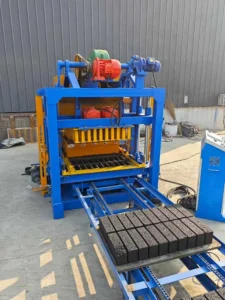
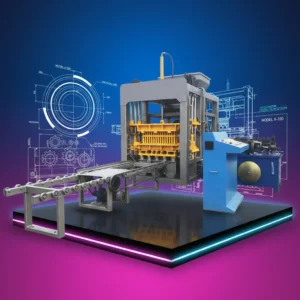
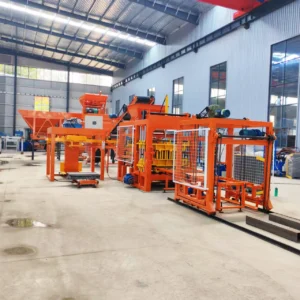
Matched Line Integration — The QTJ4-25 block machine is specified alongside its mixer, pallet feeder, stacker, and curing rack so cycle times align at every station and the press never idles waiting for upstream or downstream equipment.
Technical Specifications
| Parameter | Value |
|---|---|
| Model | QTJ4-25 |
| Product Type | Automatic Concrete Block Making Machine |
| Overall Dimensions (L×W×H) | 6400×1500×2700 mm |
| Total Mass | 3500 kg |
| Cycle Time | 25 s |
| Output Capacity (400×250×200mm hollow block) | 3 pcs/mould, 360 pcs/h, 2880 pcs/day (8h) |
| Output Capacity (400×200×200mm hollow block) | 4 pcs/mould, 450 pcs/h, 3600 pcs/day (8h) |
| Output Capacity (400×150×200mm hollow block) | 5 pcs/mould, 600 pcs/h, 4800 pcs/day (8h) |
| Output Capacity (400×100×200mm hollow block) | 7 pcs/mould, 840 pcs/h, 6720 pcs/day (8h) |
| Output Capacity (225×112.5×60mm paver) | 12 pcs/mould, 960 pcs/h, 7680 pcs/day (8h) |
| Pallet Size | 850×480 mm |
| Rated Power | 17 kW |
| Rated Pressure | 21 MPa |
| Operating Staff | 1-2 staff |
| Voltage & Frequency | 380V, 3-phase, 50Hz (customizable) |
| Mould System | Exchangeable moulds |
| Automation Level | Semi-automatic (electro-mechanical integration) |
| Warranty | 1 year (excluding wearing parts) |
Application Suitability
| Application | Material or Output |
|---|---|
| Hollow block production for building walls | Crushed stone, sand, cement, fly ash, gravel, slag |
| Solid block manufacturing for load-bearing structures | Concrete mixes with local aggregate |
| Paver and colored paver production for landscaping | Cement, sand, stone dust, pigment additives |
| Interlocking block and curbstone forming | Standard concrete and specialized mix designs |
| On-site block production for construction projects | Raw materials sourced near the project location |
Why the Line Layout Matters More Than the Press Alone
A block machine is only as fast as its slowest upstream or downstream station.
When a buyer focuses only on the press cycle time, the actual daily tonnage often falls short because the mixer cannot discharge fast enough, the pallet feeder jams, or the stacking station creates a bottleneck. In my years commissioning lines across the Middle East, I have seen the automatic block machine production line sit idle for seconds per cycle simply because supporting equipment was sourced separately and never timed to the press. The result is a turnkey block making line that produces well below the quoted capacity, and the blame gets shifted between suppliers. [NEED_CITE: common causes of throughput loss in block production lines]
Coordinating Every Station Around the 25-Second Cycle
The QTJ4-25 operates on a 25-second cycle, which sets the pace for every other station in the automatic block machine production line. The raw material feeder must deliver a measured batch to the mixer within that window, the mixer must discharge into the hopper before the next press stroke, and the pallet feeder must position a fresh pallet under the mould in time. If any one of these stations runs even a few seconds slow, the press waits and your hourly count drops. This is why the line must be specified as a single system rather than assembled from independent suppliers.
Sizing the Mixer and Feeder to the Press Demand
A mixer undersized for the QTJ4-25 will force the press to idle between batches, especially when producing dense hollow blocks that demand a full charge of concrete per stroke. The feeder configuration — whether belt or skip — must also match the distance from the mixing station to the press hopper. On several turnkey block making line projects, I found that upgrading the mixer capacity and shortening the feed path eliminated the idle gaps that were silently cutting daily output. [NEED_CITE: mixer sizing guidelines for block production lines]
Pallet Flow and Curing Rack Integration
Reading the Specs That Actually Affect Output
The rated pressure of 21 MPa and the vibration system work together to compact the concrete mix into the mould. Higher pressure increases block density and strength, but only if the vibration frequency and amplitude are matched to the specific aggregate size in your mix. Using a coarse local gravel with a vibration setting calibrated for fine sand will leave voids and weak corners. The pallet size of 850×480 mm determines how many blocks are formed per cycle and must also align with the dimensions of your curing racks and the fork spacing on your yard forklift. A mismatch here means pallets are handled manually or stacked inefficiently. The exchangeable mould system lets you switch between hollow blocks, pavers, and interlocking formats, but the changeover procedure and time must be understood before committing to a multi-format production schedule. The semi-automatic electro-mechanical integration keeps the operator count to one or two staff, though the actual labour requirement depends on whether pallet return and block stacking are mechanized in your line configuration.
What Happens When Supporting Equipment Is Left Out of the Quote
I have walked onto sites where the press was running perfectly but blocks were being carried off the pallets by hand because no stacker was included in the original order. The daily tonnage in those cases was a fraction of what the spec sheet promised. When pallet handling, stacking, and curing rack systems are treated as optional extras rather than integral parts of the automatic block machine production line, the buyer ends up paying for capacity that never materializes. The hidden cost is not just lost output — it is the extra labour, the pallet damage from manual handling, and the inconsistent curing that weakens the final product. [NEED_CITE: impact of manual pallet handling on block quality]
Why Source the Complete Line from One Supplier
Block machinery is the single focus here, which means the QTJ4-25 press, moulds, pallets, and handling equipment are specified as one matched system rather than assembled from separate vendors. The configuration is set against your actual mix design, local aggregate, and target block format — not a catalogue default that may not suit your materials. Mould design covers the formats your market actually sells, and custom mould drawings are available when standard options do not match. The automation level is selectable, so a buyer can start with semi-automatic operation and add stacking or cubing later as volume grows. Installation includes commissioning support with operator training so your crew can run the line independently from the first week.
Documentation & Verification
- Line layout drawing showing station spacing and pallet flow path for the QTJ4-25
- Capacity calculation sheet stating the block format assumed for each output figure
- Pallet specification matched to your curing rack dimensions and forklift fork spacing
- Hydraulic and electrical schematic with confirmed voltage and control language
- Factory test record run on your target block format before dispatch
- Wear parts and mould list with part numbers for reorder reference
Installation, Commissioning & Support
- Foundation plan based on the 6400×1500 mm footprint and 3500 kg mass of the QTJ4-25
- Dedicated 17 kW power circuit with confirmed voltage and 3-phase 50Hz supply
- Machine arrives in assembly-ready state with bolt-together frame sections
- First-run commissioning with your local aggregate and mix design to verify block density
- Operator training covering mould change procedure and daily maintenance checkpoints
- Spare mould and hydraulic wear parts list provided for first reorder planning
What We Need to Configure Your Line
To build an accurate line layout, share your target block formats, daily output requirement, and the raw materials available at your site. We also need your workshop dimensions, ceiling height, existing curing yard area, and local voltage and frequency so the QTJ4-25 and all supporting equipment arrive ready to connect.
Frequently Asked Questions
Q: How is daily output calculated, and which block format does each capacity figure assume?
A: Each output figure on the QTJ4-25 is tied to a specific block format. For example, 3600 pcs/day assumes a 400×200×200mm hollow block at 4 pcs per mould over an 8-hour shift. Switching to a smaller paver format changes the per-mould count and therefore the daily total. We provide a capacity sheet listing output per format so you can verify against your actual product mix.
Q: What supporting equipment is included in the turnkey block making line quotation?
A: The quotation covers the QTJ4-25 press along with raw material feeding, mixing, pallet feeding, stacking, and curing rack handling. Each station is sized so its cycle time matches the 25-second press cycle. If you already have certain equipment on-site, we can exclude those stations and adjust the line layout accordingly.
Q: How are pallet size and material chosen to match my existing curing area and forklift?
A: The standard pallet for the QTJ4-25 measures 850×480 mm. We confirm this dimension against your curing rack spacing and forklift fork width before production. If your existing yard infrastructure requires a different pallet size or material — wood, bamboo, or composite — we adjust the specification to avoid handling conflicts on arrival.
Q: How is the machine configured to my local aggregate and mix design rather than a catalogue default?
A: We request a sample of your local aggregate and your preferred cement-to-sand ratio before finalizing the vibration force and hydraulic pressure settings on the QTJ4-25. This ensures the 21 MPa rated pressure is applied in a way that suits your material, producing consistent block density without excess wear on the mould or press components.