
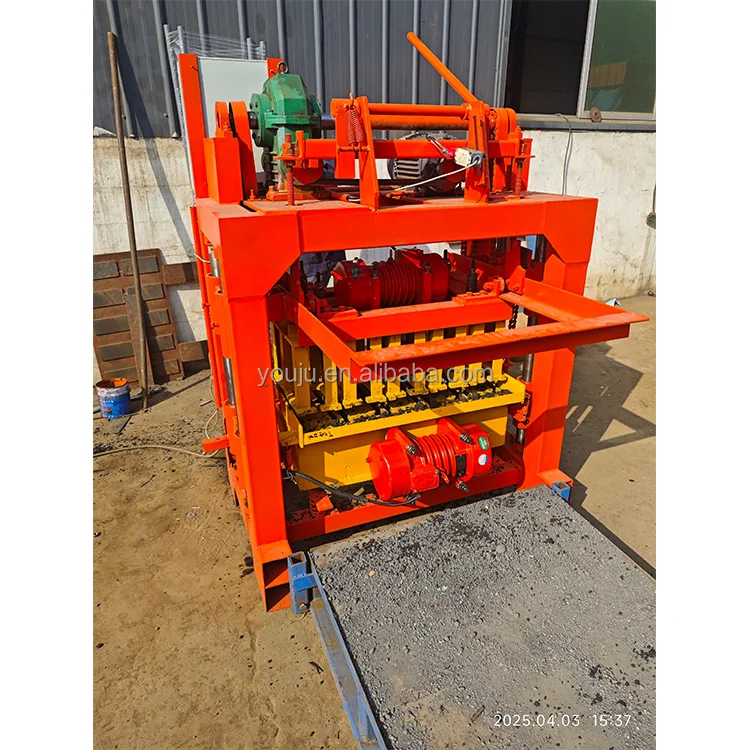
Line-Wide Cycle Match — The QTJ4-40 is specified here as one station inside a full block production line, so every upstream mixer, pallet feeder and downstream stacker is sized against its actual cycle time rather than a brochure promise.
Technical Specifications
| Parameter | Value |
|---|---|
| Model | QTJ4-40 |
| Product Type | Semi-Automatic Hydraulic Block Making Machine |
| Capacity (400×200×200 mm hollow block, 4 pcs/mould) | 2880 pcs / 8 hours |
| Capacity (400×150×200 mm hollow block, 5 pcs/mould) | 4000 pcs / 8 hours |
| Capacity (225×112.5×60 mm interlocking paver, 9 pcs/mould) | 7200 pcs / 8 hours |
| Vibration Form | Platform Vibration |
| Vibration Frequency | 2800 r/min |
| Pallet Size | 850×450 mm |
| Raw Material Ratio (approx.) | Cement 8-10 %, Sand 30-40 %, Stone 50-60 % (1:4:5) |
| Raw Materials | Concrete, cement, fly ash, crushed stone, sand, dust, gravel, slag |
| Applied Products | Hollow/solid blocks, pavers, interlocking blocks, curbstone, colored pavers |
| Overall Dimensions (L×W×H) | 1350×1460×1800 mm |
| Machine Weight | 1 T |
| Factory Area Requirement | 200 m² |
| Worker Requirement | 1-3 people |
| Automation Level | Semi-automatic (top die push/pull, automatic scraper, manual pallet handling) |
| Mould Change System | Manual (basis not stated in source) |
| Hydraulic Pressure | (source value not stated — verify against manufacturer catalog) |
| Vibration Force | (source value not stated — verify against manufacturer catalog) |
| Voltage & Frequency | (source value not stated — confirm with buyer’s site supply) |
| Control System | (source value not stated — verify PLC or relay logic) |
| Stacking Method | Manual |
| Standards | CE (certificate number not stated) |
Application Suitability
| Application | Material or Output |
|---|---|
| Small-scale hollow block plant | Crushed stone, sand and cement at 1:4:5 ratio, 400×200×200 mm format |
| On-site contractor block production | Fly ash blends and local gravel, 400×150×200 mm hollow block |
| Interlocking paver run for housing projects | Pigmented concrete mixes, 225×112.5×60 mm paver format |
| Curbstone and solid block add-on line | Coarse aggregate and cement, format dependent on mould fitted |
| First block plant with limited capital | Any locally sourced aggregate within the stated ratio range |
What "2880 Blocks a Day" Leaves Out When the Rest of the Line Is Ignored
Capacity is a line number, not a press number.
The QTJ4-40 will produce 2880 hollow blocks in an eight-hour shift only if the mixer delivers fresh concrete at the exact rhythm the press consumes it, the pallet feeder never runs dry and the curing area absorbs wet output as fast as it leaves the press. When any of those three stations lags, the press sits idle and that headline figure evaporates. I once saw a small block plant in West Africa lose nearly a full day of output because the belt conveyor between mixer and hopper ran twenty seconds slower per batch than the press cycle demanded — the operator stood waiting while the vibration motor burned power for nothing [NEED_CITE: typical bottleneck sources in semi-automatic block lines].
This is why every block production line equipment quotation we issue starts with a station-by-station timing diagram rather than a single output claim. The supporting equipment for block plant must absorb the press rhythm, not the other way around.
Upstream Stations That Must Keep the Press Fed
A block production line equipment setup around the QTJ4-40 begins with raw material feeding and mixing. The press completes a cycle and immediately demands the next charge of wet concrete; if the pan mixer is still blending, the press waits. We size the mixer drum volume and discharge gate speed so that one full mix is ready before the press finishes its current cycle, keeping the hopper topped up without flooding it. Belt conveyor width, angle and belt speed are calculated against the distance from mixer to press, not copied from a standard catalog page.
Downstream Stations That Must Clear the Press
Once the QTJ4-40 finishes a press cycle, the operator pulls the loaded pallet off and slides an empty one in. That pallet, now carrying wet blocks, must reach the curing rack before the next pallet exits. If the curing rack is too far, or the rack spacing does not match the 850×450 mm pallet, pallets pile up beside the press and the semi-automatic scraper has nowhere to deposit the next unit. We match rack dimensions and forklift travel distance to the press cycle so the supporting equipment for block plant never becomes the constraint.
Reading the Specs That Actually Decide Daily Output
The platform vibration at 2800 r/min works together with the hydraulic pressure — when both are tuned to the buyer’s mix, blocks leave the mould dense enough to handle without corner damage. Pallet size is 850×450 mm; this figure must match the curing racks already on site or the racks ordered with the line. The raw material ratio of roughly 1:4:5 (cement:sand:stone) is a starting point, not a fixed recipe, because local aggregate grading and moisture content shift the water demand and therefore the cycle time the operator can achieve. The stated factory area requirement of 200 m² covers press, mixer, pallet stack and a compact curing zone; tighter compounds force the curing rack taller, which in turn demands a different forklift reach.
When Line Stations Are Chosen Without Timing Data
If the mixer is oversized and discharges faster than the press can consume, wet concrete sits in the hopper, begins to stiffen and forces the operator to scrape hardened material out mid-shift. If the curing rack is undersized, pallets stack on the floor, blocks chip during manual handling and the stated daily output drops well below the figures in the specification table [NEED_CITE: effects of station imbalance on semi-automatic block output]. These mismatches are invisible in a press-only quotation and only appear after the line is running.
Why Sourcing the Whole Line from One Configuration Point Matters
Block machinery is our single focus, so the QTJ4-40, its moulds, pallets, mixer and rack are specified as one matched set. We calculate capacity per block format — hollow, paver or interlocking — and show the buyer which station limits the chain. Configuration is set against the buyer’s actual mix design and local aggregate, not a default table. Pallet size, mould format and curing rack pitch are cross-checked before production starts. Voltage, frequency and control language are confirmed in writing so commissioning is not delayed after arrival.
Documentation & Verification
- Line layout showing cycle time match at every station around the QTJ4-40
- Capacity calculation sheet stating block format assumed for each figure
- Pallet specification cross-referenced to buyer’s curing rack dimensions
- Voltage, frequency and control language confirmation before production
- Mould drawing and format list included with quotation
- Factory test record on buyer’s target block format before dispatch
Installation, Commissioning & Support
- 200 m² compound area required; ground slab must bear the 1 T press and loaded pallet stacks
- Voltage and frequency confirmed pre-build so the motor and control panel match site supply
- Semi-automatic scraper and die push/pull tested under load during on-site commissioning
- Operator trained on mould change procedure and manual pallet feed rhythm
- Wear parts list and mould inventory supplied at handover for first replacement cycle
- Maintenance schedule aligned to vibration platform bearing and hydraulic seal intervals
What to Include in Your Inquiry
To size the supporting equipment for block plant around the QTJ4-40, share the block formats your market buys, the daily output you need per format, the aggregate and cement available locally, and the dimensions of your curing compound. If you already own a forklift or curing racks, send the pallet size those assets accept so we match or adapt. Finally, confirm the site voltage and frequency so the motor winding and control panel are built right the first time.
Frequently Asked Questions
Q: How is line capacity calculated when the press is only one station in the chain?
A: We map every station — mixer discharge, belt transfer, press cycle, pallet swap and rack loading — against the block format you plan to run. The slowest station sets the real output, and the capacity sheet states that format explicitly so there is no gap between quoted and actual daily figures.
Q: Which upstream and downstream stations must be matched to the QTJ4-40 cycle time?
A: The mixer must deliver a full charge before the press finishes its current cycle, and the pallet feeder must present a clean pallet within the operator’s swap window. Downstream, the curing rack must absorb loaded pallets at the same rate they leave the press, and the forklift travel distance must fit inside that interval.
Q: What pallet size and material does this press require, and does it fit my existing curing racks?
A: The QTJ4-40 uses 850×450 mm pallets. We confirm rack spacing, rack height and forklift fork width against that dimension before production, so pallets slide straight from press to rack without modification.
Q: How do I confirm voltage, frequency and control language before the machine leaves the factory?
A: We send a written confirmation sheet listing motor voltage, control panel frequency and display language for your sign-off before the motor is wound and the panel is wired, preventing commissioning delays after arrival.
Q: What is the realistic footprint for a complete line around this press?
A: The stated 200 m² covers press, mixer, pallet stack and a single-layer curing zone. If compound space is tighter, we raise the curing rack and adjust forklift reach, and the layout drawing shows the revised dimensions before you commit.


