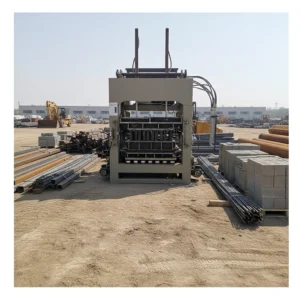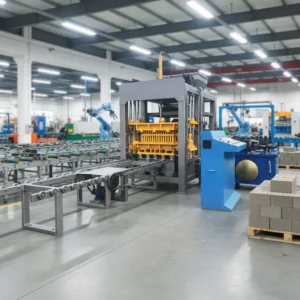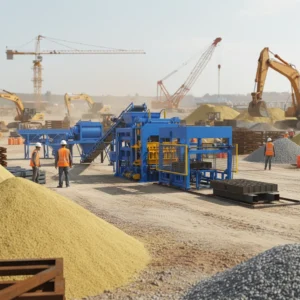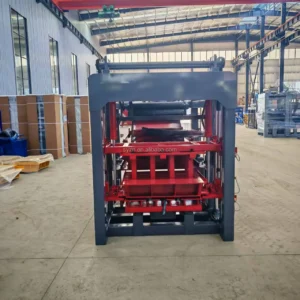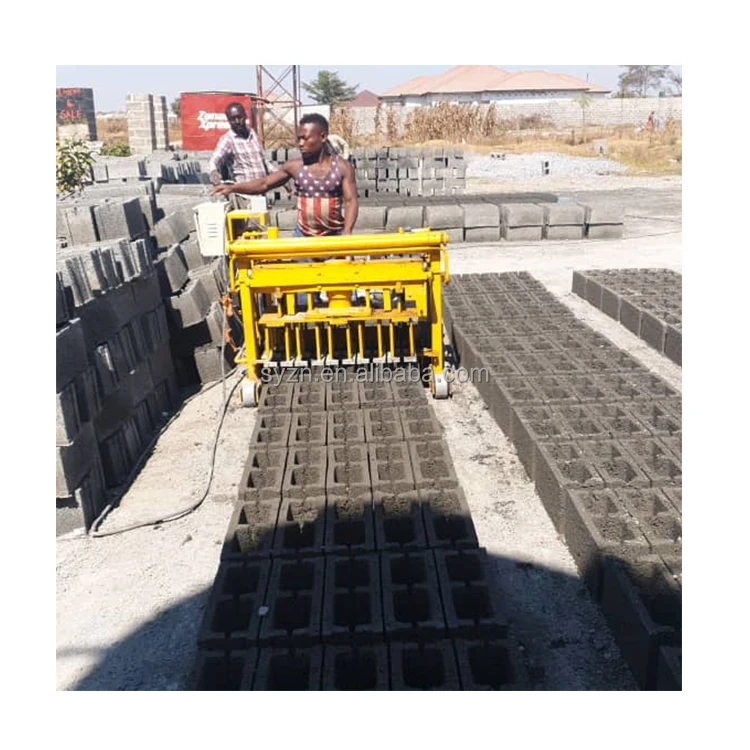
System-Level Line Matching — QMY4-30 mobile egg-laying configuration is evaluated as one coherent production setup, where mixer output, material feed cadence, and curing logistics are verified against the press cycle before dispatch.
Technical Specifications
| Parameter | Value |
|---|---|
| Model | QMY4-30 |
| Product Type | Diesel Engine Mobile Egg-Laying Block Making Machine |
| Power Source | Diesel Engine / Electric 220V/380V (configurable) |
| Vibration Method | Mold Vibration |
| Exciting Force | 28.6 KN |
| Excitation Frequency | 4500 r/min |
| Total Power | 5.95 kW |
| Molding Cycle | 30 s |
| Output Capacity | 3000 pcs/day (8 hours) (basis not stated in source — confirm block format / material / thickness) |
| Overall Dimensions | 1300 x 1500 x 1000 mm |
| Net Weight | 950 kg – 1000 kg |
| Raw Materials | concrete, sand, cement, fly ash, lime, gypsum, stone dust, slag, river sand, construction waste, mine tailings, coal gangue |
| Automation Level | Manual / Semi-automatic (egg-laying mobile type) |
| Pallet Requirement | Not applicable (cures directly on ground) |
| Mould Format | Customizable to buyer design |
| Control System | Manual operation with vibratory motor and hydraulic pump motor |
Application Suitability
| Application | Material or Output |
|---|---|
| On-site hollow block production for building contractors | Crushed stone, river sand, and cement mixes laid directly on compacted ground |
| Remote housing project block making (off-grid) | Diesel-powered operation using locally available sand and fly ash |
| Small-scale entrepreneurial block plant | Concrete and stone dust blends for solid bricks and paving formats |
| Temporary production at construction or mining sites | Slag, mine tailings, and construction waste recycled into masonry units |
Why the Upstream Feed Rate Matters More Than the Press Headline
A 30-second molding cycle only holds if the mixer and material feed can deliver a fresh batch every half minute without interruption.
When I first walked onto a job site in Cambodia, the mobile block machine line setup looked right on paper. The press was rated for steady output, but the pan mixer took closer to forty-five seconds per batch, and the operator had to wheel the mix over by hand. The press sat idle dozens of times each shift. That block production line supporting equipment mismatch turned a promising daily target into a fraction of what was quoted. [NEED_CITE: typical mixer discharge cycle times for small-scale concrete batching]
The QMY4-30 completes its vibration and demolding sequence in 30 seconds. If your block production line supporting equipment — the mixer, the water dosing, the aggregate feed — cannot match that cadence, the press spends more time waiting than pressing. This is the gap that most quotations leave wide open.
Matching the Mixer to the Molding Cadence
The QMY4-30 demands a consistent supply of semi-dry concrete every 30 seconds to maintain its rated cycle. A mobile block machine line setup that pairs this press with an undersized mixer forces the operator to either rush the mix — producing weak, inconsistent blocks — or let the press idle between cycles. The upstream batching and mixing station must be sized so that a complete, homogeneous batch is ready before the press finishes its current mold. This is where a block production line supporting equipment audit before purchase prevents the most common on-site disappointment.
Curing Area Logistics Without Pallets
Because this egg-laying machine deposits blocks directly onto the ground, the curing area becomes part of the production line whether the quotation says so or not. A block production line supporting equipment plan must account for the floor space needed per day’s output, the surface preparation required to keep blocks level, and the traffic path for moving finished product. [NEED_CITE: ground curing space requirements per 1000 concrete blocks] Without this layout, operators end up stacking blocks by hand in uneven rows, and breakage during the first days of curing erases whatever the press gained in speed.
Reading the Vibration and Pressure Specs for Your Aggregate
The 28.6 KN exciting force at 4500 r/min is the energy delivered into the mold during each cycle. Whether that produces a structurally sound hollow block depends entirely on the gradation and moisture content of the aggregate you source locally. A coarse, angular crushed stone absorbs vibration differently than fine river sand, and the mix water ratio shifts the density the press can achieve. The mobile block machine line setup must be configured against a sample of your actual raw material, not a generic catalogue mix, or block strength will vary from batch to batch.
What Happens When the Diesel Option Is Not Fully Specified
Choosing the diesel engine variant solves the off-grid power problem for the press itself, but it creates a new question: does the mixer and water pump also need to run without grid electricity? A block production line supporting equipment quotation that lists the diesel press alongside an electric-only mixer leaves the buyer scrambling for a generator on arrival day. I have seen this exact oversight stall commissioning by days while the contractor sourced a rental unit locally. [NEED_CITE: generator sizing requirements for simultaneous diesel and electric equipment on remote sites] The voltage, frequency, and power source for every station in the line must be confirmed as a single system before the machine leaves the factory.
Why Procurement Should Treat the Line as One Unit
Sourcing the QMY4-30 from one supplier and the mixer, water system, and material handling from others creates interfaces that nobody is responsible for. The machine and its supporting block production line supporting equipment are specified as one matched system here, so the feed rate, power source, and curing logistics are verified together. Configuration is set against your local aggregate and target block format rather than a default catalogue entry. Mould design covers the specific formats your market sells, including custom drawings when standard sizes do not fit. The automation level is selectable, so a buyer starting with manual operation has a clear path to add pallet handling and stacking later. Every quotation states the block format assumed in the capacity calculation, so there is no ambiguity about what the daily output figure actually means.
Documentation & Verification
- Line layout showing mixer-to-press feed path and curing area dimensions for the QMY4-30 footprint
- Capacity calculation sheet stating the exact block format and wall thickness behind the daily output figure
- Mould drawing confirming cavity count, block dimensions, and expected cycle time per format
- Voltage and power source confirmation covering both the press and all upstream block production line supporting equipment
- Factory test record run on a mix design matching the buyer’s local aggregate sample
Installation, Commissioning & Support
- Ground surface preparation guide for the 1300 x 1500 mm machine footprint and adjacent curing area
- Power source verification for diesel or 220V/380V electric operation including upstream mixer circuit requirements
- On-site assembly of the 950–1000 kg unit with vibration motor and hydraulic pump alignment check
- First-run parameter tuning of the 28.6 KN exciting force against the buyer’s actual mix design and aggregate
- Operator training covering the 30-second molding cycle rhythm and manual feed coordination
- Wear parts and mould maintenance schedule based on local material abrasiveness
Before You Request a Quotation
To configure the QMY4-30 and its supporting stations accurately, share your target block format with dimensions and wall thickness, the local aggregate type and gradation you plan to use, and whether grid power is available at the site or if the entire line must run on diesel or generator power. Include the daily output you need and the curing floor space you can allocate so the line layout can be drawn before the quotation is issued.
Frequently Asked Questions
Q: How is the 3000 pcs/day capacity verified, and which block format does it assume?
A: That figure depends entirely on the block size, wall thickness, and mix design used during testing. The quotation includes a capacity calculation sheet that states the exact format assumed, along with the molding cycle time for that format. If your target block differs, the daily output is recalculated so you know the realistic number before ordering.
Q: What upstream mixer capacity is needed to avoid bottlenecking the 30-second cycle?
A: The mixer must discharge a complete, homogeneous batch in under 30 seconds to keep pace with the QMY4-30. The block production line supporting equipment proposal specifies the mixer drum volume, motor power, and discharge method matched to this cadence, so the press is never left waiting for material between cycles.
Q: How should the curing area be laid out when there are no pallets?
A: The egg-laying method requires a flat, prepared ground surface large enough to hold one full day’s output without stacking blocks on top of each other during initial curing. The line layout document includes the floor space calculation per thousand blocks and the traffic path for moving cured product clear of the next day’s production zone.
Q: Does the diesel engine option deliver the same vibration force as the electric variant?
A: The 28.6 KN exciting force and 4500 r/min frequency are the target ratings for both power sources, but the diesel engine must be matched to the vibratory motor’s power draw to sustain that output consistently. The mobile block machine line setup quotation confirms the engine specification against the press demand so there is no performance gap.
Q: What supporting equipment should be included so nothing is left to manual workarounds?
A: The quotation covers the mixer, water dosing system, raw material feed arrangement, and curing area layout as part of the block production line supporting equipment package. Each station is specified to match the QMY4-30 cycle time and power source, so the line runs as one system from first batch to last block each shift.