
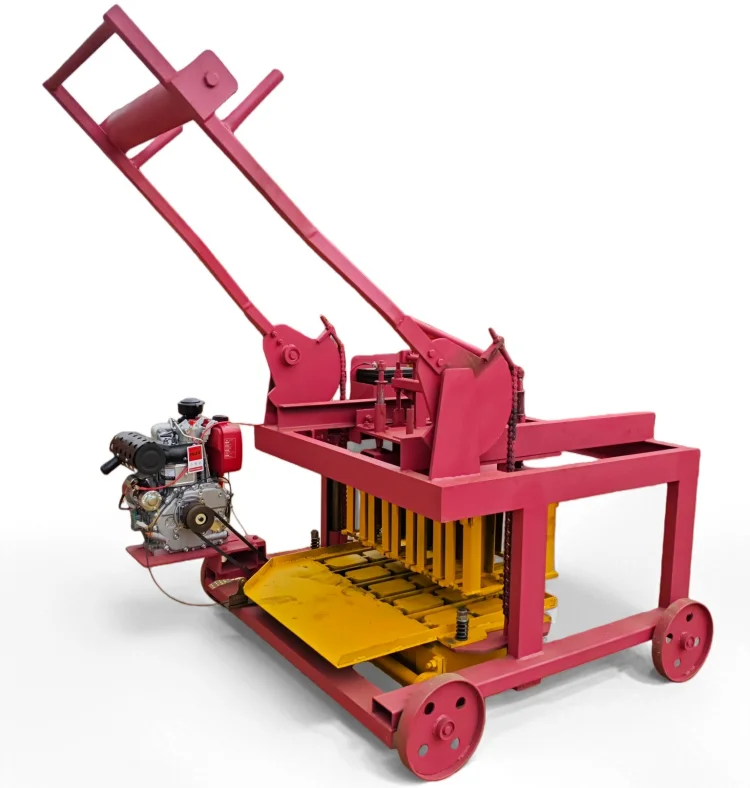
Diesel-Driven Line Matching — the QMR4-45 mobile block machine production line is quoted with a matched diesel mixer and trolley so mixing output, press cycle, and block laying stay synchronized on remote sites without grid power.
Technical Specifications
| Parameter | Value |
|---|---|
| Model | QMR4-45 |
| Product Type | Mobile Egg-Laying Block Machine |
| Molding Cycle | 45s (basis not stated in source — confirm block format / material / thickness) |
| Power Source | Diesel |
| Rated Power | 8hp |
| Molding Form | Vibration and Pressure |
| Vibration Force | 60KN |
| Total Weight | 800kg |
| Overall Dimensions | 2420 × 1320 × 1650 mm |
| Pallet Requirement | No pallet required (egg-laying type) |
| Mobility | Mobile / movable on site |
| Compatible Formats | Paver brick, hollow block, concrete block, solid brick, fly ash brick |
| Basic Equipment Included | JZC350 Diesel Concrete Mixer or JQ350 Diesel Concrete Mixer (with Electric Generating Unit); Trolley |
| Automation Level | Manual operation |
Application Suitability
| Application | Material or Output |
|---|---|
| Remote area block production without grid power | Crushed stone, sand, cement, fly ash blends |
| On-site masonry block manufacturing for construction projects | Hollow and solid concrete blocks laid directly on the ground |
| Small-scale brick making operations | Paver bricks, fly ash bricks, interlocking formats |
| Contractor-led housing projects in off-grid locations | Daily output aligned to mixer batch size and 45s molding cycle |
Why "45-Second Cycle Time" Rarely Means What Buyers Expect
The cycle number only holds true when the block format, mix design, and upstream feeding are all specified together.
When I plan lines for contractors working in regions with unstable infrastructure, the first thing I check is whether the quoted cycle time was measured on the exact block format the buyer intends to produce. A 45-second cycle on a small solid brick is a very different reality from the same cycle on a large hollow block with thicker walls. Without stating the format and mix, the number becomes meaningless once the machine arrives on site and the operator discovers each cycle takes noticeably longer [NEED_CITE: block cycle time dependency on format dimensions and aggregate grading]. For a mobile block machine production line, this mismatch is even more costly because there is no fixed conveyor or buffer silo to absorb the gap — the mixer, the press, and the trolley must all agree on the same rhythm.
Mixer-to-Press Synchronization on Off-Grid Sites
The QMR4-45 ships with either a JZC350 diesel concrete mixer or a JQ350 mixer paired with an electric generating unit, and the choice between them determines how material flows to the press. On a remote site where no grid connection exists, the diesel mixer keeps the entire mobile block machine production line independent from external power. What matters is that the batch volume per mix aligns with the hopper capacity of the press so the operator is never waiting for the next batch while the vibration motor idles.
Ground-Laying Workflow Without Pallet Logistics
Because this is an egg-laying design, blocks are deposited directly onto the ground as the machine moves forward. That eliminates pallet purchase, pallet return loops, and pallet storage area from the site plan entirely. The trolley included in the line handles raw material transport from the mixer to the press, closing the loop between mixing and molding without requiring a forklift or additional handling crew on a tight building site.
Vibration Force and Block Density in Mobile Operation
The 60KN vibration force works together with mechanical pressure to consolidate the concrete mix inside the mould. On a mobile block machine production line, this consolidation step is critical because ground conditions vary across the site — softer soil absorbs more vibration energy, potentially reducing block density compared to a poured concrete floor [NEED_CITE: vibration transmission loss on unprepared ground surfaces]. Specifying the intended block format and local aggregate grading before shipment ensures the vibration force is appropriate for the target compressive strength rather than being a generic default.
When Upstream Equipment Is Left Out of the Quote
I have seen situations where a contractor receives a mobile block machine with no mixer, no trolley, and no material feed plan — only the press itself. The result is a crew shoveling material by hand into the hopper, the press starving for mix every few cycles, and daily output falling well short of what was promised. Pallet handling, stacking, and curing not included in the quotation leaves output stacked by hand, which on an egg-laying machine means the entire curing area must be organized manually around the machine’s travel path [NEED_CITE: manual handling bottleneck in small block production operations].
Why Specify the Complete Line Here
Block machinery is the single focus, so the press, diesel mixer, and trolley are configured as one matched system rather than assembled from separate suppliers with incompatible output rates. The configuration is set against the buyer’s actual mix design and local aggregate, not a catalogue default. Mould design covers the specific formats the buyer’s market demands, including custom drawings when standard hollow or paver moulds do not fit the project specification. The line layout and capacity calculation state the block format assumed, so the buyer knows exactly what daily output to plan for. Voltage and control language are confirmed before production, avoiding commissioning delays when the generating unit arrives on site.
Documentation & Verification
- Line layout showing mixer-to-press material flow and curing area footprint
- Capacity calculation stating the block format assumed for the 45s cycle
- Machine specification sheet confirming diesel engine rating and mixer model
- Mould drawing and format list for each supplied block type
- Voltage and control language confirmation for the electric generating unit option
Installation, Commissioning & Support
- Site leveling within the 2420 × 1320 mm footprint to ensure stable egg-laying travel
- Diesel fuel supply and spare filter planning for the 8hp engine and mixer
- Mould installation and vibration force calibration against the buyer’s mix design
- Operator training on manual feed timing between JZC350 batches and press cycles
- Wear parts list covering vibration springs, mould liners, and diesel engine consumables
- Curing area layout guidance matched to the machine’s forward travel speed
Before You Request a Quote
To size this mobile block machine production line correctly, share your target block format with dimensions, the daily output you need to sustain your building schedule, and the raw materials available on your site including aggregate type and grading. If you are selecting the JQ350 mixer with electric generating unit, confirm your local voltage and frequency so the generator is wound correctly before dispatch.
Frequently Asked Questions
Q: How is the 45s molding cycle verified against my specific block format and mix design?
A: The 45-second figure must be validated against the exact block dimensions and the concrete mix you plan to use. Larger hollow blocks with thicker walls require longer vibration and pressure holding times. We provide a capacity calculation that states the block format assumed, so you can compare it directly against your project requirement before committing to the line.
Q: What supporting equipment is included in the line quotation versus what I need to source locally?
A: The quotation covers the QMR4-45 press, the selected diesel mixer (JZC350 or JQ350 with generator), and the material trolley. Items you typically source locally include diesel fuel, raw aggregates, cement, and ground preparation for the curing area. This is confirmed in the line layout document before production begins.
Q: How do I match the mixer output to the press cycle so the machine is not left waiting?
A: The mixer batch volume and mixing time must align with the press hopper capacity and molding cycle. If one batch feeds multiple cycles, the mixer must finish its next batch before the press completes those cycles. We calculate this ratio during configuration and specify the mixer model accordingly.
Q: What block formats can one QMR4-45 produce, and how long does mould change take?
A: The machine accommodates paver bricks, hollow blocks, concrete blocks, solid bricks, and fly ash bricks through mould replacement. Mould change involves unbolting the current mould and securing the new one, which is a manual process. The exact time depends on operator familiarity and is covered during on-site training.


