
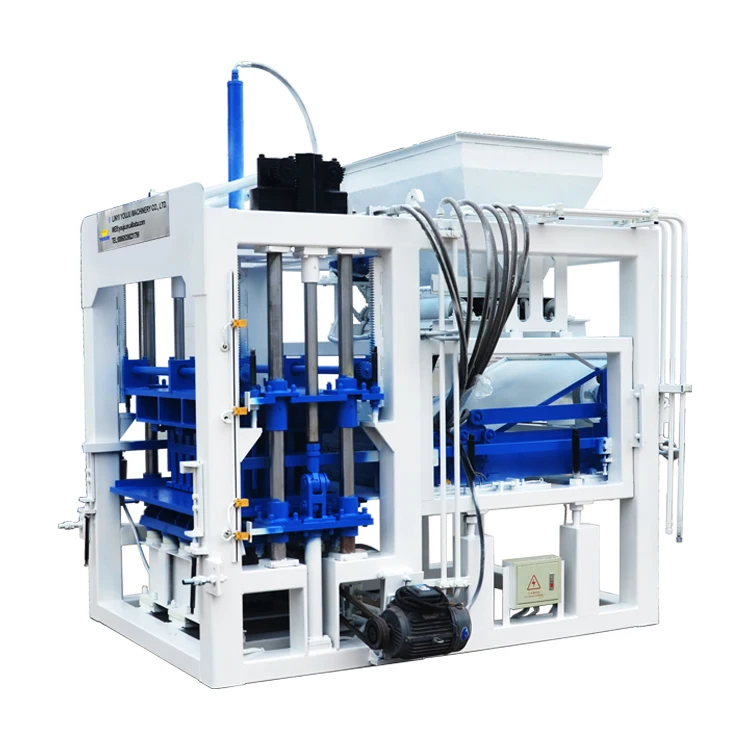
Line-wide synchronization — the QT5-15 is configured as the press node inside a raw-to-cured block line, so feeding, pallet circulation and stacking are timed to its 15–20 s cycle rather than left to mismatched add-ons.
Technical Specifications
| Parameter | Value |
|---|---|
| Model | QT5-15 |
| Product Type | Automatic Hydraulic Concrete Block Making Machine |
| Overall Dimensions (L×W×H) | 7400×1950×2800 mm |
| Net Weight | 6T |
| Rated Pressure | 21 MPa |
| Main Vibration Form | Hydraulic platform vibration |
| Vibrating Frequency | 2800–4500 rolls/minute |
| Cycle Time | 15~20 seconds (basis not stated in source — confirm block format / material / thickness) |
| Motors Power | 26.5 kW |
| Pallet Size | 1100×550 mm |
| Voltage | Configurable to buyer’s rated voltage and frequency |
| Control System | PLC with fault diagnosis and long-distance controlling system |
| Automation Level | Full automatic |
| Assembly State | Stationary |
| Warranty | One year for the whole machine |
| Standards | CE (verify certificate number) |
Application Suitability
| Application | Material or Output |
|---|---|
| Hollow block production for load-bearing walls | 400×200×200 mm hollow blocks from crushed stone, cement and local aggregate |
| Standard brick production for masonry | 240×115×90 mm solid bricks from river sand and cement |
| Paving brick production for hardscapes | 400×115×53 mm pavers from fine aggregate and cement |
| Interlocking brick production for retaining walls | Interlock formats from graded aggregate and cement |
Why "Cycle Time" Means Nothing Without the Rest of the Line
A fast automatic block making machine production line press sitting idle while a pallet feeder jams or a stacker falls behind is not fast at all.
Buyers routinely sign contracts for a press that quotes a 15-second cycle, only to discover that pallet feeding, stacking and curing rack handling were never part of the scope. Finished blocks then pile up at the discharge end, lifted by hand, and the real daily output collapses well below what the brochure suggested. The bottleneck simply migrates from the press to the weakest upstream or downstream station. [NEED_CITE: material handling bottlenecks in block plants]
From Isolated Press to Synchronized Block Line
The QT5-15 automatic block making machine production line is specified here as the forming station inside a continuous loop. Raw material feeding, mixing, pallet circulation, stacking and curing rack handling are each checked against the press cycle so no station forces another to idle. The goal is a steady cadence from the mixer to the curing yard, not a press that outruns its own support equipment.
Where the Press Meets the Pallet Circuit
Pallet size, material and return speed determine how many blocks the press can actually release per hour. A 1100×550 mm pallet must match the curing rack spacing, the forklift tine width the buyer already owns, and the stacking station’s gripper reach. Changing any one of these after the line is installed means reworking multiple stations at once. [NEED_CITE: pallet handling standards in concrete product plants]
Reading the Numbers That Actually Matter on Site
Rated pressure at 21 MPa and hydraulic platform vibration between 2800 and 4500 rolls/minute together set the compaction density of each block. Frequency is not a fixed dial; it moves with the mix, so low frequency during feeding and high frequency during compaction must be matched to the local aggregate grading and cement content. Motor power at 26.5 kW covers the press itself, not the mixer or stacker, so the site’s total connected load must be calculated station by station. The PLC fault diagnosis and long-distance controlling system lets the line supervisor read cycle counts and alarms from a central panel rather than standing at the press.
What a Mismatched Line Costs on the First Month
When the pallet return conveyor cannot keep pace with the press cycle, the operator manually drags pallets back into the feeder, and the line drops to a fraction of its theoretical throughput. When the stacking station is sized for a lighter block format than the one actually being run, gripper slips and broken pallets become a daily event. These problems are rarely the press’s fault, yet they land on the same production floor and the same daily output sheet. [NEED_CITE: hidden costs of partial block line procurement]
Why Buyers Source the Whole Line from One Spec
The press, moulds, pallets and handling equipment are specified together, so a pallet chosen for the 1100×550 mm press also fits the stacking station and the curing rack. Line layout and capacity calculation state which block format each output figure assumes, preventing surprises on the first production day. Automation level is selectable, so a buyer can commission a semi-automatic pallet return today and add full automatic stacking later without replacing the press. Voltage, frequency and PLC display language are locked in writing before production begins, not discovered when the container opens. Mould design covers the formats the buyer’s market actually buys, including custom drawings when a project calls for a non-standard block.
Documentation & Verification
- Line layout drawing showing station spacing and pallet flow for the QT5-15
- Capacity calculation stating the exact block format behind each output figure
- Pallet specification cross-referenced to the buyer’s curing rack and forklift
- Voltage, frequency and PLC language confirmation signed before production
- Factory test record running the buyer’s chosen mould at the agreed cycle time
Installation, Commissioning & Support
- Foundation plan sized to the 7400×1950 mm footprint and 6T operating weight
- Dedicated electrical circuit sized for the 26.5 kW press plus upstream and downstream loads
- Assembly sequence for the stationary press and its pallet return loop on site
- Cycle time verification across feeding, pressing and stacking stations during first run
- Operator training covering PLC fault diagnosis screens and long-distance controlling functions
- Wear parts list matched to the hydraulic valve bank and vibration platform
What to Send with Your First Inquiry
Share the block formats your market currently sells, the local aggregate source and its typical grading, and the daily output you need per format. Include the curing yard dimensions and the forklift model you plan to use, so the pallet circuit can be matched before the line is finalized. Confirm the site voltage, frequency and the PLC display language your operators will read every shift.
Frequently Asked Questions
Q: How is the output capacity of the QT5-15 calculated?
A: Each capacity figure in the spec sheet assumes a specific block format, pallet cycle and mould cavity count. The 23,040–28,800 pieces per 8-hour shift, for example, refers to a 240×115×90 mm brick with 16 pieces per mould. We restate the calculation for whichever format you intend to run most, so your daily target is based on your product, not a catalogue default.
Q: Which supporting stations are included in the line quotation?
A: The quotation scope lists raw material feeding, mixing, pallet feeding, stacking and curing rack handling as individual line items. Each station is sized so its cycle matches the press, and nothing is left as an undefined "buyer supply" item unless you explicitly choose to source it yourself.
Q: How do you prevent the pallet feeder from falling behind the press?
A: Pallet return speed is calculated from the press cycle time and the distance between the press discharge and the feeder intake. If the layout requires a longer return loop, the conveyor drive is upsized so the next pallet arrives before the press completes its current cycle.
Q: Can the 1100×550 mm pallet be changed to fit our existing curing racks?
A: Yes, provided the new pallet size still fits inside the press frame and the mould cavity layout. We adjust the pallet feeder, stacker gripper reach and curing rack spacing together, so all three stations accept the revised pallet without field modification.
Q: When do you confirm voltage, frequency and PLC language?
A: These details are locked in writing during the quotation stage, before production starts. The PLC display language is set to match your operators, and the electrical cabinet is built for your site’s rated voltage and frequency so commissioning begins on day one, not after a transformer arrives.


