
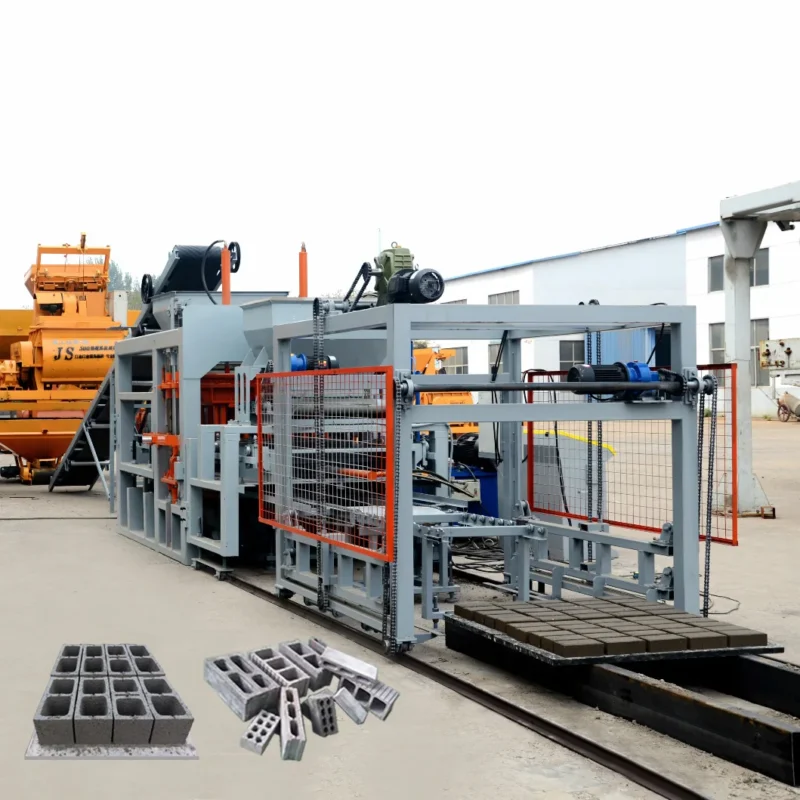
Synchronized Line Flow — every station from material feeding to cubing is paced to the QT8-15’s 15–25 s molding cycle so the press never idles between beats.
Technical Specifications
| Parameter | Value |
|---|---|
| Model | QT8-15 |
| Product Type | Fully Automatic Hydraulic Block Making Machine |
| Overall Dimensions (L×W×H) | 8300×1860×3000 mm |
| Rated Pressure | 21 MPa |
| Main Vibration Form | Platform vibration |
| Vibration Frequency | 2800–4500 r/min |
| Vibration Force | 45 kN |
| Pallet Size | 950×900 mm |
| Molding Cycle | 15–25 s (basis not stated in source — confirm block format / material / thickness) |
| Overall Power | 55.5 kW |
| Total Mass | 9 T |
| Demolding Method | Hydraulic |
| Recommended Factory Area | 500 m² |
| Control System | Computer controlled, fully automatic (source value — verify PLC brand and language options) |
| Standards | CE, ISO 9001 |
Application Suitability
| Application | Material or Output |
|---|---|
| Hollow block production | Crushed stone, sand, cement, fly ash, gravel |
| Solid block production | Sand, cement, slag, dust |
| Paving block and colored paver production | Fine aggregate, cement, pigment |
| Interlocking block production | Gravel, sand, cement |
| Curbstone production | Coarse aggregate, cement |
What a "15–25 Second Cycle" Actually Demands from the Rest of the Line
The press cycle is only as fast as the slowest station feeding or receiving from it.
When a quotation highlights a 15–25 second molding cycle, that number assumes the mixer has already delivered a fresh batch, the pallet feeder has placed the next board, and the stacker has cleared the finished product — all within that same window. In practice, the upstream batch plant or the downstream pallet handling often sets the real tempo. I have walked onto sites where a block machine of this class sat idle for nearly a third of each shift because the curing rack shuttle could not keep up [NEED_CITE: typical bottleneck analysis in block production lines]. A QT8-15 block machine production line only reaches its stated rhythm when every supporting station is timed to the press.
Matching Every Station to the Press Rhythm
A complete QT8-15 block machine production line connects raw material feeding, mixing, pallet circulation, stacking, and curing rack handling into a single coordinated sequence. The objective is straightforward: each station finishes its task within the press cycle so material and pallets arrive the moment the press is ready. When the batch plant delivers slightly late or the stacker jams, the press waits and the entire daily output drops accordingly.
Where Line Synchronization Fails Most Often
The gap between quoted and actual throughput usually opens at the hand-off points. A mixer sized only for peak demand may struggle during continuous running, and a pallet feeder rated for a lighter board format can slow down when heavier pallets are introduced. Even the curing rack shuttle must move loaded racks out and return empty ones within the QT8-15’s cycle window [NEED_CITE: pallet circulation timing in automatic block plants]. Sizing each station with a margin above the press requirement is what keeps the line balanced through a full shift.
Reading the Spec Sheet Beyond the Headline Numbers
The 21 MPa rated pressure combined with 45 kN platform vibration force determines the compaction density of each block. Higher pressure without matched vibration leaves voids; strong vibration without enough hydraulic pressure produces weak edges. Both must suit the buyer’s actual mix design and local aggregate.
The 950×900 mm pallet size must align with the curing rack dimensions and the forklift capacity already on site. Ordering pallets in a size that does not match existing racks forces either a rack rebuild or a pallet re-order before the line can run.
The 55.5 kW overall power figure covers the press alone. Adding the mixer, conveyor drives, stacker, and curing rack shuttle raises the connected load, so the transformer and switchgear must be sized for the complete line.
The 15–25 s molding cycle depends on block format, material, and wall thickness. A solid paver will cycle differently from a thin-walled hollow block, so the daily output calculation must state which format it assumes.
When Downstream Equipment Is Left Off the Quote
Purchasing a press without specifying the stacking and curing rack handling stations leaves finished blocks sitting on the pallet at the end of the conveyor. Operators then stack by hand, which slows the line to whatever pace manual labor allows. The investment in a fully automatic press is undermined because the real bottleneck moves to the back of the line [NEED_CITE: manual handling impact on block plant throughput].
Why Sourcing the Entire Line from One Supplier Matters
Block machinery is a single focus here, so the press, mould, pallet, and handling equipment are specified as one matched system rather than assembled from separate vendors. The configuration is set against the buyer’s actual mix design and local aggregate, not a catalogue default. Mould design covers the formats the buyer’s market actually sells, including custom drawings. The automation level is selectable, allowing a semi-automatic start with a defined upgrade path later. Installation and commissioning support includes operator training on the full line, not just the press.
Documentation & Verification
- Line layout drawing showing every station from material feeding to cubing with capacity stated per block format
- Pallet specification sheet confirming 950×900 mm size, material, and quantity matched to site racks
- Voltage, frequency, and PLC display language confirmed in writing before production
- Hydraulic and electrical schematics supplied with the documentation package
- Factory test record on the buyer’s specified block format before dispatch
- Wear parts and mould list included with customs documentation support
Installation, Commissioning & Support
- Foundation plan accounts for the 8300×1860 mm footprint and 9 T operating mass of the QT8-15
- Dedicated power circuit sized for the 55.5 kW press load plus all supporting station motors
- Machine arrives in dismantled shipment configuration with reassembly sequence documented
- Commissioning includes cycle time tuning across the full line for the buyer’s chosen block format
- Operator training covers PLC interface, mould change procedure, and daily maintenance routines
- Hydraulic and vibration wear parts list with reorder intervals supplied at handover
What We Need to Scope Your Line
Share the block formats you plan to produce, your target daily output per format, and the raw materials available locally so the mixer and press can be configured together. Confirm the factory area and curing space dimensions, plus the voltage, frequency, and PLC display language required at your site. Let us know which upstream and downstream equipment you already have so the QT8-15 block machine production line can be designed around it.
Frequently Asked Questions
Q: How is daily output calculated for the full line — and which block format is assumed?
A: Daily output is calculated by multiplying the molding cycle for a specific block format by the number of effective operating hours, then applying a line utilization factor that accounts for pallet circulation and stacking speed. The quotation states the assumed format, cycle time, and utilization factor so the buyer can verify against actual production targets.
Q: What supporting equipment is included in the line quotation vs. what must the buyer supply locally?
A: The quotation lists every station from raw material feeding through stacking and curing rack handling. Items the buyer typically supplies locally include the main power transformer, compressed air supply, water connection for the mixer, and the curing area structure itself. The dividing line is confirmed in the line layout document.
Q: How do the pallet feeding, stacking, and curing rack stations match the QT8-15’s cycle time?
A: Each station is sized to complete its task within the 15–25 s press window for the agreed block format. The pallet feeder places the next board, the stacker lifts and transfers finished products, and the curing rack shuttle moves loaded racks out and returns empty ones, all synchronized to the press cycle.
Q: What voltage, frequency, and control language options are confirmed before shipment?
A: Voltage and frequency are matched to the buyer’s site supply and confirmed in writing before production begins. The PLC display language is agreed at the same stage so that commissioning starts without interface confusion. All three parameters appear on the electrical schematic in the documentation package.
Q: How is the line layout adapted to the buyer’s available factory area and curing space?
A: The 500 m² recommended factory area is a starting point. The actual layout is drawn to fit the buyer’s building dimensions, column positions, and curing rack arrangement. Conveyor lengths, pallet return paths, and stacker placement are adjusted so the 950×900 mm pallets circulate smoothly within the available footprint.


