
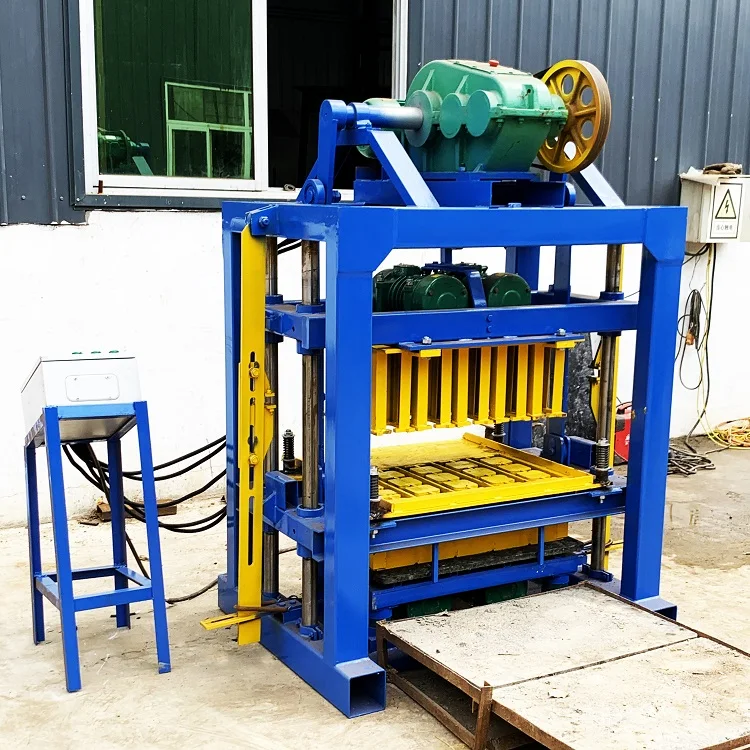
Matched Line Design — every upstream mixer, pallet return conveyor and curing rack is sized around the QTJ4-40 cycle time so the press never idles waiting for material or boards.
Technical Specifications
| Parameter | Value |
|---|---|
| Product Type | Semi-Automatic Concrete Block Making Machine |
| Model | QTJ4-40 |
| Main Vibration Form | Platform Vibration |
| Vibration Frequency | 2800 r/min |
| Pallet Size | 850 × 450 mm |
| Overall Dimensions (L × W × H) | 1350 × 1460 × 1800 mm |
| Machine Weight | 1 T |
| Factory Area Requirement | 200 m² |
| Worker Requirement | 1 – 3 people |
| Control System | Manual / Semi-automatic (top die push-pull with automatic scraper) |
| Raw Material | Concrete, cement, fly ash, crushed stone, sand, dust, gravel, slag |
| Applied Products | Hollow/solid blocks, pavers, interlocking blocks, curbstone, colored pavers |
| Voltage & Frequency | Configurable to destination market (basis to be confirmed before order) |
| Hydraulic Pressure | Available on request (basis to be confirmed with manufacturer) |
| Capacity (400 × 200 × 200 mm hollow block) | 360 pcs/h, 2880 pcs/day (4 moulds per cycle) |
| Capacity (400 × 150 × 200 mm hollow block) | 500 pcs/h, 4000 pcs/day (5 moulds per cycle) |
| Capacity (225 × 112.5 × 60 mm interlocking/paver) | 900 pcs/h, 7200 pcs/day (9 moulds per cycle) |
| General Capacity Claim | 2800 pcs/8 hours (basis not stated in source — confirm block format / material / thickness) |
Application Suitability
| Application | Material or Output |
|---|---|
| Small-to-medium hollow block plant | Cement, crushed stone, sand producing 400 × 200 × 200 mm hollow blocks |
| On-site contractor block production | Fly ash, gravel, slag mixed locally for solid and hollow walling blocks |
| Paver and interlocking brick line | Fine aggregate and cement for 225 × 112.5 × 60 mm paving units |
| First-time entrepreneur block plant | Low-capital entry into concrete masonry with 1 – 3 workers |
| Curbstone and colored paver run | Pigmented concrete mixes for municipal and landscaping formats |
Why the Press Alone Is Not the Production Line
A block press quotation without its surrounding stations is only half a machine.
Buyers regularly receive a press price and assume the rest of the line will sort itself out on site. What actually happens is the mixer finishes a batch while the QTJ4-40 is still mid-cycle, or the pallet return conveyor moves slower than the press ejects, and the whole stationary block machine production line stalls. I have watched a semi-automatic press sit idle for minutes at a time because nobody specified the pallet feeder to match its cycle, and the quoted daily output never materialized. [NEED_CITE: common causes of block line throughput shortfalls]
How Pallet Circulation Sets the Real Tempo
The QTJ4-40 runs on 850 × 450 mm pallets, and every pallet must travel from the press through the curing area and back. If the return conveyor is undersized, the press operator starts stacking wet blocks by hand just to keep the machine running, which defeats the purpose of a stationary block machine production line. We size the pallet return loop — including rack spacing, conveyor speed and forklift turnaround — against the actual cycle time of the format the buyer runs most.
Matching the Mixer Batch to the Press Appetite
The raw material ratio sits around cement 8 – 10 %, sand 30 – 40 %, stone 50 – 60 %. A pan mixer that delivers one batch every several minutes may leave the QTJ4-40 starved during the heavier hollow-block cycles, while a continuous mixer running flat-out wastes material during a mould change. We calculate the batch volume per cycle for each block format and select the mixer capacity and discharge speed so the press hopper never drops below the fill line. [NEED_CITE: mixer-to-press batch synchronization in block plants]
Reading the Specs That Actually Matter
The platform vibration at 2800 r/min works in tandem with hydraulic pressure to compact the concrete mix into the mould. Higher vibration frequency alone does not guarantee denser blocks — the pressure must match the buyer’s local aggregate gradation and moisture content, otherwise hollow blocks crack at the webs or pavers delaminate under traffic load. The 850 × 450 mm pallet dimension dictates the curing rack slot width; order racks built for a different pallet and the boards will not seat, forcing a costly re-rack before production starts. The semi-automatic top die push-pull mechanism with automatic scraper keeps the labour count at 1 – 3 workers, but only if the upstream feeder and downstream stacker are configured to the same semi-automatic level — mixing a fully automatic stacker onto a semi-auto press creates a control mismatch that stalls the line.
When the Surrounding Stations Are an Afterthought
Specifying the press without locking pallet material and thickness against the curing environment leads to warped boards that jam the return conveyor within weeks. Skipping voltage and frequency confirmation before production means the control panel arrives incompatible with the local grid, delaying commissioning by weeks while a transformer is sourced locally. Leaving the mould change procedure undefined turns a format switch into a shift-long exercise, and the buyer who paid for paver and hollow-block flexibility ends up running only one format. [NEED_CITE: impact of pallet material selection on block curing consistency]
What a Matched Line Looks Like in Practice
We treat the QTJ4-40 as one node in a stationary block machine production line rather than a stand-alone catalogue item, so the mixer, pallet feeder, curing rack and stacking station are quoted as one matched set. Every capacity figure is stated per block format — hollow, paver or interlocking — with the mould count per cycle shown, not a single headline number. Pallet size, rack dimensions and forklift fork width are confirmed against the buyer’s existing curing area before the order is placed. Moulds are designed for the formats the buyer’s market actually sells, including custom drawings where standard formats do not fit. Installation support covers the full line, not just the press, so cycle times across stations are verified on site before handover.
Documentation & Verification
- Line layout drawing showing QTJ4-40 position relative to mixer, pallet return and curing racks
- Capacity calculation sheet listing output per block format with mould count and cycle time
- Pallet specification confirming 850 × 450 mm dimensions, material and weight against rack slot width
- Voltage, frequency and control language confirmation signed off before production begins
- Factory test record documenting cycle time for each block format run during inspection
- Hydraulic and electrical schematic with component list for local maintenance sourcing
Installation, Commissioning & Support
- Foundation pad leveled to the 1350 × 1460 mm footprint with anchor bolt template provided
- Dedicated electrical circuit matched to confirmed voltage and frequency, separate from mixer supply
- Press shipped partially assembled; vibration platform and top die frame bolted on site
- First-run cycle time verified against each block format before operator handover
- On-site training covers mould change sequence, scraper adjustment and daily greasing points
- Wear parts list identifies vibration springs, scraper blades and hydraulic seals by part number
Before You Send an Inquiry
Tell us which block format you plan to run most days, the daily volume you need, and the raw materials available locally — especially aggregate type and maximum particle size. Share your existing curing area dimensions and the forklift model on site so we can match the 850 × 450 mm pallet and rack design to what you already have. Confirm the local voltage and frequency so the control panel is built correctly from the start.
Frequently Asked Questions
Q: How do I verify real daily output when capacity is quoted per block format?
A: Ask the supplier for a capacity table that lists each block format — hollow, paver, interlocking — alongside the mould count per cycle and the measured cycle time. A single headline figure like "2800 pieces per 8 hours" without a format reference does not tell you what to expect for the product you actually sell.
Q: Which supporting stations must match the QTJ4-40 cycle time?
A: The mixer batch discharge, pallet return conveyor and any stacking station all need to complete their tasks within the press cycle for the chosen block format. If any station is slower, the press idles and real output drops below the quoted figure.
Q: How do I confirm pallet size and material against my curing setup?
A: Measure your curing rack slot width and your forklift fork dimensions, then compare them to the 850 × 450 mm pallet specification. Pallet material — timber, bamboo or composite — must also suit your local humidity and curing duration to avoid warping.
Q: What floor space do I need beyond the stated 200 m² factory area?
A: The 200 m² covers the press, mixer, pallet circulation and basic curing racks. Add space for raw material storage, finished block staging and forklift travel lanes. A detailed line layout drawing from the supplier shows every station footprint before you commit.
Q: How is raw material feeding configured to match the press output tier?
A: The batching system — whether a simple volumetric hopper or a weighed belt feeder — is sized to deliver one full mixer batch within the QTJ4-40 cycle time for your primary block format, preventing material starvation during continuous runs.


