
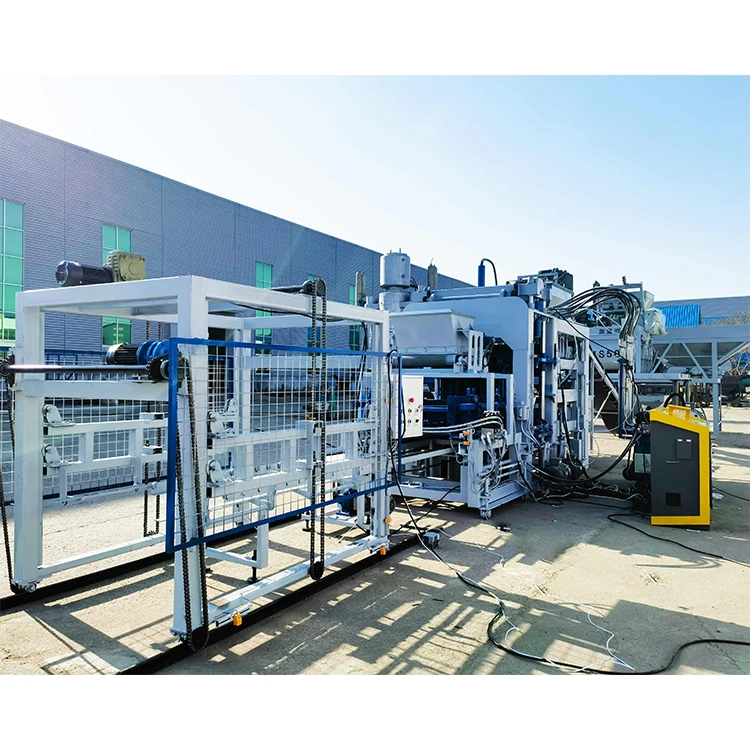
Matched System Engineering — the QT8-15 press is specified alongside its feeding, mixing, pallet circulation, and stacking stations so that cycle times align and the main press never sits idle waiting on upstream or downstream equipment.
Technical Specifications
| Parameter | Value |
|---|---|
| Model | QT8-15 |
| Product Type | Automatic Hydraulic Concrete Block Making Machine |
| Overall Dimension | 8300 × 1860 × 3000 mm |
| Rated Pressure | 21 MPa |
| Main Vibration Form | Platform Vibration |
| Vibration Frequency | 2800–4500 r/min |
| Vibration Force | 60 kN |
| Pallet Size | 950 × 900 mm |
| Molding Cycle | 15–25 s (basis not stated in source — confirm block format / material / thickness) |
| Overall Power | 55.5 kW (rated or peak not specified) |
| Total Mass | 9 T |
| Demolding Method | Hydraulic |
| General Water Consumption | 12 T/Day |
| Factory Area | 600 m² |
| Control System | PLC with human-machine interface dialogue system |
| Feeding System | Semi-closed screen reticular rotational forced feeding unit |
| Vibration Source | Double vibration sources with frequency conversion and braking |
Application Suitability
| Application | Material or Output |
|---|---|
| Hollow block production plants | Crushed stone, sand, cement, fly ash |
| Solid block manufacturing | Gravel, slag, cement blends |
| Paver and interlocking brick lines | Colored concrete mixes, fine aggregate |
| Kerbstone and curb production | Coarse aggregate with cement binder |
| On-site housing project block output | Local sand, dust, and cement |
What a "15–25 Second Cycle" Hides About Your Daily Output
A cycle time means nothing unless every station in the automatic concrete block making machine production line can keep pace with it.
I once watched a mid-range block press sit idle for forty seconds each cycle because the mixer discharge could not match the press demand. The operator stood there watching the hopper, waiting for enough material to fill the mould. Multiply that by several hundred cycles and the daily shortfall is enormous. With the QT8-15, the 15–25 second molding cycle only delivers real throughput when raw material feeding, pallet circulation, and wet-side stacking are all timed to the same beat [NEED_CITE: synchronization standards in concrete block production lines]. Buyers who evaluate the press in isolation often discover the bottleneck has simply moved to the next station down the line.
How Raw Material Feeding Meets the Press Cycle
The semi-closed screen reticular rotational forced feeding unit on the QT8-15 is designed to push material into the mould box with consistent density across the full 950 × 900 mm pallet area. In a complete automatic concrete block making machine production line, the feeder must refill and distribute within the same window the press uses for vibration and hydraulic demolding. If your mixer feeds the hopper in surges rather than a steady flow, the forced feeder still runs but the material bed becomes uneven, causing density variation from one cycle to the next. Matching mixer discharge rate to feeder intake is the first synchronization checkpoint.
Pallet Circulation and the Downstream Handoff
Each pressed block leaves the QT8-15 on a 950 × 900 mm pallet, and that pallet must be stripped, returned, and re-fed before the next cycle begins. The pallet return loop needs to move at least as fast as the press cycles, which means conveyor speed, pallet buffer capacity, and the stacker’s retrieval rate all have to be calculated against the shortest realistic molding cycle. When pallet handling is underspecified, the press pauses while a pallet is fetched manually — a pattern I have seen repeated on lines where only the press was upgraded [NEED_CITE: pallet circulation design for stationary block plants]. The automatic concrete block making machine production line only earns its name when pallet flow is uninterrupted.
Reading the Vibration and Pressure Specs for Line Design
The QT8-15 delivers 60 kN of vibration force through platform vibration at 2800–4500 r/min, paired with 21 MPa rated hydraulic pressure. For the surrounding line, this matters because higher vibration force demands a rigid pallet that transmits energy rather than absorbing it — flimsy pallets dampen the signal and produce weak blocks. The double vibration sources with frequency conversion and braking mean the press can adjust intensity per format, but only if the pallet material and curing rack spacing are chosen to match. A mismatched pallet spec sends ripple effects through the stacking station and the forklift schedule in the curing yard.
The Cost of Leaving Supporting Stations to Chance
When pallet feeding, stacking, and curing rack handling are excluded from the line quotation, the buyer fills those gaps with manual labor — and the daily output drops well below what the press can produce. I have seen operators stacking wet blocks by hand at the end of a shift because no automatic stacker was specified, turning a high-cycle press into a low-output bottleneck [NEED_CITE: hidden costs of incomplete block line quotations]. The QT8-15’s PLC dialogue system can coordinate signals across stations, but only if those stations exist in the layout. A line missing even one automated link forces the entire production rhythm to slow down to the pace of the slowest manual step.
Why Sourcing the Full Line from One Specification Point Matters
Block machinery as a single focus means the QT8-15 is not treated as a standalone press but as the center of a matched system. Configuration is set against the buyer’s actual mix design and local aggregate, so the feeding unit and mixer are sized to deliver the correct material at the correct rate. Pallet size is confirmed against the buyer’s curing area and existing forklift before production starts. The PLC control language, voltage, and frequency are locked down so commissioning proceeds without electrical surprises. Mould design covers the formats the buyer’s market actually sells, and the automation level can be set semi-automatic now with a defined upgrade path later.
Documentation & Verification
- Line layout showing every station from material infeed to cured block output
- Capacity calculation stating which block format each output figure assumes
- Pallet specification matched to curing rack dimensions and forklift capacity
- Hydraulic and electrical schematic for post-commissioning maintenance reference
- Factory test record on buyer’s target block format before dispatch
- Voltage, frequency, and PLC display language confirmation sheet
Installation, Commissioning & Support
- Foundation pad sized to 8300 × 1860 mm footprint with vibration isolation
- Dedicated 55.5 kW circuit with confirmed voltage and frequency before wiring
- Machine arrives in dismantled state; reassembly covers press, feeder, and pallet loop
- First-run parameter setting for vibration frequency and hydraulic pressure per block format
- Operator training on PLC dialogue system including fault signal interpretation
- Wear parts list covering hydraulic seals and vibration motor bearings
Preparing Your Line Inquiry
To size the supporting stations around the QT8-15, share your target block format with dimensions, your daily output requirement, and the local aggregate you plan to use. Confirm your workshop dimensions including ceiling height for the stacking station, and specify the voltage and frequency at your site. If you have existing mixers, conveyors, or curing racks that the new line must connect to, include their specifications so the pallet loop and feeder can be matched.
Frequently Asked Questions
Q: How is line cycle time synchronized across feeding, pressing, pallet transfer, and stacking stations?
A: Each station’s cycle is calculated against the QT8-15’s shortest molding cycle for your target block format. The PLC dialogue system exchanges timing signals so the feeder discharges, the press vibrates, and the pallet conveyor advances in a coordinated sequence. If any station runs slower, the entire line defaults to that pace.
Q: What pallet size and material are specified, and how does that match my curing area and forklift?
A: The standard pallet is 950 × 900 mm. Material choice — wood, bamboo, or composite — depends on vibration transmission requirements and your forklift’s load rating. Pallet dimensions must align with curing rack slot width and the spacing of your curing yard to avoid manual rehandling.
Q: Which stations are included in the quotation for a complete line?
A: A full quotation covers raw material feeding, mixing, the QT8-15 press, pallet feeder, wet-side stacker, and curing rack handling. Each station is listed separately so you can see exactly what is included. Stations you already own can be removed, and the remaining equipment is re-priced.
Q: Can the line be configured in stages, starting semi-automatic and adding automation later?
A: Yes. The QT8-15’s PLC system supports a semi-automatic start with manual pallet handling, and the upgrade path to automatic stacking and cubing is defined at the design stage. Connection points and signal interfaces for future stations are installed during initial commissioning so the expansion does not require rewiring the press.


