
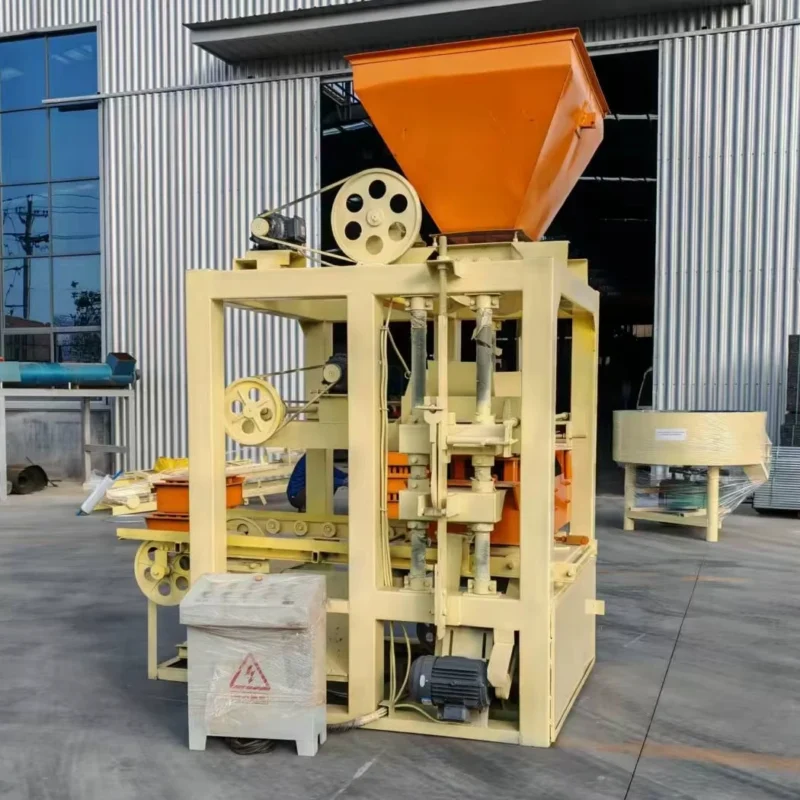
Integrated Line Rhythm — The QTJ4-24 is specified alongside its mixer, pallet return, and curing rack so every station matches the 24–26 s press cycle instead of leaving the host waiting for material.
Technical Specifications
| Parameter | Value |
|---|---|
| Model | QTJ4-24 |
| Product Type | Semi-Automatic Cement Block Making Machine |
| Overall Dimensions (L×W×H) | 3600×1700×2560 mm |
| Pallet Size | 850×450 mm |
| Molding Cycle | 24–26 s (basis to be confirmed per block format) |
| Overall Power | 11.95 kW |
| Vibration Force | 45 kN |
| Vibration Configuration | 2×3 kW lower vibrators + 2×1.5 kW upper vibrators |
| Total Mass | 2 T |
| Molding Method | Mechanical |
| Material Distribution | Full-automatic spiral |
| Reducer for Mold Lifting | 350-type |
| Control System | PLC controlled |
| Automation Level | Semi-automatic |
| Raw Materials | Cement, sand, stone |
| Mould Format | Hollow block, solid block, interlocking brick, paving brick |
Application Suitability
| Application | Material or Output |
|---|---|
| Hollow block production for load-bearing walls | Crushed stone, cement, sand |
| Solid block manufacturing for partition walls | Dense aggregate mix, cement |
| Interlocking brick production for paving | Fine sand, cement, pigment |
| Paving brick output for driveways and walkways | Stone dust, cement, coarse sand |
Why the Mixer Capacity Must Match the Press Cycle
A block production line is only as fast as its slowest station upstream of the press.
I once watched a contractor in Amman lose over two thousand blocks in a single shift because his self-sourced mixer could not deliver a fresh batch within the 24–26 s molding window of the press. The host sat idle while the belt waited for material, and no amount of operator urgency could close the gap. When buyers evaluate block production line equipment, the press cycle is the fixed anchor — every feeder, mixer, and conveyor must be sized to that rhythm or the quoted output becomes fiction [NEED_CITE: typical mixer-to-press throughput matching principles].
Matching Upstream Feed to the Spiral Distributor
The QTJ4-24 uses a full-automatic spiral material distribution system that draws a measured volume into the mold box each cycle. This means the upstream mixer and belt conveyor must deliver a consistent, uninterrupted flow of prepared mix. If the mixer discharges in large intermittent batches rather than a steady trickle, the spiral runs partially empty on some cycles, producing under-filled molds and weaker blocks. Sizing the mixer to the press throughput — not to a theoretical peak — is the difference between a line that runs smoothly and one that constantly starves.
Pallet Circulation as the Bottleneck No One Quotes
With an 850×450 mm pallet and a 24–26 s cycle, the press ejects a loaded pallet roughly every half minute. In a semi-automatic setup, operators manually move pallets to the curing area, but the return loop must still keep empty pallets arriving at the press without delay. If the curing rack layout or pallet stack height forces the forklift to make longer trips, the press waits. Block making machine supporting equipment must include a clear pallet return plan — whether gravity roller, manual cart, or powered conveyor — matched to the actual curing distance and the forklift the buyer already owns [NEED_CITE: pallet handling best practices in semi-automatic block plants].
Reading the Specs That Determine Line Balance
The 45 kN vibration force is generated by a dual-level configuration: two 3 kW lower vibrators compact the mix from below while two 1.5 kW upper vibrators settle the surface. This arrangement matters because it dictates the mix stiffness the press can handle — a drier mix needs more force to consolidate, while a wetter mix risks slumping on demolding. The mechanical molding method with a 350-type reducer for mold lifting provides a fixed stroke rhythm that does not fluctuate with hydraulic oil temperature, making cycle times more predictable across a hot day. At 11.95 kW overall power, the electrical supply must account for motor starting current across the entire line, not just the press alone, to avoid breaker trips during simultaneous mixer and vibrator startup.
What Happens When Supporting Stations Are Undersized
A buyer who sources the cheapest available mixer and pallet feeder often discovers that the press spends a third of each shift idling. The daily block count falls well below expectations, yet every machine is technically running. The real cost is not the equipment itself but the lost production hours and the operator wages paid while the line waits. Correcting this after installation means replacing or adding equipment in a space that was not designed for it [NEED_CITE: hidden costs of mismatched block line stations].
Why the Line Comes from One Source
The QTJ4-24 is specified as the center of a complete semi-automatic line rather than a standalone press. Mixer capacity, belt speed, pallet return path, and curing rack spacing are all calculated against the 24–26 s cycle before the quotation is issued. The pallet size of 850×450 mm is confirmed against the buyer’s existing forklift fork width and curing yard dimensions so nothing arrives incompatible. Voltage, frequency, and PLC display language are locked in before production starts, preventing commissioning delays when the container arrives on site.
Documentation & Verification
- Line layout drawing showing each station’s position and throughput matched to the 24–26 s cycle
- Machine specification sheet with confirmed voltage, frequency, and PLC language
- Pallet specification detailing material, dimensions, and load rating for curing rack design
- Electrical schematic for the 11.95 kW system so site electricians can prepare connections
- Factory test record on the buyer’s selected block format before dispatch
Installation, Commissioning & Support
- Foundation plan sized to the 3600×1700 mm footprint and 2 T operating mass
- Dedicated circuit planned for 11.95 kW total draw plus mixer starting current
- Assembly sequence covering press erection, vibrator wiring, and spiral feeder alignment
- First-run parameter setting for vibration duration and mold lift speed on the chosen format
- Operator training on pallet loading rhythm and mold change procedure
- Wear parts list for vibrators, spiral flights, and mold liners with reorder references
Preparing Your Inquiry
To size the supporting equipment around the QTJ4-24, share the block format you plan to produce most, your target daily output, and the raw materials available locally. Confirm your site voltage and frequency, the language your operators read, and the dimensions of your planned curing area. If you already have a mixer or forklift on site, include those details so the line layout accounts for existing assets rather than duplicating them.
Frequently Asked Questions
Q: How do I verify the real daily output of the QTJ4-24 in a full line?
A: Output depends on the specific block format, mix design, and how well upstream stations keep pace with the 24–26 s cycle. Request a capacity calculation that states the assumed block dimensions and the throughput required from each supporting station. This gives you a realistic daily figure rather than a theoretical press-only maximum.
Q: What supporting equipment must match the press cycle to avoid bottlenecks?
A: The mixer discharge rate, belt conveyor speed, and pallet return loop must each deliver within the 24–26 s window. If any station is slower, the press idles. The line quotation should specify each station’s capacity relative to the press cycle so no single point constrains output.
Q: How does the 850×450 mm pallet size affect my curing setup?
A: Curing rack shelf spacing, rack depth, and forklift fork width must all accommodate this pallet dimension. Confirm your existing forklift and yard layout before ordering so the pallet return and stacking flow are not disrupted by equipment that cannot handle the size.
Q: What electrical details should I confirm before shipment?
A: Voltage, frequency, and PLC display language must be agreed before production begins. Share your site supply specs and operator language preference early so the control panel and motor ratings are correct on arrival, avoiding rewiring or replacement delays.
Q: What is included in the line quotation versus what I supply locally?
A: The quotation covers the press, specified supporting equipment, and documentation. The buyer typically provides the foundation, utility connections, curing area, and any locally sourced material handling tools. A clear scope list in the proposal prevents gaps between what arrives and what the site needs.


