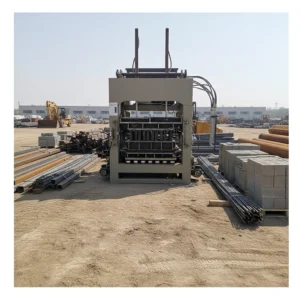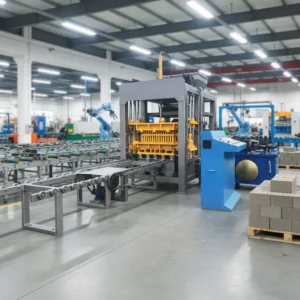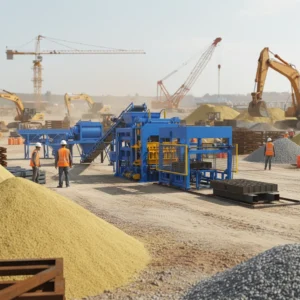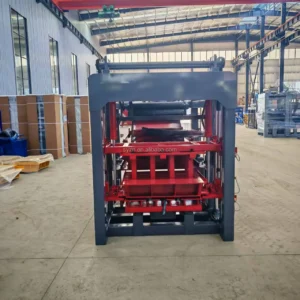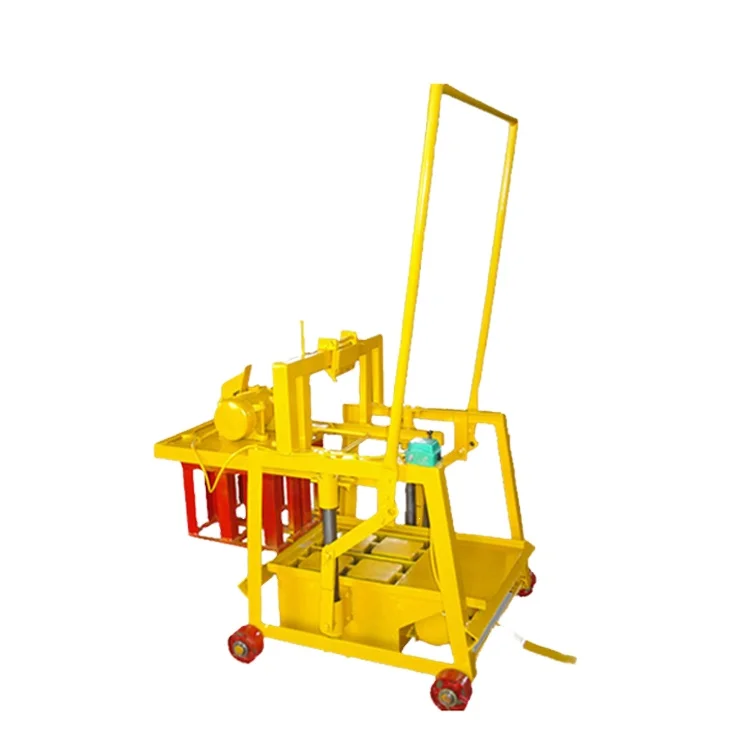
Integrated Line Matching — every station around the QMJ2-45 mobile brick making machine is sized so the 45-second press cycle is never starved for mix or blocked by a full curing floor.
Technical Specifications
| Parameter | Value |
|---|---|
| Product Type | Mobile Brick Making Machine |
| Model | QMJ2-45 |
| Rated Power | 1.5 kW |
| Voltage & Frequency | According to buyer’s local voltage (confirm voltage and frequency before order) |
| Control System | Semi-automatic, electricity-powered |
| Overall Dimensions (L×W×H) | 920 × 800 × 1258 mm |
| Net Weight | 150 kg |
| Mould Format | 300 × 150 × 100 mm (basis for stated capacity) |
| Pcs per Mould | 2 |
| Cycle Time | 45 s |
| Output Capacity | 160 pcs/h, 1280 pcs/8h (based on 300×150×100 mm solid block format) |
| Raw Material | Concrete, sand, cement |
| Exciting Power | 2 vibrators per mould |
| Vibration Type | Bed mould vertical vibration + upper mould compression vibration |
| Automation Level | Semi-automatic (mobile / egg-laying type) |
| Assembly State | Shipped as single mobile unit |
Application Suitability
| Application | Material or Output |
|---|---|
| On-site housing project production | Hollow and solid blocks from crushed stone, sand, and cement |
| Startup block operation | Standard masonry blocks with low initial capital |
| Satellite production for existing plants | Remote or temporary site blocks without a fixed plant build |
| Small contractor self-supply | Daily walling blocks using locally sourced aggregate |
What a "45-Second Cycle" Hides About Your Daily Output
A mobile brick making machine production line only reaches its stated capacity when the mixer, curing area, and material feed keep the same pace as the press itself.
Many buyers discover on the first production day that the quoted cycle time is technically accurate but practically unreachable. The press finishes a moulding cycle, then sits idle waiting for the pan mixer to discharge the next batch, or the operator runs out of flat ground to lay fresh blocks on. The mobile block machine supporting equipment surrounding the QMJ2-45 — the mixer throughput, the wheelbarrow route, the curing floor area — is where the real daily volume is won or lost [NEED_CITE: mobile block machine daily output vs mixer capacity studies]. Planning those stations before the press arrives prevents the most common on-site bottleneck.
Mixing Station Sizing Around the Press
The QMJ2-45 demands a fresh batch every 45 seconds, which translates to a mixer discharge rhythm that must never lag behind the press. A pan mixer or drum mixer rated below the hourly material consumption will force the operator to pause the mobile brick making machine production line between cycles. Matching mixer drum volume to the block format and mould cavity count removes that dead time and keeps the egg-laying rhythm unbroken.
Curing Floor Planning for Egg-Laying Output
An egg-laying machine leaves every block directly on the ground, so the curing floor must be wide enough to hold a full day’s production and allow walking space for the operator to move the press forward. For the QMJ2-45, a flat concrete slab long enough to accommodate the stated daily output per shift, plus aisles for manual turning and later dispatch, prevents the operator from stacking blocks too close and damaging green edges.
Electrical Supply at Remote Sites
With a total rated power of 1.5 kW and two mould vibrators, the QMJ2-45 places a modest load on site electricity, but voltage stability at remote construction sites is often poor. Confirming the exact voltage and frequency with the supplier before the machine is wired ensures the motor windings match the local grid and avoids rewinding delays after arrival [NEED_CITE: voltage mismatch damage in small construction motors]. A dedicated circuit with proper grounding keeps the semi-automatic control functioning through the shift.
When the Supporting Equipment Is Undersized
Buyers who pair the QMJ2-45 with an underpowered mixer or skip the curing area survey often find that the actual daily output is a fraction of the quoted figure. The press itself is capable, but every idle minute waiting for mix or floor space compounds across an eight-hour shift. Sizing the mobile block machine supporting equipment to the press cycle, rather than to catalogue defaults, is the difference between a profitable first month and a prolonged ramp-up [NEED_CITE: block plant commissioning delays from mismatched equipment].
Why Source the Complete Line from One Supplier
Block machinery as a single focus means the QMJ2-45, its mixer, pallet alternatives, and curing handling are specified as one matched system rather than assembled from separate vendors. The configuration is set against the buyer’s actual mix design, local aggregate, and target block format, not a catalogue default. Mould design covers the formats the buyer’s market actually sells, with custom drawings available. The automation level is selectable so a contractor can start mobile and upgrade to stationary later. Installation support includes operator training on the exact line layout provided.
Documentation & Verification
- Line layout drawing showing mixer placement, material feed route, and curing area sized to QMJ2-45 daily output
- Machine specification sheet confirming rated power, vibration type, and mould format used for capacity calculation
- Voltage and frequency confirmation document signed before production begins
- Factory test record on the buyer’s specified block format and mix design
- Operation and maintenance manual covering daily greasing points and vibrator inspection intervals
Installation, Commissioning & Support
- Flat concrete curing slab prepared to the dimensions stated in the line layout before machine arrival
- Single-phase or three-phase power drop matching the confirmed voltage and frequency, with dedicated 1.5 kW circuit
- Machine shipped as one mobile unit, requiring only vibration motor wiring and control box connection on site
- First-run commissioning with mix trial on buyer’s local aggregate to verify block density and cycle rhythm
- Operator training on mould change procedure, vibrator maintenance, and daily production record keeping
- Wear parts list supplied with the machine, covering vibrator bushes and mould liner plates
Preparing Your Line Inquiry
To size the supporting equipment accurately around the QMJ2-45, share the block formats your market sells, the daily volume you need to hit, and the aggregate available near your site. Include your local voltage, frequency, and the dimensions of the curing area you can prepare. If you already own a mixer or material handling equipment, list its model and rated output so the line proposal matches what is already on the ground.
Frequently Asked Questions
Q: How is the 1,280 pcs/day capacity calculated, and what block format does it assume?
A: The figure is based on the 300×150×100 mm solid block format, with two blocks per mould and a 45-second cycle, running continuously for eight hours. A different block format changes the pieces-per-mould count and may extend the cycle, so the actual daily output must be recalculated for your specific product.
Q: What mixer capacity and feed rate are needed so the QMJ2-45 is not starved between cycles?
A: The mixer must discharge a batch within the 45-second press cycle to avoid idle time. We calculate the required drum volume from your block format and mix design, then recommend a mixer model whose throughput keeps the press running without material gaps.
Q: How do I confirm voltage, frequency, and control display language for my site before shipment?
A: We provide a written voltage and control confirmation document that records your site’s electrical supply and preferred language. This is signed off before the machine enters production, ensuring the motor windings and control labels match your local requirements on arrival.
Q: What curing area and pallet arrangement does a mobile egg-laying machine require?
A: The QMJ2-45 lays blocks directly on the ground, so no pallets are needed. The curing floor must be flat, concrete, and large enough to hold a full shift’s output plus walking aisles. We include the required floor dimensions in the line layout drawing.
Q: How does the QMJ2-45 connect to upstream mixing and downstream curing in a complete block line?
A: The line layout specifies the mixer position, material feed route, and curing area relative to the press travel path. Each station is timed so the mixer discharges on the press rhythm and the operator can move the unit forward without stepping on green blocks.