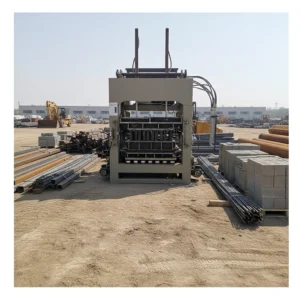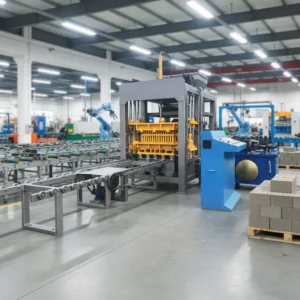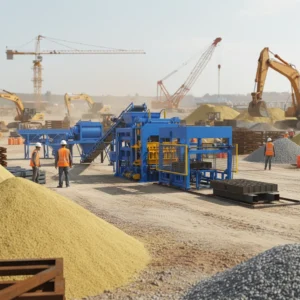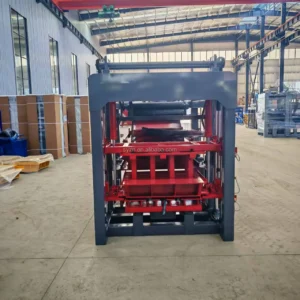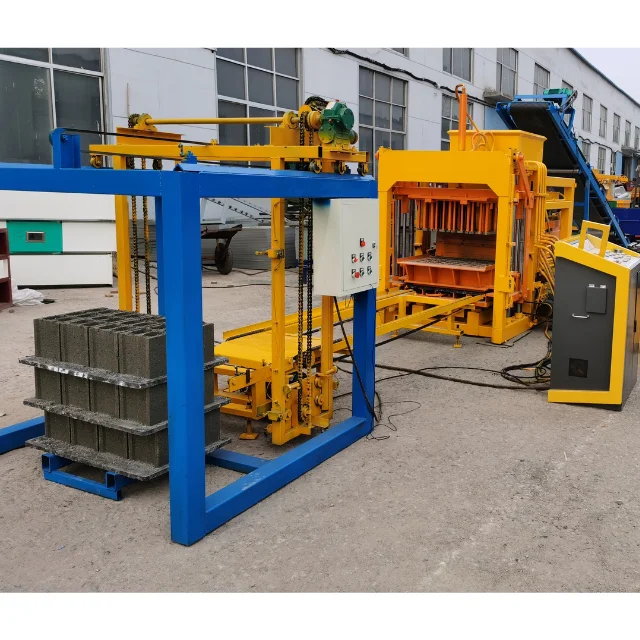
Matched Line Coordination — every station from raw material feeding through stacking is sized against the QT4-15A press cycle so the host machine is never left waiting for upstream or downstream equipment.
Technical Specifications
| Parameter | Value |
|---|---|
| Model | QT4-15A |
| Product Type | Hydraulic Block Making Machine |
| Overall Dimensions (L×W×H) | 4100 × 1600 × 2600 mm |
| Rated Pressure | 16 – 21 MPa |
| Main Vibration Form | Platform Vibration |
| Vibration Frequency | 4200 r/min |
| Vibration Force | 55 kN |
| Pallet Size | 880 × 550 mm |
| Molding Cycle | 25 – 30 s (basis not stated in source — confirm block format, material and thickness) |
| Overall Power | 18.45 kW (source value — verify against final motor schedule) |
| Total Mass | 4 T |
| Demolding Method | Hydraulic |
| Recommended Factory Area | 300 m² |
| Control System | Configurable (PLC or relay logic to buyer specification) |
| Voltage & Frequency | Configurable to buyer’s site supply |
| Warranty | 1 year |
Application Suitability
| Application | Material or Output |
|---|---|
| Hollow block production for load-bearing walls | Crushed stone, sand, cement, fly ash |
| Solid block production for partition and foundation work | Gravel, sand, cement blends |
| Paving block and colored paver runs | Fine aggregate with pigment dosing |
| Interlocking brick for retaining and landscape structures | Crushed stone and cement at low water-cement ratio |
| Kerbstone and curb units for road infrastructure | Coarse gravel with high-pressure hydraulic compaction |
| Porous and permeable block for drainage applications | Single-size aggregate with controlled cement paste |
Why the Surrounding Line Decides Real Daily Output
A press that waits for pallets or mixer batches never reaches its rated cycle, no matter what the nameplate says.
I spent years on the test floor watching machines perform perfectly in isolation, only to see them stall once bolted down on a real site. One customer ordered a standalone QT4-15A without specifying the block production line equipment around it. When the mixer could not discharge fast enough and the pallet feeder jammed on warped boards, the press sat idle for seconds that added up to thousands of missing blocks every shift. That mismatch is the single biggest reason buyers feel cheated by capacity figures [NEED_CITE: common causes of output shortfall in small block plants]. Getting the block machine supporting equipment right from day one is what separates a quoted number from a bankable daily total.
Upstream Stations That Must Keep Pace
The QT4-15A completes a mold cycle in roughly 25 to 30 seconds, so the mixer must deliver a fresh batch within that same window. If the pan mixer is undersized or the conveyor belt runs too slow, the press pauses and the whole block production line equipment train loses rhythm. We calculate the mixer batch weight against the block format the buyer actually sells, then size the conveyor width and speed to refill the hopper before the next vibration cycle starts.
Downstream Handling That Prevents a Pallet Traffic Jam
Once the press demolds, the wet block sits on an 880 × 550 mm pallet that must travel to the curing area without delay. A manual cart system works for low volume, but as soon as daily targets climb, an automatic stacker and rack shuttle become necessary. Specifying the block machine supporting equipment at the quotation stage means the buyer receives a coordinated layout rather than a press surrounded by improvised trolleys [NEED_CITE: pallet handling bottlenecks in semi-automatic block lines].
Reading the Specs That Matter on Site
Rated pressure of 16 to 21 MPa works with the 55 kN platform vibration to compact the mix. Higher pressure alone will not produce strong blocks if the vibration frequency is wrong for the aggregate gradation. The 4200 r/min vibration must be matched to the buyer’s local crushed stone size; otherwise the mold fills unevenly and corners stay soft. Pallet size 880 × 550 mm must align with existing curing racks and forklift tine spacing, or the buyer faces unbudgeted rack replacement. Overall power of 18.45 kW means the site needs a dedicated breaker and stable supply; voltage fluctuation beyond the motor tolerance will trip the contactor and halt the line mid-cycle.
The Cost of Skipping Line Coordination
Buyers who treat the press as a standalone purchase often discover the real expense after arrival. A mixer that cannot keep up forces the operator to run shorter batches, cutting output and raising cement waste per block. Pallets ordered separately may arrive in a different thickness, jamming the feeder rails. Voltage mismatch discovered at commissioning delays production for weeks while transformers are sourced locally [NEED_CITE: export machinery voltage mismatch incidents]. These are not equipment failures; they are specification gaps that a coordinated block production line equipment quotation would have closed before the deposit was paid.
Why Procurement Through a Line-Focused Supplier Works
We configure the QT4-15A inside a full station map, so every belt speed, hopper gate and stacker lift is validated against the press cycle before steel is cut. Mould design starts from the block format the buyer’s market actually buys, not a catalogue default, and custom drawings are produced when local dimensions differ. Automation level is selectable; a buyer can launch with manual pallet return and add an automatic stacker later without replacing the press. Factory testing runs the press together with its feeder and stacker so timing issues surface before shipping. Operator training covers the entire sequence, not just the press panel, reducing the learning curve once the line is live.
Documentation & Verification
- Line layout drawing showing each station footprint and pallet travel path for the QT4-15A
- Capacity calculation sheet stating the exact block format and mix assumed for the 25–30 s cycle
- Pallet specification confirming 880 × 550 mm size, material grade and load rating
- Hydraulic and electrical schematics with confirmed voltage, frequency and wire colors
- Factory test record with press and handling stations running together as one system
- Operation and maintenance manual in the buyer’s requested control language
Installation, Commissioning & Support
- Foundation pad sized for 4100 × 1600 mm footprint with anchor bolt template supplied before pour
- Dedicated 18.45 kW circuit with isolator and phase-monitor relay to protect the main motor
- Press arrives in two main assemblies; re-alignment of vibration table checked on site
- First-run parameter setting includes vibration duration and hydraulic pressure matched to buyer’s mix
- Operator training covers mixer batching, pallet feeding and stacker cycle, not only the press screen
- Wear parts list identifies mold liners, vibration springs and hydraulic seals with reorder codes
What to Include in Your Inquiry
Tell us the block format and dimensions you sell most, the daily output target, and the raw materials available locally so we can size the mixer and confirm the vibration setting. Share your existing curing rack dimensions and forklift capacity so the 880 × 550 mm pallet choice is validated, and confirm site voltage, frequency and preferred control language to avoid commissioning delays.
Frequently Asked Questions
Q: How is the 25–30 s molding cycle verified, and for which block format does it apply?
A: That figure is a general range recorded during factory testing. The actual cycle depends on block height, wall thickness, mix moisture and vibration amplitude. We run a sample mold with your target format and confirm a realistic cycle time before the line is finalized.
Q: Which upstream and downstream stations must match the press pace?
A: The mixer must discharge a full batch within one mold cycle, the pallet feeder must index in time, and the stacker or rack shuttle must clear the delivery station before the next pallet arrives. Any slow station forces the press to idle and cuts daily output.
Q: Is the 880 × 550 mm pallet compatible with my existing curing racks and forklift?
A: We check your rack slot width and forklift tine spacing before confirming pallet size. If your current racks are narrower or your forklift uses a different pallet footprint, we adjust the pallet spec or propose rack modifications so the line works end to end.
Q: What voltage, frequency and control language must be confirmed before production?
A: We need your site supply voltage, phase and frequency, plus the language for the PLC display and manual. Confirming these before steel cutting avoids rewiring and reprogramming delays once the block production line equipment arrives on site.
Q: Can the line start semi-automatic and add stacking later?
A: Yes. The QT4-15A can run with manual pallet return at the beginning. When volume grows, an automatic stacker and cubing station can be inserted into the existing layout without replacing the press or altering the foundation.