
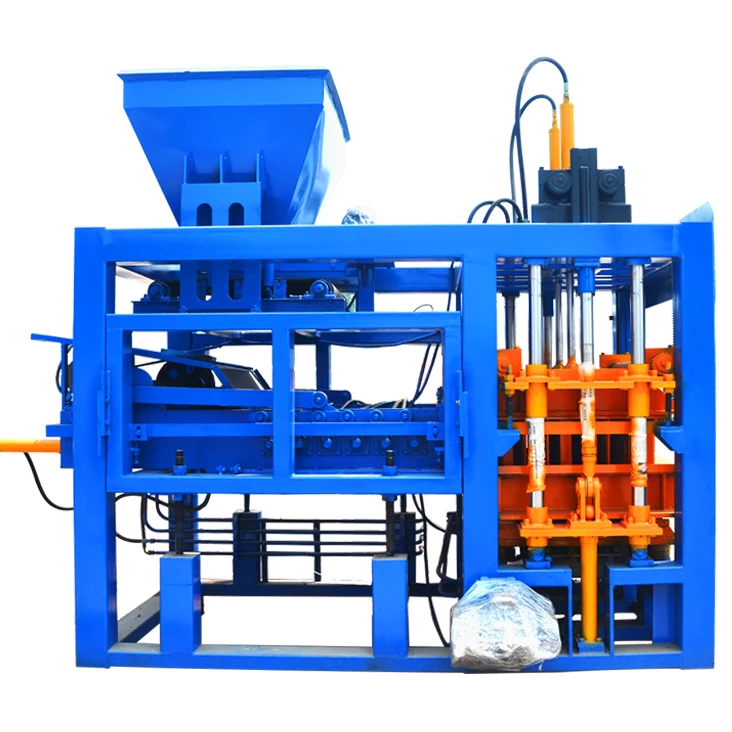
Matched Line Engineering — Every station from raw material feed to stacking is specified against the QT8-15 press cycle so the 15–25 s molding window is never wasted by upstream or downstream delays.
Technical Specifications
| Parameter | Value |
|---|---|
| Model | QT8-15 |
| Product Type | Automatic Stationary Concrete Block Making Machine |
| Overall Dimensions | 8400 × 1700 × 2950 mm |
| Overall Power | 37 kW |
| Molding Cycle | 15–25 s (basis to be confirmed — depends on block format, material and thickness) |
| Vibration Frequency | 2800–4500 r/min |
| Main Vibration Form | Platform Vibration |
| Net Weight | 10,000 kg |
| Pallet Size | 950 × 900 mm |
| Factory Area Required | 600 m² |
| Voltage | Customized to local voltage (frequency and phase to be confirmed) |
| Control System | Computer with fault diagnosis and long-distance monitoring |
| Automation Level | Automatic (included stations to be confirmed) |
| Applied Products | Hollow blocks, solid blocks, pavers, interlocking blocks, curbstones, colored pavers |
| Warranty | 1 year for whole machine (excluding spare parts) |
Application Suitability
| Application | Material or Output |
|---|---|
| Hollow block production for commercial and residential walls | Crushed stone, sand, cement blends |
| Solid block manufacturing for load-bearing structures | Dense aggregate and cement mixes |
| Paving block and colored paver runs | Fine aggregate with pigment dosing |
| Interlocking block and kerbstone output | Coarse aggregate with higher cement content |
| On-site block production for housing projects | Locally sourced sand and gravel |
Why a 15-Second Cycle Means Nothing Without the Rest of the Line
A stationary block making machine production line only delivers its rated cycle when every upstream and downstream station keeps pace.
I once watched a QT8-15 press sit idle for nearly half its shift because the mixer could not deliver a fresh batch in time and the pallet return conveyor was two positions behind. The press itself was capable, but the surrounding stations had been sourced separately and never synchronized. Buyers who evaluate a stationary block making machine production line on press speed alone regularly see real daily output fall far short of the quoted number [NEED_CITE: cycle time synchronization across block line stations].
How Station-to-Station Timing Determines Real Output
The QT8-15 completes a molding cycle in 15–25 seconds depending on block format, which means the mixer must deliver a homogeneous batch within that same window and the pallet feeder must present a clean pallet before the press opens. When any single station lags, the press waits and the entire stationary block making machine production line loses throughput proportionally. Mapping each station’s cycle against the press cycle before the equipment ships prevents this mismatch and keeps daily output predictable.
Pallet Size as the Dimension That Governs the Downstream Layout
The 950 × 900 mm pallet is not just a press accessory — it sets the spacing of curing rack slots, the reach of the forklift tines, and the footprint of the stacking station. If the buyer already operates a curing yard designed for a different pallet dimension, the new line will create a handling bottleneck the moment blocks leave the press. Confirming pallet size against existing infrastructure before the stationary block making machine production line enters production avoids costly yard rework after delivery [NEED_CITE: pallet dimension compatibility with curing racks and forklifts].
Reading the Spec Sheet Beyond the Press
The 37 kW overall power rating tells you the total electrical load the plant must supply, but it does not break down how that draw is distributed across the mixer motor, hydraulic pump, and vibration system. A buyer planning the electrical room needs each station’s individual load to size breakers and cable runs correctly. Similarly, the adjustable vibration frequency range of 2800–4500 r/min allows operators to tune compaction for different aggregate gradations — running a fine-sand paver mix at the upper end and a coarse hollow-block mix lower — which directly affects block density and demolding strength. The platform vibration form concentrates force through the pallet rather than the mould walls, meaning mould wear is reduced and format changes stay faster over the machine’s service life.
What Happens When Supporting Stations Are Left Out of the Quote
Quotations that cover only the press leave buyers discovering after arrival that pallets must be moved by hand, wet blocks are stacked manually on the curing floor, and no batching system exists to feed the mixer consistently. The result is a high-cycle machine operated at a fraction of its capacity, with labor costs rising to cover the gaps that automated stations should have filled [NEED_CITE: hidden labor costs from incomplete block line quotations].
Why Buyers Choose This Supply Source for a Full Line
Block machinery is the single focus here, so the QT8-15 press, its moulds, pallets, and handling equipment are specified as one matched system rather than assembled from unrelated suppliers. The configuration is set against the buyer’s actual mix design and local aggregate, not a catalogue default. Mould design covers the formats the buyer’s market actually sells, and automation level is selectable — a buyer can start with semi-automatic pallet handling and add stacking later. Installation includes operator training so the crew understands cycle synchronization from day one.
Documentation & Verification
- Line layout drawing with capacity calculation stating the block format assumed
- Machine specification sheet covering the full 8400 × 1700 × 2950 mm footprint
- Mould drawing and format list matched to buyer’s target market
- Pallet specification confirming 950 × 900 mm size and material grade
- Voltage and control language confirmation signed before production
- Factory test record on buyer’s chosen block format before dispatch
Installation, Commissioning & Support
- Foundation plan sized to the 10,000 kg net weight and vibration load
- Electrical schedule breaking down the 37 kW total across all stations
- Machine shipped in dismantled state with reassembly supervised on site
- First-run cycle timing verified against the 15–25 s window per format
- Operator training covering PLC fault diagnosis and remote monitoring features
- Wear parts list identifying hydraulic and vibration consumables for reorder
What to Prepare Before Requesting a Quote
Share your target block format with dimensions, the daily output you need, and the local aggregate you plan to use. Confirm your site’s voltage, frequency, and the language your operators need on the control display. Let us know the pallet size and curing rack layout you already run so the stationary block making machine production line is configured around them.
Frequently Asked Questions
Q: How can I verify the real daily output of the QT8-15 for my block format?
A: Request a capacity calculation that states the exact block format, material mix, and thickness assumed for the quoted cycle time. A 15–25 second cycle varies significantly between a small solid paver and a large hollow block, so the daily figure must be tied to your specific product. Without that breakdown, the quoted output is a reference number, not a guarantee.
Q: Which upstream and downstream stations must be included so the press is never bottlenecked?
A: At minimum, the quotation should list raw material feeding, a mixer matched to the press batch size, a pallet feeder, a block stacking station, and a curing rack handling system. Each station’s cycle time must be documented against the 15–25 second press window to confirm synchronization before the line ships.
Q: How do I confirm the 950 × 900 mm pallet fits my existing curing area?
A: Measure the slot spacing on your current curing racks and the fork opening on your forklift. If the 950 × 900 mm pallet does not match, discuss alternative pallet dimensions before production starts, because changing pallet size after the line is built affects mould design, stacking station geometry, and rack layout.
Q: How are voltage, frequency, and PLC language confirmed before shipment?
A: A written confirmation sheet covering voltage, phase, frequency, and control display language is signed before the line enters production. This prevents commissioning delays caused by mismatched electrical supply or an interface the operators cannot read [NEED_CITE: common commissioning delays from unconfirmed voltage and language settings].
Q: What mould formats are available and how long does a changeover take?
A: Moulds are designed for the block formats your market sells, including hollow, solid, paving, interlocking, and kerbstone types. Changeover time depends on the mould clamping system specified for the line — confirm the figure in your quotation so you know whether format switches fit within a shift or require dedicated downtime.


