
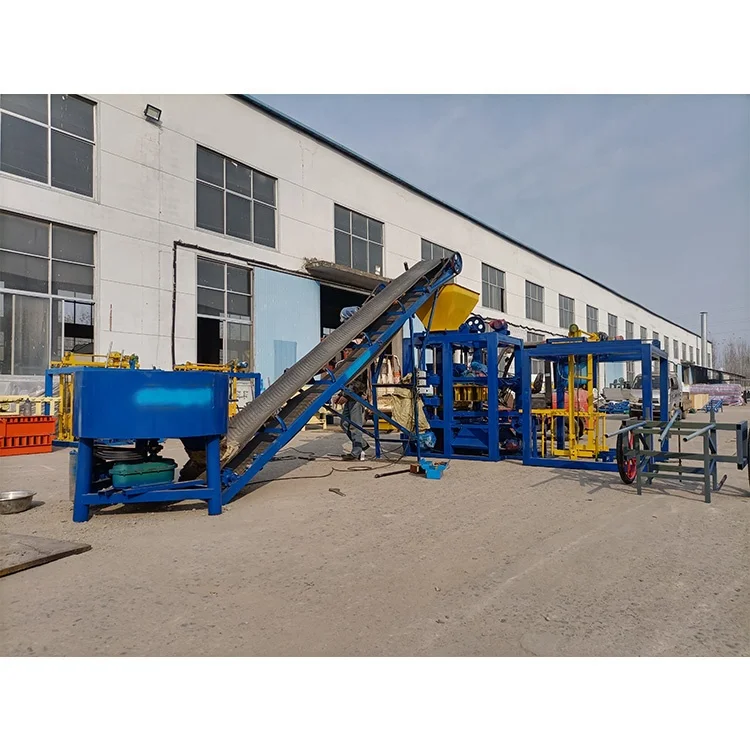
Synchronized Line Timing — the QTJ4-25 press, JQ350 mixer and pallet circuit are calculated together so no station idles waiting for the next cycle.
Technical Specifications
| Parameter | Value |
|---|---|
| Model | QTJ4-25 |
| Product Type | Stationary Block Making Machine |
| Rated Power | 17.9 kW |
| Overall Dimensions | 6400 × 1500 × 2700 mm |
| Total Mass | 2500 kg |
| Molding Cycle | 25 s |
| Pallet Size | 850 × 550 × 20 mm |
| Vibration Frequency | 2800 r/min |
| Exciting Force | 60 kN |
| Output Capacity | 960 pcs/h, 7680 pcs/day (basis: 400×200×200 mm hollow block, 4 pcs/mould) |
| Standard Configuration | Host machine 1 set, block mould 1 set, JQ350 mixer |
| Automation Level | Semi-automatic |
| Forming Method | Hydraulic pressure with bed mould vertical vibration and upper mould compression vibration |
| Voltage & Frequency | Configurable to buyer’s local supply (to be confirmed before production) |
| Control System | Relay logic or PLC (to be confirmed with buyer) |
| Stacking Method | Manual pallet handling with trolley |
Application Suitability
| Application | Material or Output |
|---|---|
| Hollow block production for masonry walls | Crushed stone, sand, cement and water mix; 8-inch, 6-inch, 5-inch and 4-inch formats |
| Solid block production for load-bearing structures | Dense aggregate blend with cement binder |
| Paving block and kerbstone manufacturing | Fine aggregate surface layer with coarse base mix, format changed via mould swap |
| On-site construction block production | Local quarry sand and gravel with Portland cement, semi-automatic operation for contractor crews |
| First-plant entrepreneur setup | Locally sourced raw materials matched to regional block market demand |
Why "Cycles per Hour" Tells Only Half the Story
A block making machine production line delivers real daily output only when every station — mixer, press, pallet return and stacking — runs at the same tempo.
Too often a buyer receives a quotation quoting cycles per hour without stating which block format that figure assumes. The press might complete a cycle every 25 seconds, but if the JQ350 mixer discharge interval is longer, the host sits idle and real tonnage drops well below the brochure promise [NEED_CITE: mismatch between quoted cycle rate and actual daily output in block plants]. That gap between quoted capacity and actual daily tonnage is where most first-plant disappointments originate.
Matching Mixer Discharge to Press Feeding
The block making machine production line built around the QTJ4-25 starts with the JQ350 mixer sized so its batch discharge rate keeps pace with the 25-second molding cycle. When the mixer finishes a batch, the material must already be in the hopper above the press; any delay means the vibration table runs empty and block density suffers. We calculate the hourly demand from your target block format, then confirm the mixer batch weight and interval match that demand before the line ships.
Pallet Circuit and Curing Area Alignment
Pallet size is 850 × 550 × 20 mm, and that dimension must align with the curing rack shelf spacing and the forklift fork width already on your site. If the pallet is too wide for the rack, you end up rebuilding the curing area after the machine arrives — a cost that never appeared in the original quotation [NEED_CITE: on-site rework costs from pallet and curing rack mismatch]. We verify pallet dimensions, material and load rating against your existing handling equipment before production begins.
Reading the Vibration and Pressure Numbers
The QTJ4-25 uses bed mould vertical vibration at 2800 r/min combined with upper mould compression vibration, generating 60 kN of exciting force. This dual-vibration approach compacts the concrete mix from both directions, improving block density and reducing the void ratio in hollow blocks. The hydraulic pressure holds the mould halves closed during vibration so the block retains its shape before the pallet moves to the curing area. Together, vibration frequency and hydraulic pressure determine whether the block meets the compressive strength your local market requires.
The Cost of Skipping the Line-Level Calculation
When a buyer purchases the press alone and sources the mixer and pallet system separately, the cycle times rarely align. The press waits for material, the pallet return conveyor jams because the spacing is wrong, and manual stacking becomes the bottleneck that caps daily output far below what the press can theoretically produce [NEED_CITE: bottleneck shifting in semi-automatic block plants]. These hidden costs show up as overtime labour, missed delivery deadlines and customer complaints about inconsistent block strength.
Why Specify the Full Line from One Source
Block machinery is our single focus, so the QTJ4-25 host, JQ350 mixer, mould and pallet are specified as one matched system rather than assembled from separate suppliers. Configuration is set against your actual mix design and local aggregate, not a catalogue default. Mould design covers the formats your market actually sells, and the automation level is selectable so you can start semi-automatic and add automatic stacking later. Installation support includes operator training so your crew understands the cycle relationship between every station.
Documentation & Verification
- Line layout and capacity calculation stating the 400×200×200 mm hollow block format assumed
- Machine specification sheet with pallet size 850 × 550 × 20 mm confirmed
- Mould drawing and format list showing cycle time per block type
- Voltage and control language confirmation signed before production
- Factory test record on your target block format before dispatch
- Packing photographs and customs documentation support
Installation, Commissioning & Support
- Foundation plan sized to the 6400 × 1500 mm footprint and 2500 kg mass
- Dedicated power circuit for the 17.9 kW rated load, voltage confirmed to local supply
- Host machine and JQ350 mixer dismantled for container loading, reassembled on-site
- First-run parameter setting for vibration frequency and molding cycle on your mix
- Operator training covering mould change procedure and pallet handling routine
- Wear parts list for vibration table springs and hydraulic seals with reorder codes
What to Share with Your Inquiry
Tell us the block formats your market sells, the daily output you need, and the raw materials available locally — sand type, aggregate size, cement grade. Confirm your site voltage, frequency and preferred control language. If you already have curing racks and a forklift, send us the rack shelf spacing and fork width so we can verify pallet compatibility before the line is built.
Frequently Asked Questions
Q: How is the daily output of the QTJ4-25 calculated?
A: The stated 7680 pieces per day assumes a 400×200×200 mm hollow block at 4 pieces per mould, running a 25-second cycle. For other formats like paving blocks or kerbstones, the pieces-per-mould count and cycle time change, so we recalculate daily output for each format you plan to produce before finalizing the line.
Q: How do the mixer and press cycle times stay synchronized?
A: We calculate the hourly material demand from your block format and daily schedule, then confirm the JQ350 mixer batch capacity and discharge interval match the 25-second press cycle. If the mixer cannot keep pace, we adjust the batch size or recommend a larger mixer so the press hopper never runs empty.
Q: Will my existing curing racks accept the 850 × 550 mm pallet?
A: We cross-check pallet dimensions, material and load rating against your curing rack shelf spacing and forklift fork width before production. If the pallet does not fit, we adjust the specification or recommend rack modifications so no on-site rework is needed after delivery.
Q: Which stations are included and which must I source locally?
A: The standard package includes the QTJ4-25 host, one mould set and the JQ350 mixer. Pallets, curing racks, water supply and foundation work are sourced locally. We provide a complete station list in the quotation so you know exactly what is included and what to prepare before arrival.


