
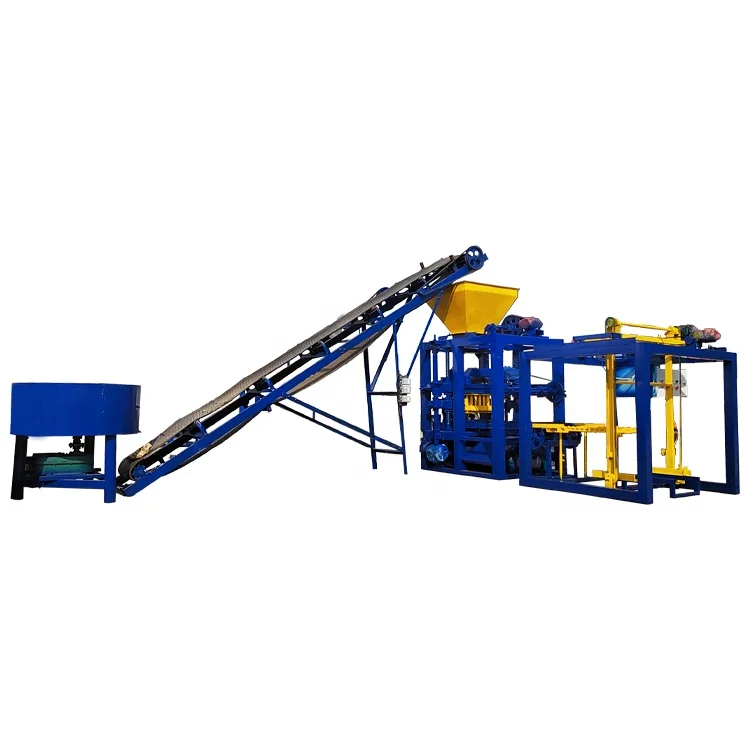
Line-Matched System — the QTJ4-24 is configured as part of a complete block production line where material feeding, mixing, and pallet circulation are timed to the 24–26 s molding cycle, not sold as a standalone press.
Technical Specifications
| Parameter | Value |
|---|---|
| Model | QTJ4-24 |
| Product Type | Stationary Block Making Machine |
| Overall Dimensions (L×W×H) | 3600×1700×2560 mm |
| Pallet Size | 850×450 mm |
| Molding Cycle | 24–26 s (basis not stated in source — confirm block format / material / thickness) |
| Overall Power | 11.95 kW |
| Vibration Force | 45 kN |
| Vibration Configuration | 2×3 kW lower vibrators + 2×1.5 kW upper vibrators |
| Total Mass | 2 T |
| Molding Method | Mechanical |
| Material Distribution | Full-automatic spiral |
| Reducer | 350-type (for mold lifting) |
| Raw Materials | Cement, sand, stone |
| Automation Level | Semi-automatic |
| Warranty | 1 year for whole machine (excluding spare parts) |
Application Suitability
| Application | Material or Output |
|---|---|
| Hollow block production | Cement, sand, and crushed stone mixes |
| Solid block production | Dense aggregate blends with cement binder |
| Paving block production | Fine sand and cement with pigment options |
| Interlocking brick production | Graded stone and cement for dry-stack formats |
What the Molding Cycle Number Hides About Your Daily Output
The cycle time printed on a spec sheet only tells half the story — what matters is whether every upstream and downstream station can keep pace.
I have watched a stationary block making machine production line sit idle for seconds each cycle because the mixer discharged too slowly and the pallet feeder jammed on warped boards. The press was capable, but the surrounding equipment was not matched. When the line is built station by station with cycle times calculated per block format, the QTJ4-24 runs without waiting. When it is not, real daily output drops well below what the molding cycle suggests. [NEED_CITE: line balancing principles in concrete block manufacturing]
How Each Station Connects to the Press
The QTJ4-24 operates on a 24–26 s molding cycle, which sets the heartbeat for the entire stationary block making machine production line. Raw material must arrive at the hopper before each cycle begins, the pallet must be in position before the mold descends, and the finished block must clear the press area before the next pallet enters. If any one of these handoffs takes longer than the cycle allows, the press waits — and that idle time compounds across a full shift.
Where Bottlenecks Typically Form
The mixer is often the first station to fall behind. A pan mixer that takes forty seconds to discharge a batch cannot feed a press cycling every twenty-five seconds. The pallet return path is another common constraint: if pallets are moved by hand from the curing area back to the press, the rhythm breaks the moment a worker steps away. [NEED_CITE: material flow analysis in semi-automatic block plants] Matching each station’s throughput to the QTJ4-24 cycle is what separates a line that runs from a line that stalls.
Reading the Specifications That Matter for Line Integration
The 45 kN vibration force, generated by four vibrators (two 3 kW lower and two 1.5 kW upper), determines block density alongside the buyer’s mix design and local aggregate. Vibration that is too low for a stiff mix leaves weak blocks; vibration that is too high for a wet mix causes segregation. The 850×450 mm pallet size must align with the curing rack spacing and forklift tines already on site — ordering non-standard pallets after the line is installed creates a bottleneck that no amount of press speed can fix. The 350-type reducer on the mold lifting mechanism affects maintenance intervals: a worn reducer causes uneven mold descent and inconsistent block height across the pallet.
The Cost of Skipping Line-Level Planning
When a buyer orders only the press and adds supporting equipment later, conveyor heights rarely match, pallet sizes differ, and the electrical panel lacks the inputs needed for synchronized control. The result is a line that runs but never reaches its designed rhythm. Workers compensate with manual handling, and output gaps widen over a shift without anyone identifying a single point of failure. [NEED_CITE: hidden costs of unbuilt production lines in masonry equipment]
Why the Line Approach Changes the Outcome
Every supporting station — mixer, pallet feeder, conveyor, stacking area — is specified against the QTJ4-24 cycle time so the press is never the station waiting. The pallet size is confirmed against the buyer’s curing racks and forklift before production begins, not after arrival. Voltage, frequency, and control language are locked in during the order stage to prevent commissioning delays. Capacity calculations state the block format assumed, so daily output expectations match reality. Mould design covers the formats the buyer’s market actually sells, including custom drawings when standard options do not fit.
Documentation & Verification
- Line layout drawing showing station positions, conveyor lengths, and pallet return path for the QTJ4-24 footprint
- Capacity calculation sheet stating the block format and mix assumed for the 24–26 s cycle
- Pallet specification matched to buyer’s curing rack spacing and forklift capacity
- Voltage, frequency, and control display language confirmation before production
- Factory test record on the buyer’s target block format before dispatch
- Hydraulic and electrical schematic for the complete line configuration
Installation, Commissioning & Support
- Foundation plan sized to the 3600×1700 mm footprint and 2 T operating mass of the QTJ4-24
- Dedicated power circuit rated for the 11.95 kW total draw with correct voltage and frequency
- Machine and supporting equipment assembled on-site with conveyor heights matched to press infeed
- First-run commissioning with cycle timing verified at each station from mixer to stacking
- Operator training covering mold change procedure on the 350-type reducer mechanism
- Wear parts list and reorder schedule for vibrators, reducer components, and mold surfaces
What to Include in Your Inquiry
Send the block formats your market sells, the daily volume you need, and the raw materials available locally. Confirm the curing area dimensions and forklift you plan to use so the 850×450 mm pallet can be validated or adjusted. State your site voltage and frequency along with the preferred control display language so the stationary block making machine production line is configured before production starts.
Frequently Asked Questions
Q: How is daily output calculated for the QTJ4-24, and what block format does the 24–26 s cycle assume?
A: The 24–26 s cycle is published without a stated block format, so daily output must be recalculated based on the specific block size, mix design, and number of cavities per mold you will run. We provide a capacity sheet showing output per format so your expectations match the actual production rhythm on your floor.
Q: What supporting equipment must match the press cycle to avoid idle time?
A: The mixer discharge rate, pallet feeder speed, and conveyor return path must all complete their tasks within the 24–26 s cycle. If any station is slower, the QTJ4-24 waits. We calculate each station’s throughput and specify the supporting equipment so no handoff becomes a bottleneck.
Q: Is the 850×450 mm pallet compatible with standard curing racks and forklifts?
A: This pallet size fits many standard rack systems, but curing rack spacing and forklift tine width vary by region and supplier. We confirm your existing rack dimensions and forklift capacity before production to avoid ordering pallets that do not match your curing area.
Q: What does the line layout look like from raw material feeding through to stacking?
A: The typical layout flows from aggregate bins through a mixer to the press hopper, with pallets circulating from the stacking end back to the infeed. The QTJ4-24 sits at the center, and every conveyor length and station position is drawn to fit your site footprint before the order is confirmed.
Q: What voltage and control language options are available for export markets?
A: Voltage and frequency are configured to your site supply before production begins. The control display language is confirmed at the same stage. Locking these details in early prevents commissioning delays when the stationary block making machine production line arrives at your facility.


