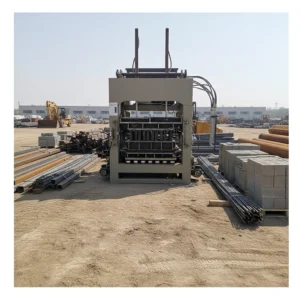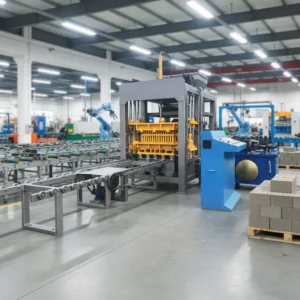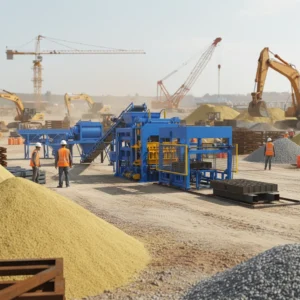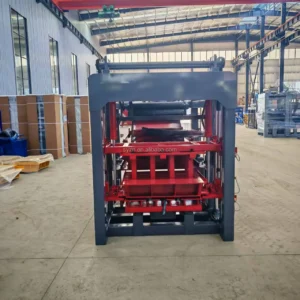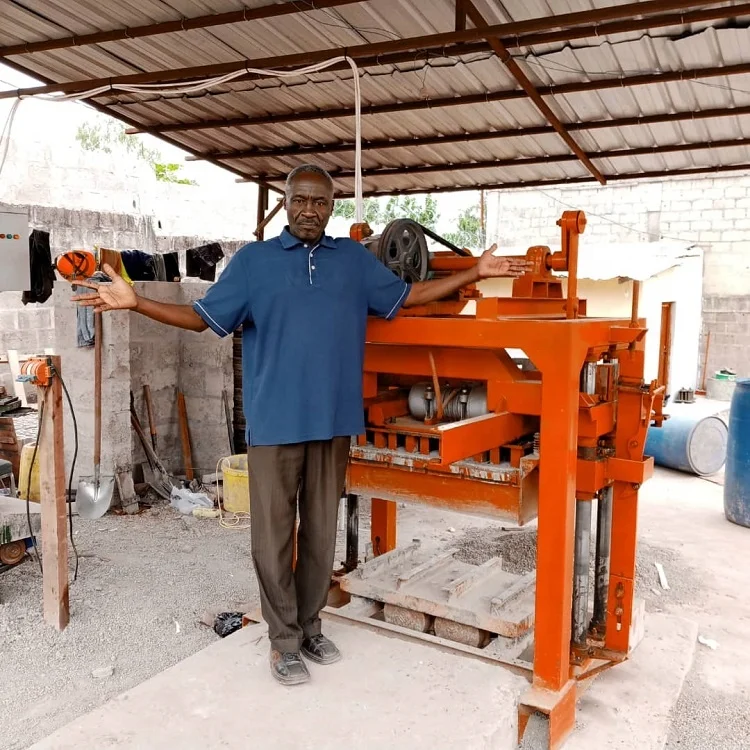
Line-Level Engineering — every feeder, mixer discharge rate, pallet loop and stacking station is sized against the QTJ4-40’s 40-second cycle so the press is never left idle waiting on upstream or downstream support.
Technical Specifications
| Parameter | Value |
|---|---|
| Model | QTJ4-40 |
| Product Type | Small Semi-Automatic Cement Block Making Machine |
| Rated Power | 9.5 kW |
| Molding Cycle | 40 s |
| Theoretical Productivity (400×200×200 mm hollow block, 4 pcs/mould) | 360 pcs/h, 2800 pcs/day (basis stated) |
| Theoretical Productivity (400×150×200 mm hollow block, 5 pcs/mould) | 450 pcs/h, 3600 pcs/day (basis stated) |
| Theoretical Productivity (225×112.5×60 mm solid brick, 9 pcs/mould) | 800 pcs/h, 6400 pcs/day (basis stated) |
| Vibration System | Bed mould vertical vibration + upper mould compression vibration |
| Mould Actuation | Top die push-and-pull with automatic scraper |
| Pallet Size | 850 × 450 mm |
| Overall Dimensions (L×W×H) | 1350 × 1460 × 1800 mm |
| Machine Weight | 1 T |
| Voltage | Configured to buyer’s local voltage |
| Automation Level | Semi-automatic (manual pallet handling) |
| Assembly State | Fully assembled, single-unit machine |
Application Suitability
| Application | Material or Output |
|---|---|
| On-site hollow block production | Concrete, sand, cement, crushed stone |
| Paving brick and solid brick molding | Concrete, sand, cement, fly ash |
| First block plant setups | Concrete, sand, cement, lime, gypsum |
| Format expansion for existing distributors | Concrete, sand, cement, fly ash, lime |
The Mixer Discharge Bottleneck No One Quotes
A small semi-automatic block machine production line only achieves its press cycle when every upstream and downstream station can keep pace with the 40-second mould time. The press is only as fast as the slowest feeder, mixer discharge, or pallet return loop allows it to be.
I have spent months on Latin American job sites watching presses sit idle while a mixer struggled to discharge volcanic ash aggregate or a worker carried pallets one at a time from a curing rack that was too far away. [NEED_CITE: cycle time matching in small block production lines] The catalogue says 360 pieces per hour on a 400×200×200 mm hollow block format — but that assumes a mixer that can drop a batch in under 40 seconds, a pallet supply that never runs dry, and a worker or rack system that clears finished blocks before the next cycle demands space. Miss any one of those, and the 40-second cycle stretches to 60 or 80 seconds, cutting real daily output far below what was budgeted for.
Sizing the Feed Side to the 40-Second Cycle
The QTJ4-40 draws 9.5 kW total, which means the upstream mixer, feeder belt, and any cement screw must share the same electrical panel without tripping. When we lay out a small semi-automatic block machine production line around this press, we calculate the mixer batch size against the mould volume — a 400×200×200 mm hollow block at four pieces per mould demands a specific batch weight, and the mixer must discharge that batch within the press cycle, not after it.
Aggregate density varies by region. A lightweight pumice in Mexico behaves differently in a hopper than the dense basalt a contractor might use in Colombia, and each affects how quickly the feeder belt can refill the mould box before the next vibration cycle begins. [NEED_CITE: aggregate flow characteristics in block machine feeders]
Pallet Flow and the Downstream Bottleneck
With an 850 × 450 mm pallet, the line needs a curing area sized for the day’s output and a return path that gets empty pallets back to the press operator before the next cycle completes. On a small semi-automatic block machine production line, pallet handling is manual, which means the distance from the press to the curing rack and back defines the operator’s physical pace.
Place the curing rack too far away and the operator cannot return pallets within the 40-second window. Use pallets that are heavier than the buyer’s existing forklift can comfortably carry, and every transfer slows down. [NEED_CITE: pallet return logistics in semi-automatic block plants] We map the pallet flow path before confirming the line layout, matching pallet weight and dimensions to the buyer’s forklift and floor space.
Reading the Specs Against Real Production
The dual vibration system — bed mould vertical vibration combined with upper mould compression vibration — determines block density and surface finish. Higher vibration force compacts the mix more tightly, which matters when a buyer’s market demands a minimum compressive strength for load-bearing hollow blocks.
The top die push-and-pull actuation with an automatic scraper shortens the mould cycle by reducing the manual steps between pressing and pallet removal. This design keeps the operator’s hands free to position the next pallet, which directly supports maintaining the 40-second cycle under semi-automatic conditions.
At 1 T machine weight and 1350 × 1460 × 1800 mm overall dimensions, the QTJ4-40 fits into a compact workshop footprint, but the total line footprint must include the mixer station, pallet staging area, curing rack rows, and a clear aisle for forklift or hand-truck movement.
The Cost of Skipping the Line Layout
Buyers who purchase the press alone and source the mixer, pallet feeder, and stacking stations separately often discover after installation that the stations were never timed to one another. The mixer may be rated for a different batch weight, the pallet rack may hold fewer pallets than a single shift requires, or the curing area may be too small to absorb the day’s output. [NEED_CITE: mismatched station timing in block production setups]
These mismatches do not appear in any single supplier’s quotation. They only surface when the line runs for the first time and the operator spends half the shift waiting on material or walking pallets back and forth. The result is a line that technically works but never reaches the daily throughput the buyer used to justify the investment.
Why Source the Full Line From One Specification Point
Block machinery as a single focus means the press, mould, pallet, and handling equipment are specified as one matched system — not assembled from separate suppliers who each quote their station in isolation.
Configuration is set against the buyer’s actual mix design and local aggregate, so the mixer and feeder are sized for the material that will actually run through the hopper, not a laboratory default.
Pallet size and material are confirmed against the buyer’s curing area footprint and forklift capacity before the order is placed, not after the line arrives on site.
Automation level is selectable — a buyer can start with semi-automatic manual pallet handling and add automatic pallet feeding or stacking later as volume grows.
Installation and commissioning support includes operator training on cycle time management, so the team on site understands how each station’s pace affects the press output.
Documentation & Verification
- Line layout drawing showing station sequence, pallet flow path, and cycle time matching points
- Capacity calculation stated per block format with the mix design and aggregate assumed
- Pallet specification covering material, thickness, and weight confirmed against buyer’s curing rack
- Voltage, frequency, and control language confirmation before dispatch
- Factory test record on the buyer’s target block format before shipment
- Packing photographs and customs documentation support
Installation, Commissioning & Support
- 9.5 kW total draw requires a dedicated circuit matching the buyer’s confirmed voltage and frequency
- Fully assembled single-unit delivery reduces on-site assembly to station connection and levelling
- 1350 × 1460 × 1800 mm footprint requires a levelled concrete pad with clearance for pallet return aisle
- First-cycle commissioning includes mixer discharge timing adjusted to the 40-second mould cycle
- Operator training covers mould change procedure and vibration force adjustment for different block formats
- Wear parts and mould list supplied with reorder lead times noted for local stocking
What to Prepare Before Requesting a Line Quote
To build a line layout that actually matches your site, we need to know your target block format, the aggregate and cement available locally, the daily output you need, and the floor space you have for curing. Share your local voltage and frequency, the forklift or hand-truck you already operate, and whether you plan to run one shift or two. If you are adding this line alongside existing equipment, tell us what is already on the floor so the station sequence connects properly.
Frequently Asked Questions
Q: How do I verify that mixer output and pallet supply keep up with the QTJ4-40’s 40-second cycle?
A: We calculate the mixer batch size against your target block format and mould cavity count, then confirm the mixer can discharge within the 40-second cycle. For pallet supply, we count the pallets needed for your daily output and match that to your curing rack capacity and return distance, so empty pallets are always available at the press.
Q: What supporting stations are included in the line quotation and what is left to the buyer?
A: The quotation covers the press, mould, raw material feeder, mixer, pallet feeder, and stacking arrangement as one matched system. Curing rack structure, forklift, and workshop infrastructure are the buyer’s scope, but we provide the layout drawing showing exactly where each station sits and what space to reserve.
Q: How does pallet size and material choice affect my existing curing area layout?
A: The 850 × 450 mm pallet must fit your curing rack shelves and be light enough for your forklift or hand-truck to carry when loaded with wet blocks. We confirm pallet weight and material against your rack spacing and forklift capacity before the order is placed, not after the pallets arrive.
Q: What voltage and frequency must be confirmed before the line ships?
A: The QTJ4-40 draws 9.5 kW and is configured to the buyer’s local voltage and frequency before production. Confirming these values — along with control panel language — before dispatch avoids commissioning delays when the line arrives on site and needs to connect to the local electrical panel.
Q: Can the line start semi-automatic and later add automatic pallet feeding or stacking?
A: Yes. The QTJ4-40 is configured as semi-automatic with manual pallet handling, but the line layout can reserve space and mounting points for an automatic pallet feeder or stacker to be added later. This lets a buyer start with lower investment and add automation as production volume grows.