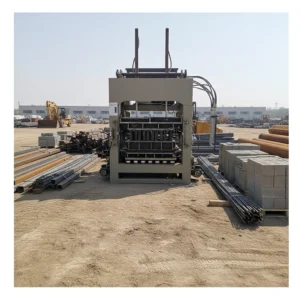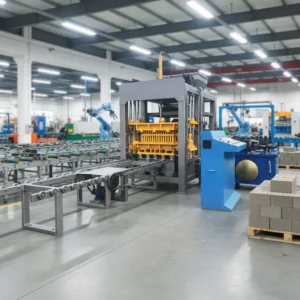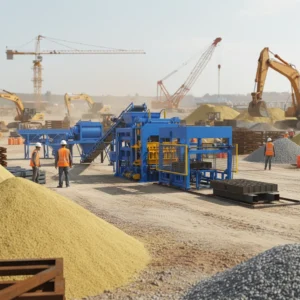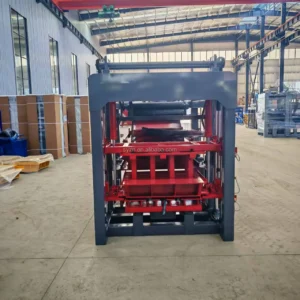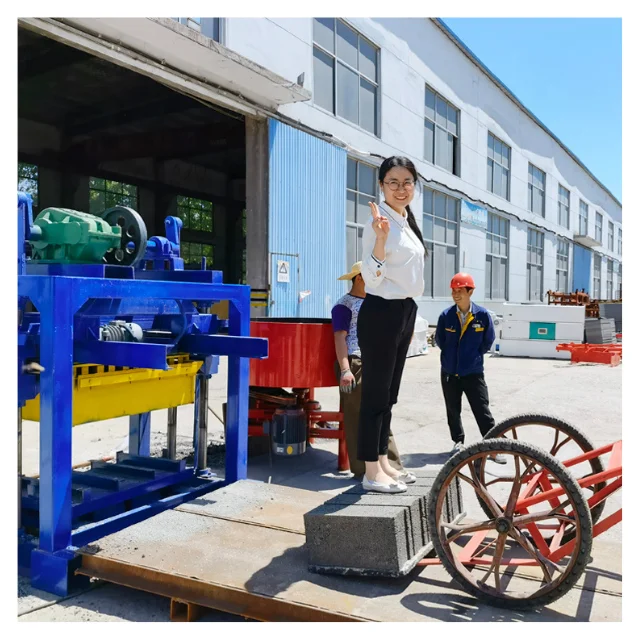
Balanced Line Timing — The QTJ4-40 press is specified alongside its feeder, mixer, and pallet circulation so that every station matches the 40-second moulding cycle, preventing upstream or downstream bottlenecks.
Technical Specifications
| Parameter | Value |
|---|---|
| Product Type | Semi-automatic Concrete Block Making Machine |
| Model | QTJ4-40 |
| Rated Power | 9.5 kW |
| Molding Cycle | 40 s |
| Theoretical Productivity (400×200×200 mm hollow block, 4 pcs/mould) | 360 pcs/h, 2800 pcs/day |
| Theoretical Productivity (400×150×200 mm hollow block, 5 pcs/mould) | 450 pcs/h, 3600 pcs/day |
| Theoretical Productivity (225×112.5×60 mm solid brick, 9 pcs/mould) | 800 pcs/h, 6400 pcs/day |
| Raw Materials | Concrete, sand, cement, fly ash, lime, gypsum |
| Machine Weight | 1 T |
| Overall Dimensions (L×W×H) | 1350×1460×1800 mm |
| Pallet Size | 850×450 mm |
| Automation Level | Semi-automatic |
| Mould Operation | Top die push-and-pull with automatic scraper |
| Vibration Method | Bed mould vertical vibration + upper mould compression vibration |
| Voltage | According to buyer’s local voltage (basis to be confirmed) |
Application Suitability
| Application | Material or Output |
|---|---|
| Small-scale hollow block production | Crushed stone, sand, and cement mixes |
| Solid brick manufacturing | Fly ash, lime, and gypsum blends |
| On-site building project supply | Concrete with locally sourced aggregates |
| First plant setup for entrepreneurs | Low-investment semi-automatic line configuration |
What a 40-Second Cycle Actually Demands from the Rest of the Line
The press cycle only matters if the mixer, pallet feeder, and stacking stations can keep pace.
A semi-automatic block machine production line often disappoints buyers because the quoted cycle time reflects the press alone. When the mixer upstream takes longer to discharge a batch, or the pallet conveyor cannot return an empty pallet in time, the QTJ4-40 sits idle for seconds that add up across a shift [NEED_CITE: line balancing principles in concrete product manufacturing]. Real daily output then falls noticeably below the theoretical capacity, and the buyer blames the press for what is actually a line timing mismatch.
Matching Every Station to the 40-Second Rhythm
The semi-automatic block machine production line built around the QTJ4-40 treats the press as one node in a continuous loop. The raw material feeder must deliver a measured batch to the mixer within the same window the press completes a cycle. If the mixer discharges too slowly, the hopper above the press runs dry and the next cycle starts late. Each station is therefore specified with a discharge or travel time that fits inside the 40-second envelope, leaving a small buffer rather than a hidden delay.
Pallet Circulation as the Hidden Constraint
Pallet handling is where many semi-automatic lines quietly lose time. The QTJ4-40 uses an 850×450 mm pallet, and every pallet carrying a freshly pressed block must travel to the curing area, be stripped, and return before the next cycle completes. If the curing rack layout or the forklift route adds even a few seconds to that loop, the pallet feeder runs out and the press waits [NEED_CITE: pallet return cycle impact on block output]. Line planning therefore starts with the buyer’s existing curing space and forklift capacity, not just the press footprint.
Reading the Specs That Shape Block Quality
The dual vibration system — bed mould vertical vibration combined with upper mould compression vibration — compacts the concrete mix from two directions simultaneously. This produces a denser block wall and a more uniform surface finish than single-axis vibration alone, which matters when the buyer’s market demands consistent compressive strength across batches. The 9.5 kW rated power drives both the vibration motors and the hydraulic scraper, so electrical supply must account for the starting current peak. Machine weight of 1 T and overall dimensions of 1350×1460×1800 mm mean the QTJ4-40 fits inside a standard workshop bay, but the floor must still be levelled to keep vibration energy directed into the mould rather than dissipated through an uneven base.
The Cost of Ignoring Line Balance
When a buyer purchases the press separately and sources the mixer and pallet conveyor from different suppliers, cycle mismatches are almost guaranteed. The press idles while the mixer finishes a batch, or pallets pile up at the curing rack because the return conveyor runs slower than expected. Output per shift drops, labour cost per block rises, and the buyer invests in manual stacking to compensate — exactly the cost the semi-automatic configuration was supposed to remove [NEED_CITE: hidden costs of unbalanced block production lines]. These losses do not appear in any quotation, yet they show up on the first day of production.
Why Sourcing the Line as a Single Package Matters
Block machinery is the sole focus here, so the QTJ4-40 press, mould, pallet, and handling equipment are specified as one matched system rather than assembled from separate suppliers. Configuration is set against the buyer’s actual mix design, local aggregate, and target block format instead of a catalogue default. Mould design covers the formats the buyer’s market actually sells, including custom drawings. The automation level is selectable, allowing a buyer to start semi-automatic and add automatic stacking or cubing later. Installation and commissioning support includes operator training so the line runs correctly from the first shift.
Documentation & Verification
- Line layout drawing showing station spacing and pallet return path for the QTJ4-40
- Capacity calculation stating which block format and mould the output figure assumes
- Pallet specification matched to buyer’s curing rack dimensions and forklift load rating
- Voltage and control language confirmation sheet signed before production begins
- Hydraulic and electrical schematic covering the 9.5 kW power circuit
- Factory test record on the buyer’s target block format before dispatch
Installation, Commissioning & Support
- Levelled concrete pad required under the 1350×1460 mm base to direct vibration into the mould
- Dedicated circuit for the 9.5 kW rated power with voltage confirmed before wiring
- Machine arrives as a single unit; pallet feeder and mixer ship as separate line stations
- First-run mould setup and vibration timing adjusted to the buyer’s mix on site
- Operator training covers mould change procedure and scraper maintenance
- Wear parts list includes vibration motor brushes and scraper blades
What to Include in Your Inquiry
Provide your target block format and daily output requirement so the line can be balanced around the QTJ4-40 cycle. Share your local raw material type and the voltage and frequency at your site. If you already have a curing area or forklift, include the pallet dimensions and load capacity those systems handle so the pallet specification aligns from the start.
Frequently Asked Questions
Q: How do I verify the real daily output and which block format the capacity figure is based on?
A: Every capacity figure we quote states the exact block format, mould cavity count, and cycle time it assumes. For the QTJ4-40, theoretical productivity is listed separately for 400×200×200 mm hollow blocks, 400×150×200 mm hollow blocks, and 225×112.5×60 mm solid bricks, so you can match the number to the product your market actually buys.
Q: How should the mixer, feeder, and pallet circulation be sized to match the press cycle?
A: Each station must complete its task within the 40-second moulding cycle. The mixer discharge time, feeder batch weight, and pallet return speed are all calculated against that window. We provide a line timing chart showing each station’s duration so no single point holds up the QTJ4-40.
Q: What pallet size and material work with my existing curing area and handling equipment?
A: The QTJ4-40 uses an 850×450 mm pallet. Before the line is finalised, we check this dimension against your curing rack spacing and forklift fork width. If your existing equipment cannot accommodate that pallet, the line layout is adjusted or an alternative pallet material is recommended.
Q: What automation upgrades can be added to the QTJ4-40 line later?
A: The semi-automatic configuration leaves room for automatic stacking, cubing, and PLC control to be added as production volume grows. Pallet feeder and conveyor mounting points are included in the initial line layout so upgrades do not require structural changes to the plant floor.