
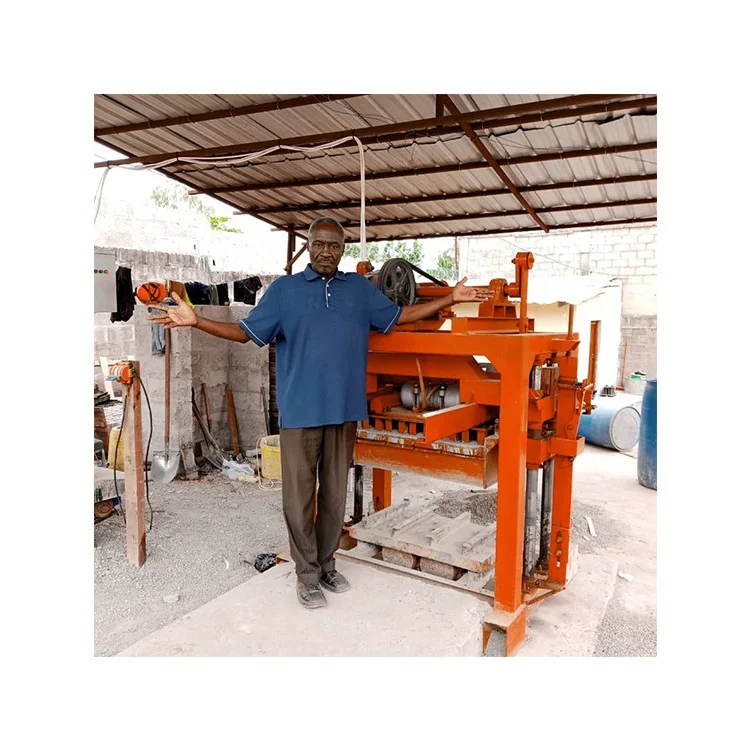
Line Pacing Integrity — every station from mixer discharge to pallet feed is sized against the QTJ4-40’s 40-second cycle so no upstream or downstream bottleneck starves the press.
Technical Specifications
| Parameter | Value |
|---|---|
| Model | QTJ4-40 |
| Product Type | Semi-Automatic Concrete Block Making Machine |
| Overall Dimensions (L×W×H) | 1350×1460×1800 mm |
| Rated Power | 10.4 kW |
| Molding Cycle | 40 s |
| Output Capacity (Hollow 400×200×200 mm) | 4 pcs/mould, 360 pcs/hour, 2880 pcs/day |
| Output Capacity (Hollow 400×150×200 mm) | 5 pcs/mould, 450 pcs/hour, 3600 pcs/day |
| Output Capacity (Solid 225×112.5×60 mm) | 9 pcs/mould, 800 pcs/hour, 6400 pcs/day |
| Pallet Size | 850×450×20 mm |
| Net Weight | 1.2 T |
| Vibration System | Bed mould vertical vibration + upper mould compression vibration |
| Automation Level | Semi-automatic |
| Voltage | According to local voltage (basis to be confirmed) |
| Raw Materials | Concrete, sand, cement, fly ash, lime, gypsum |
| Block Formats Supported | Hollow, solid, paver (standard sizes: 8 in, 6 in, 5 in, 4 in; custom on request) |
| Required Auxiliary Equipment | Mixer, host machine, block mould, pallets |
| Pallet Material Options | Fiber glass (optional), wooden pallet (local sourcing supported) |
Application Suitability
| Application | Material or Output |
|---|---|
| Small-scale hollow block plant | Crushed stone, sand, and cement producing 400×200×200 mm hollow blocks |
| Solid brick production for masonry | Sand, cement, and fly ash forming 225×112.5×60 mm solid bricks |
| On-site block production for contractors | Local aggregate and cement for 400×150×200 mm hollow blocks at building sites |
| Paving block manufacturing | Crushed granite or basalt with cement for interlocking paver formats |
| First block plant for entrepreneurs | Mixed concrete raw materials across hollow and solid formats at entry-level investment |
Why the Mixer Matters More Than the Press
A quoted output figure only describes the press. The semi-automatic block machine production line reaches that figure only when every station around the press is timed to its cycle. I have watched entire production days collapse because a mixer discharged a batch every 90 seconds while the press demanded fresh material every 40. The operator stood idle, pallets sat empty, and the daily tally fell to half the brochure number [NEED_CITE: typical batch-to-cycle mismatch in small block plants]. When a buyer evaluates the QTJ4-40, the conversation must start with how the mixer, pallet feed, and curing rack capacity all synchronize to the 40-second molding cycle — not with the headline output number alone.
Station Boundaries and Where Cycle Time Breaks Down
In a semi-automatic block machine production line, the press is only one node. Material flows from the mixer through a feeding chute into the mould box, then the formed blocks on pallets move by hand or gravity roller to the curing area. Each transfer point carries a time cost. If the mixer takes 80 seconds per batch but the QTJ4-40 finishes a cycle in 40, the press waits. We map every station’s throughput against the press cycle before finalizing the line layout, so the bottleneck is always the press itself — which is where it should be.
Matching Pallet Flow to the 40-Second Rhythm
The QTJ4-40 uses 850×450×20 mm pallets, and each cycle consumes one. Over an eight-hour shift, that means hundreds of pallets cycling between the press and the curing racks [NEED_CITE: pallet turnover rates in semi-automatic block lines]. If the curing area is too small or the forklift cannot move loaded racks fast enough, pallets pile up at the press discharge and production stalls. The pallet specification must align with the buyer’s existing curing footprint and handling equipment, not the other way around. Fiber glass pallets are available for longer service life, while wooden pallets can be sourced locally to control initial cost.
Vibration and Pressure Across Block Formats
The QTJ4-40 uses a dual vibration approach: vertical vibration from the bed mould combined with compression vibration from the upper mould. This matters when switching between hollow blocks and dense solid bricks. Hollow formats need strong vibration to push the concrete mix into thin-walled cavity sections, while solid formats demand sustained compression to achieve target density. A single vibration mode cannot handle both extremes well. The dual system lets the operator adjust the balance depending on the format in production, which is important for plants running multiple block types across a week.
What Happens When Stations Are Specified Separately
Buying the press from one supplier and the mixer from another often produces a line where nobody takes responsibility for the gaps between stations. The mixer vendor says their machine is rated for the right volume; the press vendor says their cycle time is correct. Yet the discharge height of the mixer does not match the feed hopper of the press, or the mixer batch size is twice what the press mould box can accept per cycle [NEED_CITE: integration gaps in multi-vendor block lines]. The result is a line that technically works but never reaches the output either vendor promised. Every component around the QTJ4-40 should be specified as part of one system.
Why the Line Layout Comes Before the Quotation
A line drawing is not a sales brochure — it is the document that shows whether the buyer’s floor space, curing area, and power supply can actually support the planned output. For the QTJ4-40, the layout must account for the 1350×1460 mm machine footprint, the mixer placement relative to the feed chute, pallet storage and return paths, and the distance to curing racks. Without this drawing, a buyer cannot verify that the line fits the available space or that the electrical supply can handle the combined 10.4 kW load plus mixer power. We produce the layout and capacity calculation before the quotation, stating the block format assumed for each output figure.
Documentation & Verification
- Line layout showing mixer, press, and curing rack positions with pallet flow paths
- Capacity calculation sheet stating the exact block format behind each output number
- Pallet specification matched to buyer’s curing rack dimensions and forklift rating
- Voltage and control language confirmation document signed before production
- Factory test record running the buyer’s target block format before dispatch
- Hydraulic and electrical schematic for on-site troubleshooting
Installation, Commissioning & Support
- Foundation pad leveled to tolerance for the 1350×1460 mm base footprint
- Dedicated electrical circuit rated for 10.4 kW plus mixer load at confirmed voltage
- Pallet guide rails aligned on-site to match 850×450×20 mm pallet dimensions
- First production run supervised with operator training on mould change procedure
- Wear parts list covering vibration springs, hydraulic seals, and mould liners
- Recommended maintenance schedule tied to molding cycle count
Before You Request a Quote
To size the semi-automatic block machine production line correctly, we need to know the block formats your market actually buys and the daily volume you must deliver. Share your local aggregate type and typical mix design so the vibration settings and mould configuration can be matched from the start. Confirm the voltage and frequency at your site, the pallet handling equipment you already have, and the curing space available — these details determine whether the line around the QTJ4-40 can sustain its cycle rate across a full shift.
Frequently Asked Questions
Q: How is daily output calculated when the line includes mixing, pallet feed, and stacking?
A: We calculate from the press cycle time, then subtract realistic losses for pallet return, mould filling, and operator handling. The figure is stated per block format — hollow 400×200×200 mm yields a different daily total than solid brick. Mixer batch time and pallet availability are factored in so the number reflects a complete line, not just the press running uninterrupted.
Q: What pallet size and material does the line assume?
A: The QTJ4-40 runs on 850×450×20 mm pallets. We confirm whether fiber glass or locally sourced wooden pallets suit your curing racks and forklift. Pallet thickness affects the vibration transfer and block density, so the material choice is part of the line specification, not an afterthought.
Q: Which stations are included in the quotation and which are left for local sourcing?
A: The quotation covers the press, mould, pallets, and any feeding or mixing equipment we supply. Items like curing racks, forklifts, and water supply are typically sourced locally. We state clearly which stations are included so there are no gaps when the line arrives at your site.
Q: How do I match mixer batch size and discharge rate to the QTJ4-40 cycle time?
A: The mixer must discharge one batch within or slightly below the 40-second cycle to keep the press fed without overflow. We specify the mixer drum capacity and discharge mechanism so the batch volume matches the mould box fill requirement. Mismatched batch size is one of the most common causes of lost output in small block plants.


