
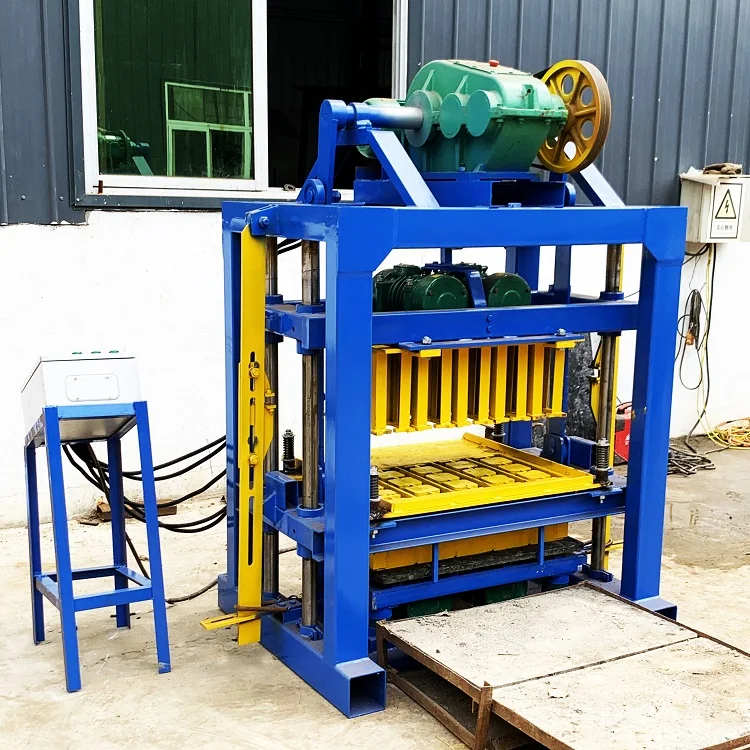
System-Matched Press and Line — the QTJ4-40 is configured with its mixer, pallet loop and curing footprint sized together so the press station never sits idle waiting for the next feed.
Technical Specifications
| Parameter | Value |
|---|---|
| Model | QTJ4-40 |
| Product Type | Manual Movable Block Making Machine |
| Main Vibration Form | Platform Vibration |
| Vibration Frequency | 2800 r/min |
| Per Hour Output | 360 pcs/h (basis: 400×200×200mm hollow block) |
| Per Hour Output | 500 pcs/h (basis: 400×150×200mm hollow block) |
| Per Hour Output | 900 pcs/h (basis: 225×112.5×60mm interlocking block) |
| Daily Capacity | 2880 pcs/day (basis: 400×200×200mm hollow block, 8-hour shift) |
| Daily Capacity | 4000 pcs/day (basis: 400×150×200mm hollow block, 8-hour shift) |
| Daily Capacity | 7200 pcs/day (basis: 225×112.5×60mm interlocking block, 8-hour shift) |
| Mould Cavities | 4 pcs (400×200×200mm), 5 pcs (400×150×200mm), 9 pcs (225×112.5×60mm) |
| Pallet Size | 850×450 mm |
| Raw Materials | Concrete, cement, fly ash, crushed stone, sand, dust, gravel, slag |
| Mix Ratio | Cement 8–10%, sand 30–40%, stone 50–60% |
| Overall Dimensions | 1350×1460×1800 mm |
| Machine Weight | 1 T |
| Factory Area Required | 200 m² |
| Workers Required | 1–3 people |
| Control System | Manual operation with top die push/pull and automatic scraper |
| Automation Level | Manual / semi-manual |
| Power Source | Engine and Motor |
| Voltage & Frequency | To be confirmed before ordering |
| Applied Products | Hollow/solid blocks, pavers, interlocking blocks, curbstone, colored pavers |
| Standards | CE |
Application Suitability
| Application | Material or Output |
|---|---|
| Small-scale hollow block plant | Crushed stone, sand, cement at 1:4:5 ratio producing 400×200×200mm blocks |
| On-site contractor production | Fly ash and gravel mix for 400×150×200mm structural blocks |
| Interlocking paver manufacturing | Fine sand and cement blend for 225×112.5×60mm interlocking units |
| Landscaping and municipal colored pavers | Pigmented concrete mix for curbstone and decorative formats |
| First-plant entrepreneur setup | Low-volume startup using locally sourced aggregate and cement |
Why the Supporting Block Machine Equipment Decides Your Real Output
A press that waits for material is a press that costs you money every minute it sits idle.
I once stood on a site in the Gulf where a brand-new stationary block machine produced barely half its nameplate output. The mixer feeding it was undersized, and every cycle the operator stood watching an empty hopper. The block production line equipment around the press — mixer throughput, pallet return speed, curing rack distance — must all match the cycle rhythm of the press itself. When any one station lags, the entire line slows to its pace [NEED_CITE: block plant bottleneck analysis by station throughput].
Mapping Every Station Around the QTJ4-40 Press
The QTJ4-40 is the forming station. Before it, raw aggregate and cement enter a mixer sized so that one batch is ready before the previous batch is fully consumed. The mixed material then feeds into the hopper above the mould. Behind the press, pallets carrying wet blocks must travel to the curing zone, and empty pallets must return fast enough to meet the next cycle. If the block production line equipment at any of these points is mis-sized, the press sits idle and the shift target slips.
Sizing the Line to Your Chosen Block Format
Output changes dramatically with the block format. At 360 pcs/h on 400×200×200mm hollow blocks the mixer and pallet loop can be modest. Switch to 225×112.5×60mm interlocking blocks at 900 pcs/h and the same mixer will not keep up, the pallet return path must be faster, and the curing area must absorb more than twice the volume per shift. Every supporting block machine equipment station must be re-checked when you change the target format [NEED_CITE: cycle time versus supporting equipment throughput in block plants].
Reading the Specs That Shape Line Design
Platform vibration at 2800 r/min compacts the concrete mix from below while the top die push/pull mechanism presses from above. This dual action determines block density and demoulding quality — if vibration force and hydraulic pressure are not matched to the buyer’s aggregate gradation, blocks crack during curing or fail compressive strength tests. The 850×450 mm pallet size dictates the curing rack spacing and forklift tine width; ordering pallets that do not fit existing racks means rebuilding the curing zone. A factory area of 200 m² covers raw material storage, the mixing station, the press footprint, pallet circulation, curing zone and finished block stacking — a tighter yard forces compromises in curing time or stockpile depth.
What Happens When One Station Is Overlooked
Buyers who quote only the press often discover mid-shift that wet blocks are stacking on the floor because no pallet return system was included. Others find that their curing racks were built for a different pallet dimension, forcing a full rack rebuild before the first saleable block leaves the yard. These are not machine defects — they are line gaps that turn a quoted capacity into a fraction of reality [NEED_CITE: common block line commissioning failures due to missing auxiliary stations].
Why Procurement Here Closes Those Gaps
The machine, mould, pallet and handling equipment are specified as one matched system rather than assembled from separate suppliers. Configuration is set against the buyer’s actual mix design and local aggregate, not a catalogue default. Mould design covers the formats the buyer’s market actually sells, with custom drawings available. Automation level is selectable, so a buyer can start with the QTJ4-40 manual setup and add pallet feeders or stackers later. Installation includes operator training at the press station and every supporting point in the line.
Documentation & Verification
- Line layout drawing showing every station from feeder to curing rack, capacity stated per block format
- Pallet specification sheet confirming 850×450 mm dimensions against your existing rack and forklift
- Factory test record with your chosen mould running full cycles before dispatch
- Voltage and frequency confirmation document signed before production starts
- Operation manual covering press station and all supporting block machine equipment
Installation, Commissioning & Support
- 200 m² factory area verified for material storage, press placement, pallet loop and curing zone
- Voltage and frequency confirmed in writing; dedicated circuit sized to the QTJ4-40 motor rating
- Machine delivered with platform vibration system pre-assembled; top die and scraper adjusted on site
- First-run commissioning tests cycle rhythm against mixer output and pallet return speed
- Operator training covers mould change procedure, scraper adjustment and daily maintenance checkpoints
- Wear parts list for vibration platform, scraper blades and pallet contact surfaces supplied at handover
What We Need to Size Your Line
To match the supporting block machine equipment to the QTJ4-40, share your target block format and daily volume, the aggregate and cement types available locally, your existing curing rack dimensions and forklift specifications, and the site voltage and frequency. If you already have a mixer or conveyor in place, send the model and throughput rating so we can verify it fits the press cycle.
Frequently Asked Questions
Q: How is the daily output of the QTJ4-40 verified for each block format?
A: Every capacity figure is stated with its basis. Hollow blocks at 400×200×200mm yield 2880 pcs/day over an 8-hour shift at 360 pcs/h. Switching to 225×112.5×60mm interlocking blocks raises throughput to 900 pcs/h and 7200 pcs/day. The supporting block machine equipment must be re-sized for whichever format you choose.
Q: What supporting equipment must be included so the press never waits?
A: A mixer with batch time shorter than the press cycle, a pallet feeder holding enough stock for continuous runs, and a pallet return path that clears wet blocks and sends empties back before the next mould closes. Missing any of these stations turns quoted capacity into idle time.
Q: How do I check the 850×450 mm pallet against my existing setup?
A: Measure your curing rack slot width and depth, and your forklift tine spacing. If the pallet overhangs the rack or the tines cannot engage it, curing and handling will stall. We confirm pallet dimensions against your equipment before the line is laid out.
Q: What is the full factory area when the QTJ4-40 runs in a complete line?
A: The 200 m² figure covers raw material storage, the mixing station, the press itself, pallet circulation paths, the curing zone and finished block stacking. A smaller yard forces shorter curing times or reduced stockpile depth, both of which affect output quality.
Q: How do I confirm voltage and motor type before the machine is built?
A: Share your site voltage, frequency and phase in writing during the inquiry stage. We issue a confirmation document listing the exact motor and control specifications for the QTJ4-40 and all supporting block machine equipment before production begins [NEED_CITE: voltage and frequency standards by export market].


