
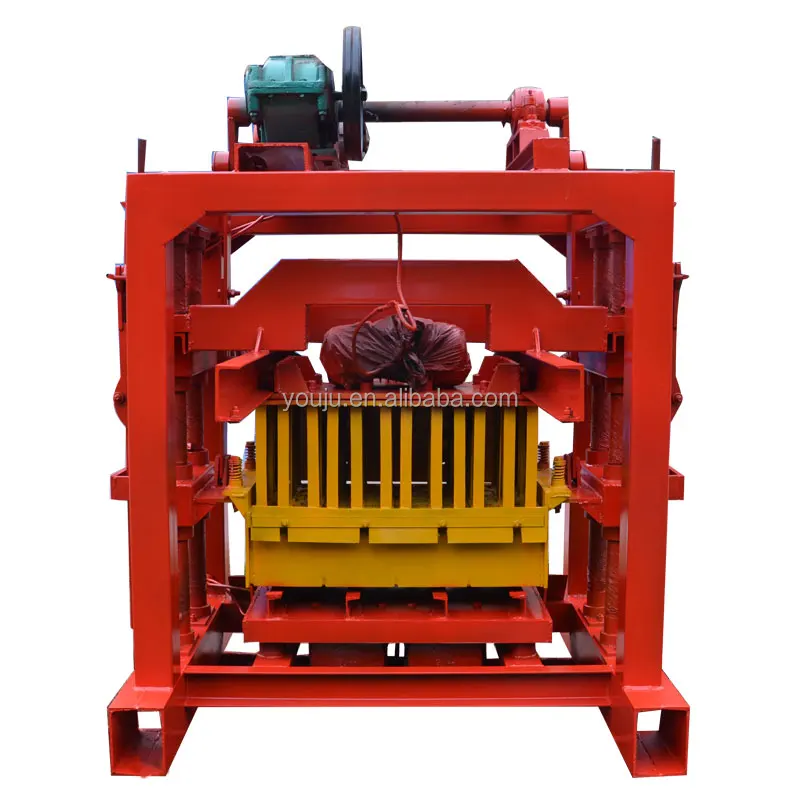
Upstream and Downstream Synchronization — The QTJ4-40 is specified as a matched small line where mixer output, pallet rhythm and curing area are balanced against the 40-second press cycle, so no station sits idle.
Technical Specifications
| Parameter | Value |
|---|---|
| Model | QTJ4-40 |
| Product Type | Manual Concrete Block Making Machine |
| Rated Power | 10.4 kW |
| Voltage & Frequency | Three-phase four-wire (exact voltage and frequency to be confirmed per target market) |
| Control System | Electrical control with mechanical interworking (PLC not included) |
| Overall Dimensions (L×W×H) | 1350 × 1460 × 1800 mm |
| Net Weight | 1200 kg |
| Cycle Time | 40 s |
| Vibration Frequency | 2800 r/min |
| Pallet Size | 850 × 450 × 20 mm |
| Mould Format (Included) | 400×200×200 mm hollow block, 5 pcs per mould |
| Output Capacity | 2400 pcs/h based on 400×200×200 mm hollow block, 5 pcs/mould (basis to be confirmed for other formats) |
| Assembly State | Main machine supplied with JQ350 mixer |
| Automation Level | Manual operation with electric-mechanical combination |
| Stacking Method | Manual (basis to be confirmed) |
| Hydraulic Pressure | Value not stated in source — to be confirmed |
| CE Declaration | Applicable where required by destination market |
Application Suitability
| Application | Material or Output |
|---|---|
| Small-scale hollow block production | Crushed stone, sand, cement and water mixes for 400×200×200 mm blocks |
| On-site workshop block making | Local aggregate and cement blends for housing project supply |
| First block plant for entrepreneurs | Basic hollow and solid block formats from locally sourced raw materials |
| Distributor adding block formats | Standard hollow blocks with potential to expand format range later |
What the Press Cycle Hides About Your Line Throughput
A 40-second cycle on the QTJ4-40 block machine production line only tells you how fast the press itself moves — it says nothing about whether your mixer can deliver fresh batch on time or your operators can clear cured pallets before the next one drops.
I once configured a small line for a project in the Middle East where the press ran perfectly, but the upstream JQ350 mixer could not keep up because the local sand had higher moisture than expected, slowing each batch down just enough to leave the press waiting between cycles. The daily output fell noticeably short of what the cycle time alone suggested. That is the kind of mismatch a line-level calculation catches before the equipment ships [NEED_CITE: impact of aggregate moisture on mixer batch time in concrete block production].
When you evaluate a QTJ4-40 block machine production line, the question is not just "how many blocks per hour" but "how many blocks per shift, given my raw material, my pallet handling speed and my curing space." Every station upstream and downstream of the press must be counted.
Matching Mixer Throughput to Press Demand
The included JQ350 mixer is sized so that its batch output aligns with the press throughput under standard conditions. In a QTJ4-40 block machine production line, if the mixer takes longer per batch than the press cycle allows, the press operator stands idle and the line loses rhythm. The mixer-to-press ratio must be verified against your actual mix design and local aggregate grading before the line is finalized.
Pallet Flow and Curing Area Sizing
The 850 × 450 mm pallet defines how much curing floor you need per shift. Every pallet that leaves the press must be moved, racked and left undisturbed until the block reaches handling strength. If your curing racks were built for a different pallet dimension, or your forklift cannot navigate the aisle width the pallet layout demands, the downstream end of your QTJ4-40 block machine production line becomes the real bottleneck [NEED_CITE: pallet size compatibility with curing rack and forklift specifications in block plants].
Interpreting the Core Specifications
The 2800 r/min vibration frequency works with the electric-mechanical control to compact the mix during the 40-second cycle. Higher vibration alone does not guarantee denser blocks — the force must match the stiffness of your particular mix. A drier mix may need the full vibration amplitude, while a wetter local aggregate blend might require a shorter vibration window to avoid segregation.
The 10.4 kW rated power covers both the vibration motor and the mixer drive when running together. Your site electrical supply must provide stable three-phase power at the confirmed voltage and frequency, with cable gauge and leakage protection sized for the combined starting current. I have seen commissioning delayed by weeks because the local panel was wired for a different frequency standard [NEED_CITE: electrical infrastructure requirements for exported concrete machinery].
The 1350 × 1460 × 1800 mm footprint of the press itself is compact, but the full line — mixer feeding zone, pallet staging area and block removal path — needs a clear layout drawing so nothing interferes with the operator’s work rhythm.
When Stations Are Specified in Isolation
A mixer chosen only on drum capacity, without checking batch time against the press cycle, leaves operators manually rationing material. A pallet size selected for the press without checking the curing rack means buying new racks after the line arrives. These are not theoretical issues — they show up on the first production day when the line stalls and nobody can identify which station caused the stop [NEED_CITE: common commissioning failures in small-scale block production lines].
Why This Line Is Configured as One System
The QTJ4-40 block machine production line is quoted with the JQ350 mixer, pallet specification and mould list as a single matched set, not as separate items pulled from a catalogue. The capacity calculation states which block format it assumes, so you can compare it against your actual product mix.
Moulds are designed for the formats your local market buys, and custom mould drawings are available if your standard block dimensions differ. The electric-mechanical control coordinates upper and lower vibrators with mould lifting to reduce damage from operator error during manual operation.
The automation level starts at manual with mechanical assist, but the line layout leaves room to add pallet feeding or stacking stations later without replacing the press. Voltage, frequency and control language are confirmed before production starts, not after the crate arrives at your port.
Documentation & Verification
- Line layout drawing showing mixer, press, pallet flow and curing area with cycle time per block format
- Machine specification sheet with confirmed voltage, frequency and control language
- Mould drawing and format list stating realistic output per block type
- Factory test record run on your specified block format before dispatch
- Pallet specification matched to your curing rack dimensions and forklift capacity
- Operation and maintenance manual with wear parts list and replacement intervals
Installation, Commissioning & Support
- Foundation pad sized for 1350 × 1460 mm press footprint with vibration isolation allowance
- Dedicated three-phase circuit rated for 10.4 kW combined load with correct voltage and frequency
- Mixer and press assembled on site from shipped modules with alignment check
- First-run parameter setting for vibration duration matched to your local mix design
- Operator training covering mould change procedure and mechanical interworking safety
- Wear parts list supplied with recommended replacement schedule for vibration components
Before You Request a Quote
Send the block format you sell most, your target daily output and the raw materials available locally. Include your site voltage and frequency, the curing area you can allocate, and whether your existing forklift and racks match the 850 × 450 mm pallet. If you already run a mixer or any upstream equipment, tell us its model and batch time so the line calculation accounts for it.
Frequently Asked Questions
Q: How is daily output calculated when producing different block formats on the same line?
A: Each block format has a different number of cavities per mould and may need a different vibration setting, so the cycle time and pieces per mould both change. The realistic daily output must be recalculated per format based on the cavity count and the actual cycle time achieved with your mix, not assumed from the hollow block figure alone.
Q: What mixer capacity does the QTJ4-40 line need to avoid bottlenecks?
A: The JQ350 mixer is included because its batch volume and mixing time align with the press throughput under standard mix conditions. If your local aggregate requires a longer mixing time or a different water-to-cement ratio, the effective batch rate changes and must be recalculated to confirm the mixer still keeps pace.
Q: Can pallet feeding and stacking be added later to upgrade from manual operation?
A: The line layout is planned so that pallet feeding and stacking stations can be introduced without replacing the press or changing the mould system. The upgrade path depends on your available floor space and whether the curing rack layout supports mechanized pallet movement between stations.
Q: What electrical preparation is needed before the line arrives on site?
A: You need a dedicated three-phase supply matching the confirmed voltage and frequency, with cable gauge and leakage protector rated for the 10.4 kW combined load. Proper earthing must be installed, and the control panel language should be confirmed before the machine enters production so operators can read all indicators.
Q: How does the line handle raw material that differs from the original mix design?
A: The mixer-to-press balance is recalculated based on your actual aggregate gradation and moisture content. Vibration duration and amplitude are adjusted during commissioning to match the density requirement of your block format, and the capacity calculation is updated to reflect the real cycle time achieved on site.


