
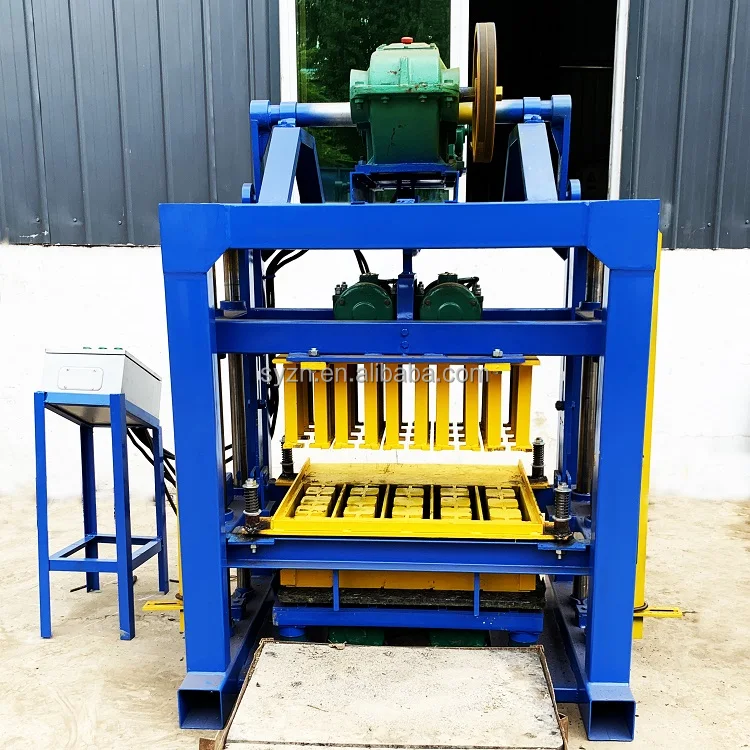
Matched System Sizing — mixer output, pallet circulation and curing area specified against the QTJ4-40’s 40-second cycle so the press never idles between strokes.
Technical Specifications
| Parameter | Value |
|---|---|
| Model | QTJ4-40 |
| Product Type | Hydraulic Semi-Automatic Block Making Machine |
| Overall Dimensions (L×W×H) | 1350 × 1460 × 1800 mm |
| Machine Weight | 1.2 T |
| Rated Power | 10.4 kW |
| Cycle Time | 40 s |
| Vibration System | Bed mould vertical vibration + upper mould compression vibration |
| Pallet Size | 850 × 450 × 20 mm |
| Automation Level | Semi-automatic |
| Mould Compatibility | Hollow, solid, paver (8″, 6″, 5″, 4″ formats) |
| Output – Hollow 400×200×200 mm | 4 pcs/mould, 360 pcs/h, 2880 pcs/day |
| Output – Hollow 400×150×200 mm | 5 pcs/mould, 450 pcs/h, 3600 pcs/day |
| Output – Solid 225×112.5×60 mm | 9 pcs/mould, 800 pcs/h, 6400 pcs/day |
| Raw Materials | Concrete, sand, cement, fly ash, lime, gypsum |
| Voltage | Configurable to local supply (confirm before production) |
| Required Line Equipment | Mixer, host machine, block mould, pallets |
Application Suitability
| Application | Material or Output |
|---|---|
| Small-scale hollow block plant | Crushed stone, sand and cement producing 400×200×200 mm hollow blocks |
| On-site contractor production | Fly ash and cement solid bricks for housing project walls |
| Paver and kerbstone runs | Fine aggregate and cement for 8″ and 6″ interlocking pavers |
| First-time entrepreneur plant | Low-volume mixed format output with manual pallet handling |
| Supplementary line for existing plant | Secondary press adding solid brick capacity alongside a primary automatic line |
What "360 Pieces per Hour" Actually Means for Your Line
The cycle figure only holds when mixer discharge, pallet supply and manual stacking keep pace with every 40-second stroke.
A block production line equipment setup that quotes output based on a single format without stating the assumption will disappoint the moment the shift starts. I once watched a semi-automatic press sit idle for twelve seconds every cycle because the operator was still fetching the next pallet by hand. Over an eight-hour shift those gaps added up to hundreds of missing blocks. The QTJ4-40 is no different — its rated throughput depends entirely on whether the upstream mixer and downstream pallet circulation are sized to match. [NEED_CITE: capacity calculation standards for concrete block presses]
How the Mixer-Press-Pallet Loop Must Balance
A turnkey block plant built around this press starts with the mixer. Its batch size and discharge interval must align with the 40-second moulding cycle so the hopper never runs dry. If the mixer takes ninety seconds per batch but the press consumes material every forty seconds, a buffer hopper or a larger mixer becomes necessary. The block production line equipment only performs as a system when every station feeds the next without delay.
Pallet Circulation Defines Your Real Daily Output
With a pallet size of 850 × 450 × 20 mm, each board stays occupied from the moment the press drops a fresh block until that block is cured and stripped. For continuous operation across an eight-hour shift, the pallet pool must cover the press output plus the entire curing rack inventory. If pallets are short, the operator stops the press and waits — and the stated daily output collapses. This is where most small block plants lose capacity without realising it. [NEED_CITE: pallet circulation planning for semi-automatic block lines]
Reading the Specs That Actually Matter
The dual vibration system — vertical vibration on the bed mould combined with compression vibration from the upper mould — determines block density and surface finish. Without matched vibration on both sides, hollow blocks emerge with thin walls that crack during curing. The 10.4 kW rated power must be read alongside the vibration motors’ share of that total; insufficient vibration force relative to the hydraulic pressure produces blocks that pass a visual check but fail a compressive strength test. Pallet material and thickness also matter: a warped wooden pallet transfers uneven pressure to the block base, and a fibreglass pallet that is too flexible absorbs vibration energy the mould needs.
When the Wrong Pallet Format Derails the Whole Shift
Pallet size and material chosen without regard to the curing area and forklift the buyer already has is a problem I have seen play out more than once. A plant in West Africa received pallets that were too wide for their existing curing racks, forcing a complete rack rebuild before the first block could be stacked. The QTJ4-40 specifies 850 × 450 × 20 mm pallets — confirm that dimension against your rack spacing and forklift tine width before the order goes to production. [NEED_CITE: pallet and curing rack dimension compatibility in block plants]
Why Buyers Come Back to This Configuration
Block machinery is the single focus here, which means the mixer, mould, pallet and handling equipment are specified as one matched set rather than assembled from separate suppliers. The QTJ4-40’s configuration is set against your actual mix design and local aggregate, not pulled from a catalogue default. Mould design covers the formats your market actually sells, including custom drawings when standard sizes do not match. Automation level is selectable — a buyer can start with semi-automatic manual pallet handling and add automatic stacking later without replacing the press. Voltage, frequency and PLC display language are confirmed before the machine leaves the factory, avoiding the commissioning delays I have personally seen cost weeks on site.
Documentation & Verification
- Line layout showing mixer-to-press-to-curing flow with capacity matched per station
- Pallet specification confirming material, quantity and forklift compatibility
- Voltage, frequency and control panel language confirmation sheet
- Mould drawing and format list with cycle time stated per block size
- Factory test record run on your target block format before dispatch
- Operation and maintenance manual with wear parts and mould replacement schedule
Installation, Commissioning & Support
- Foundation pad sized to the 1350 × 1460 mm footprint with anchor bolt template provided
- Dedicated power circuit rated for the 10.4 kW total load at your confirmed voltage and frequency
- Machine shipped as a single skid; vibration assembly and hopper bolted on at site
- First-run parameter tuning against your local aggregate and mix proportions
- Operator training covering mould change procedure and pallet handling rhythm
- Wear parts list with reorder intervals for hydraulic seals and vibration springs
What to Share Before Quoting
To size a block production line equipment package around this press, we need your target block format and daily volume, the raw materials available locally and their grading, your site’s voltage and frequency, and the dimensions of the curing area you plan to use. If you already own a mixer or forklift, share those specs too so the pallet and buffer hopper selections align with what is already on your floor.
Frequently Asked Questions
Q: What upstream and downstream equipment does the QTJ4-40 need to run continuously?
A: The press requires a mixer with batch output matched to the 40-second cycle, a pallet pool large enough to fill the curing racks without interrupting production, and a manual or semi-automatic stacking workflow downstream. Without these three stations balanced, the press will idle between strokes and actual output will fall below the rated figure.
Q: How many pallets are required to keep the press cycling without waiting?
A: Pallet count depends on your curing time and shift length. For an eight-hour shift producing hollow blocks, you need enough 850 × 450 × 20 mm pallets to cover the entire curing rack inventory plus the pallets currently in the press cycle. Shortage means the operator stops and waits.
Q: How is daily output calculated when producing multiple block formats?
A: Each format has a different pieces-per-mould count and cycle behaviour. The QTJ4-40 produces four hollow 400×200×200 mm blocks per cycle but nine solid 225×112.5×60 mm bricks per cycle. Daily output must be recalculated for whichever format dominates your production schedule, not averaged across formats.
Q: What curing area footprint is needed for an eight-hour shift?
A: At the stated hollow block capacity, the curing racks must hold up to 2880 blocks before pallets can be stripped and recycled. The actual floor area depends on your rack height and spacing, but planning must start from that total block count and your local curing duration.
Q: Can the semi-automatic line be upgraded to automatic pallet feeding later?
A: Yes. The QTJ4-40’s semi-automatic configuration can accept automatic pallet feeding and stacking modules as an upgrade path. The press itself does not need replacement; the upstream and downstream stations are extended with automated handling equipment while the moulding cycle remains unchanged.


