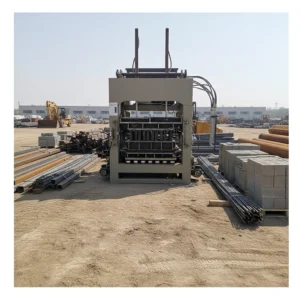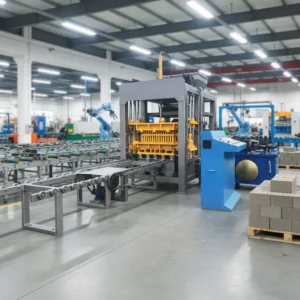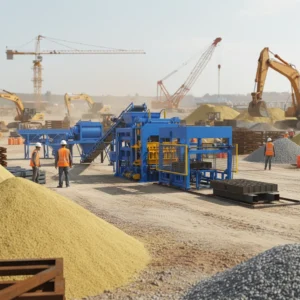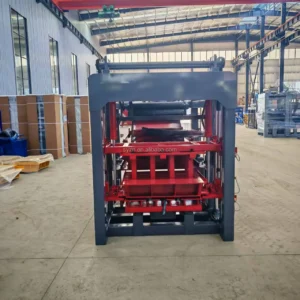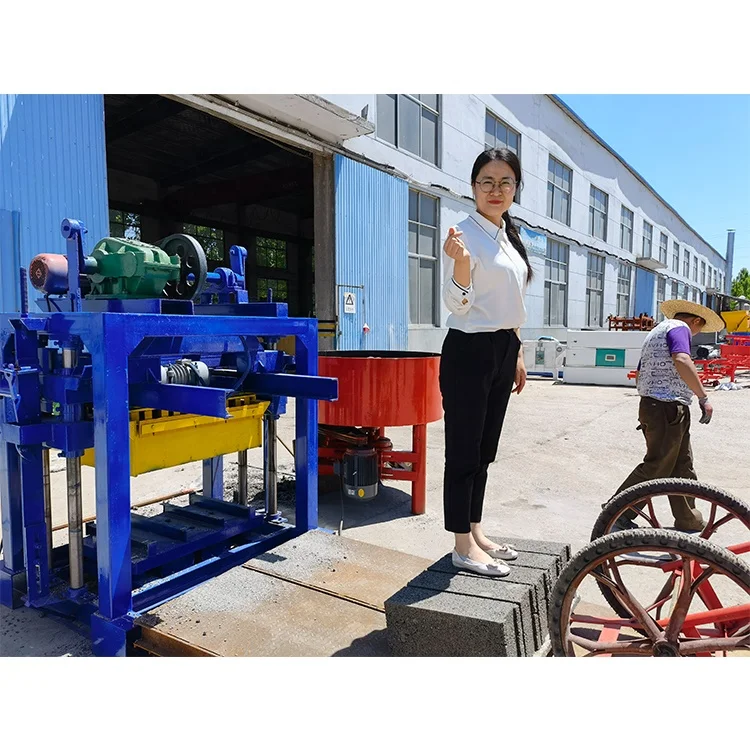
Pacing the Line to the Press — Every station in the QTJ4-40 block production line equipment layout is calculated against the 40-second molding cycle so upstream feed and downstream pallet handling stay synchronized without manual intervention bottlenecks.
Technical Specifications
| Parameter | Value |
|---|---|
| Model | QTJ4-40 |
| Product Type | Semi-Automatic Concrete Block Making Machine |
| Molding Cycle | 40 s |
| Rated Power | 10.4 kW |
| Overall Dimensions | 1350 × 1460 × 1800 mm |
| Machine Weight | 1 T |
| Pallet Size | 850 × 450 mm |
| Vibration Method | Bed mould vertical vibration + upper mould compression vibration |
| Control System | Semi-automatic (top die push-pull with automatic scraper) |
| Voltage | Configured to buyer’s local voltage (basis to be confirmed) |
| Raw Materials | Concrete, sand, cement, fly ash, lime, gypsum |
| Theoretical Output (400×200×200mm hollow block, 4 pcs/mould) | 360 pcs/h, 2800 pcs/day |
| Theoretical Output (400×150×200mm hollow block, 5 pcs/mould) | 450 pcs/h, 3600 pcs/day |
| Theoretical Output (225×112.5×60mm solid brick, 9 pcs/mould) | 800 pcs/h, 6400 pcs/day |
Application Suitability
| Application | Material or Output |
|---|---|
| Small to medium concrete block plants | Hollow blocks from crushed stone, sand, and cement |
| On-site contractor block production | Solid bricks and pavers using locally sourced aggregates |
| Hollow block manufacturing | Fly ash, lime, and gypsum blends with cement binder |
| Paving block and kerbstone production | Dense concrete mixes with fine aggregate gradation |
Why "Daily Output" Means Nothing Without the Line Context
The press cycle sets the tempo, but the real capacity depends on whether every supporting station can keep that beat.
When a quotation lists 2000 to 2500 pieces per 8-hour shift without naming the block format, buyers discover the hard way that the number assumed the smallest brick in the mould catalog. I once configured a line for a West African contractor where the mixer discharged faster than the press could consume, and the surplus concrete piled up on the shop floor before anyone noticed the mismatch. That gap between headline capacity and actual throughput is where block production line equipment projects stall [NEED_CITE: typical causes of block line throughput shortfalls in emerging markets].
The QTJ4-40 completes a moulding cycle every 40 seconds. Every conveyor, pallet return loop, and stacking station around it must be timed to that same interval, or the press sits idle waiting for the next pallet.
Matching the 40-Second Cycle Across Every Station
The 40-second molding cycle is the metronome for the entire block production line equipment setup. If the raw material feeder delivers a batch every 60 seconds, the press loses one-third of its available cycles. Upstream, the mixer discharge rate and the hopper gate timing must align so fresh concrete arrives exactly when the scraper clears the mould. Downstream, the wet-block pallet exit conveyor must pull the loaded pallet away before the next cycle begins, or the operator is forced into manual retrieval that erodes the semi-automatic advantage.
Pallet Circulation as the Hidden Bottleneck
The 850 × 450 mm pallet dimension governs more than just the mould footprint. It determines curing rack slot spacing, the forklift tine width required for rack loading, and the pallet return conveyor track gauge. A plant with an existing curing yard designed for a different pallet size faces a choice: re-slot every rack or accept that pallets pile up on the floor until a worker clears them by hand. Continuous circulation requires enough pallets in the loop to cover press output, curing dwell time, and return travel simultaneously [NEED_CITE: pallet inventory calculation methods for semi-automatic block lines].
Reading the Specs That Actually Shape Your Line
The 10.4 kW rated power of the QTJ4-40 is one input to a total connected load calculation that must also account for the mixer motor, conveyor drives, and any stacking equipment. Specifying voltage and frequency at the line level — not just the press — prevents the situation where the mixer motor is wired for 50 Hz but the site runs at 60 Hz, shortening bearing life and tripping thermal overloads within weeks. The vertical bed mould vibration combined with upper mould compression vibration means the machine densifies concrete through dual-axis compaction, which affects block strength differently depending on your local aggregate grading and cement content. The semi-automatic top die push-pull with automatic scraper defines exactly where an operator must be present: the operator loads raw pallets and monitors the scraper, while the vibration and compression phases run on timer.
What Happens When Line Stations Are Sized Independently
Purchasing the press from one supplier and the mixer, conveyors, and curing racks from separate vendors without a unified cycle-time calculation is the most common source of line imbalance. The mixer may be rated for a batch volume that exceeds what the press consumes in its cycle window, leading to concrete stiffening in the hopper before it reaches the mould. The pallet return loop may be one station too short, so pallets accumulate at the press exit and must be dragged away manually, turning a semi-automatic line into a fully manual one in practice [NEED_CITE: consequences of unmatched station cycle times in concrete block production].
Why Sourcing the Full Line from One Point Matters
Every station around the QTJ4-40 is specified against the same 40-second cycle constraint, so the mixer batch size, conveyor speed, and pallet inventory are calculated together rather than quoted as independent catalog items. Mould design covers the formats your market actually sells, with custom drawings available when standard hollow or solid block profiles do not match local building codes. The pallet specification — material, quantity, and rack compatibility — is confirmed against the 850 × 450 mm size before the quotation is issued, eliminating the surprise of pallets that do not fit your curing yard. Voltage, frequency, and control language are confirmed for the full line, not just the press, so every motor and PLC display arrives matched to your site supply. Automation level is selectable, meaning you can commission the QTJ4-40 as a semi-automatic press today and add automatic stacking or pallet feeding modules later without replacing the core machine.
Documentation & Verification
- Line layout drawing with station cycle times matched to the 40-second press cycle
- Capacity calculation sheet stating the block format behind each output figure
- Pallet specification covering material, dimensions, and curing rack compatibility
- Voltage and frequency confirmation for every motor across the full line
- Factory test record on your target block format before dispatch
- Hydraulic and electrical schematic for on-site troubleshooting
Installation, Commissioning & Support
- Foundation plan accounting for the 1350 × 1460 mm footprint and vibration isolation requirements
- Dedicated circuit sizing based on the 10.4 kW press load plus all upstream and downstream motors
- Machine shipped as a single unit with pallet return conveyor sections packed separately for site assembly
- First-run commissioning with your local aggregate and cement blend to verify block density and cycle timing
- Operator training on the semi-automatic scraper sequence and top die push-pull safety procedure
- Wear parts list covering vibration springs, scraper blades, and mould liners specific to your block format
Before You Send an Inquiry
Share your target block formats, the daily volume you need per format, and the local aggregate and cement types available at your site. Confirm your site voltage and frequency so the entire line — mixer, conveyors, and press — can be wired before shipment. If you already have curing racks or forklifts in place, send the dimensions so the 850 × 450 mm pallet and rack layout can be verified against your existing infrastructure.
Frequently Asked Questions
Q: How is line capacity calculated, and which block format is the daily output based on?
A: The capacity calculation starts with the 40-second moulding cycle and works outward to each supporting station. Daily output figures must state the specific block format — for example, 2800 pieces per day assumes a 400×200×200mm hollow block at 4 per mould. A different format changes the number per cycle and therefore the total. We provide a format-by-format breakdown rather than a single headline number.
Q: What supporting equipment is included in the quotation beyond the press itself?
A: The quotation covers raw material feeding, mixing, pallet circulation, and stacking stations sized to the QTJ4-40 cycle. Each station is listed with its own cycle time so you can verify there is no bottleneck. Curing racks and pallets are included or excluded based on your preference, stated explicitly in the line item breakdown.
Q: How do I match the 850 × 450 mm pallet to my existing curing area and forklift?
A: We ask for your curing rack slot spacing and forklift tine width before finalizing the pallet specification. If your existing racks use a different pallet size, we can adjust the pallet return conveyor design or recommend rack modifications so the QTJ4-40 integrates without requiring a full yard rebuild.
Q: What total connected power does the full line require beyond the 10.4 kW press?
A: Total connected load depends on the mixer motor rating, conveyor drive count, and any stacking equipment selected. We calculate the sum across all stations and recommend a dedicated circuit rating with headroom for starting current. Voltage and frequency are confirmed for every motor to match your site supply before production begins.
Q: How does semi-automatic operation on the QTJ4-40 affect staffing of upstream and downstream stations?
A: Semi-automatic operation means the vibration and compression phases run on timer, but an operator is present to load pallets and monitor the scraper. Upstream, the mixer can be manually or automatically batched depending on your chosen automation level. Downstream, pallet exit and stacking can remain manual or be upgraded to automatic feeding and cubing as your production volume grows.