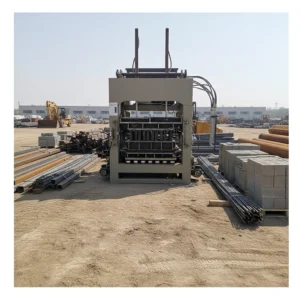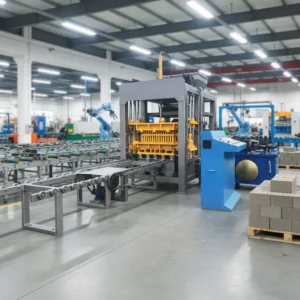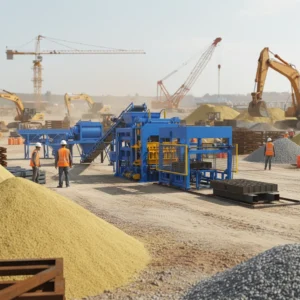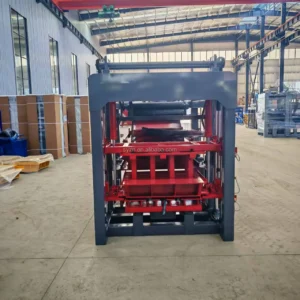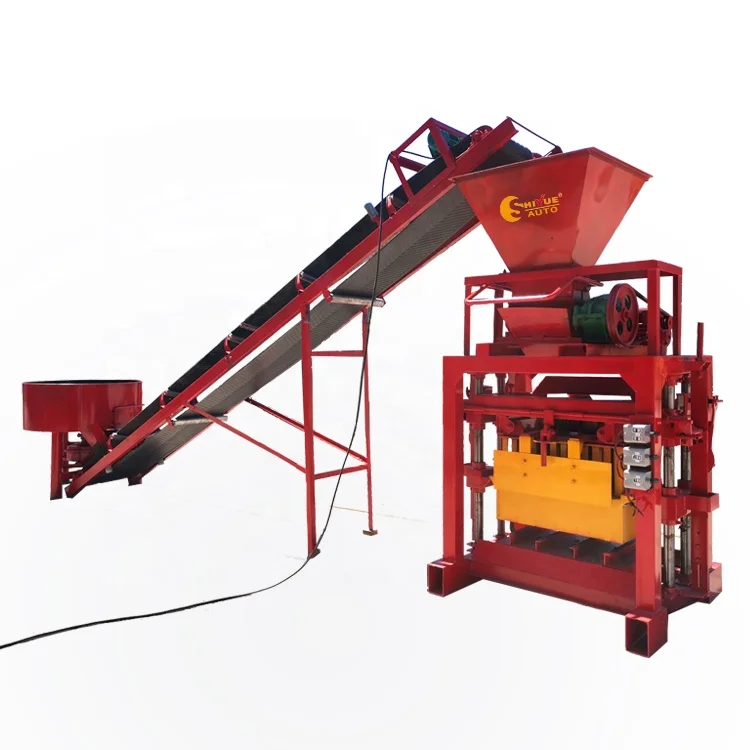
Matched Line Integration — The QTJ4-35 block press is specified alongside its JQ350 mixer, pallet dimensions, and curing layout so material flow never stalls the molding cycle.
Technical Specifications
| Parameter | Value |
|---|---|
| Model | QTJ4-35 |
| Product Type | Small Semi-Automatic Concrete Block Making Machine |
| Overall Dimensions (L×W×H) | 1350×1460×1800 mm |
| Molding Cycle | 35 s |
| Vibration Frequency | 2800 r/min |
| Exciting Force | 30 kN |
| Total Power | 11.15 kW |
| Mixer Model | JQ350 |
| Pallet Size | 850×450×20 mm |
| Net Weight | 1500 kg |
| Frame Construction | Four-lead column guide, channel steel stand |
| Mould Compression | Upper mould and bottom mould compression |
| Applied Products | Concrete hollow blocks (8 inch, 6 inch), solid bricks |
| Output Capacity (Hollow Block 400×200×200 mm) | 408 pcs/hr, 3264 pcs/8hr (4 pcs/mould) |
| Output Capacity (Hollow Block 400×150×200 mm) | 510 pcs/hr, 4080 pcs/8hr (5 pcs/mould) |
| Output Capacity (Solid Brick 240×115×53 mm) | 2100 pcs/hr, 17000 pcs/8hr (18 pcs/mould) |
| Raw Materials | Crushed stones, sand, cement, dust, fly ash |
| Automation Level | Semi-automatic (manual pallet handling) |
| Voltage & Frequency | (basis to be confirmed) |
| Control System | (basis to be confirmed) |
| Hydraulic Pressure | (basis to be confirmed) |
| Mould Change Time | (basis to be confirmed) |
| Stacking Method | Manual (basis to be confirmed) |
Application Suitability
| Application | Material or Output |
|---|---|
| Small-scale block plant start-up | Hollow blocks (400×200×200 mm) from crushed stone, sand, and cement |
| On-site contractor production | Solid bricks (240×115×53 mm) using locally available aggregate and fly ash |
| Paver and kerbstone expansion | Semi-dry concrete mixes fed via JQ350 pan mixer |
| First-time entrepreneur plant | Matched line from raw material batching through manual pallet curing |
Why the Mixer Must Match the Press Cycle
If the JQ350 mixer discharges slower than the 35-second molding cycle, the press sits idle and daily output drops regardless of the machine’s rated speed.
A block press does not operate in isolation. The QTJ4-35 block machine production line supporting equipment must deliver a fresh batch of semi-dry concrete to the hopper before each 35-second cycle completes. When the pan mixer is undersized or the belt conveyor is too slow, the press waits for material and the theoretical 408 hollow blocks per hour becomes an unreachable figure. I have watched lines lose thousands of blocks in a single shift because one station was out of rhythm with the rest. [NEED_CITE: production line synchronization and bottleneck analysis in concrete block manufacturing]
From Raw Feed to Cured Block: Matching Each Station
The QTJ4-35 block machine production line supporting equipment connects raw material feeding, mixing, molding, pallet handling, and curing into one continuous sequence. The JQ350 pan mixer must complete its batch within the window that the press consumes the previous load, ensuring a steady flow of material to the hopper. Every station must be timed so the press never waits and the pallet supply never runs dry.
Pallet Size and Curing Area Alignment
The 850×450×20 mm pallet is the physical link between the press output and the curing yard. If the curing racks are built for a different pallet dimension, or the buyer’s existing forklift cannot handle the loaded weight, the entire downstream handling process breaks down. Confirming pallet compatibility before shipment prevents costly site modifications. [NEED_CITE: pallet standardization in concrete product curing operations]
Vibration Force and Frame Stability Under Continuous Load
The 30 kN exciting force at 2800 r/min compacts the concrete mix into the mould cavity, directly influencing block density and strength. The four-lead column guide and channel steel frame absorb this vibration across an eight-hour shift, maintaining alignment between the upper and lower mould halves. Without a rigid frame, repeated vibration loosens guide clearances and produces blocks with uneven wall thickness. The 11.15 kW total power drives both the vibration motor and the mixer, keeping the electrical load within a single circuit for easier site wiring.
The Cost of an Unbalanced Line Layout
When supporting equipment is sourced separately without a unified line layout, gaps emerge between stations. A mixer placed too far from the press increases material travel time. Pallets stacked by hand without a defined curing rack layout consume more floor space than planned, and the QTJ4-35 block machine production line supporting equipment fails to reach its projected output. These mismatches rarely appear until the first full production day, when the bottleneck reveals itself as lost time at the press. [NEED_CITE: common causes of output shortfall in small-scale block plants]
Why Source the Full Line from One Supplier
Specifying the press, mixer, pallets, and handling as one matched system removes the guesswork from station-to-station timing. Configuration is set against the buyer’s actual mix design and local aggregate, not a catalogue default. Mould design covers the formats the buyer’s market actually sells, including custom drawings when required. Installation and commissioning support ensures the 35-second cycle holds under real site conditions, not just during a factory test. Documentation includes a line layout with capacity calculations stated per block format so daily projections are honest from the start.
Documentation & Verification
- Line layout drawing showing station spacing and cycle time matching for the QTJ4-35 and JQ350
- Capacity calculation sheet listing output per block format with mould count assumed
- Pallet specification matched to buyer’s curing rack dimensions and forklift load rating
- Voltage and frequency confirmation documented before production begins
- Factory test record on buyer’s specified block format and mix design
- Operation and maintenance manual covering mould change and vibration motor service intervals
Installation, Commissioning & Support
- Foundation pad leveled to support 1500 kg net weight and 30 kN continuous vibration
- Dedicated 11.15 kW circuit with confirmed voltage and frequency before energizing
- JQ350 mixer positioned per layout drawing to match the 35-second molding cycle
- First-run test on buyer’s local aggregate and target block format at the site
- Operator training on upper and lower mould compression and manual pallet handling
- Wear parts list covering vibration motor bearings and mould liner replacement schedule
Before You Request a Quotation
Provide the exact block format and dimensions your market requires, along with the local raw materials available and their typical grading. Share your site’s voltage, frequency, and the language needed for the control panel. Include your curing yard dimensions and the forklift model you operate so the 850×450×20 mm pallet can be verified against your existing handling setup.
Frequently Asked Questions
Q: How do I confirm the 35-second cycle holds for my block format?
A: Cycle time depends on the block dimensions, wall thickness, and your specific mix design. We run a factory test using your target format and a representative sample of your local aggregate before shipment, documenting the actual cycle achieved so the capacity calculation reflects real conditions.
Q: What supporting equipment is included in the line?
A: The line covers the QTJ4-35 press, JQ350 pan mixer, pallet supply, and the layout drawing connecting each station. Manual pallet handling and stacking are standard at this tier. Automatic stacking or curing rack systems can be added as separate line components if your volume justifies them.
Q: Does the JQ350 mixer keep up with the press demand?
A: The JQ350 batch volume and discharge time are calculated against the 35-second molding cycle and the number of pieces per mould. If your mix design requires a longer blending time, the layout adjusts mixer placement or adds a buffer hopper to prevent material starvation at the press.
Q: Will the pallet size fit my existing curing racks?
A: The 850×450×20 mm pallet must match your curing rack slot width and your forklift tine spacing. Share your rack dimensions and forklift model before production so we confirm compatibility or adjust the pallet specification to avoid handling problems after arrival.
Q: What electrical information do you need before building the machine?
A: We require your site voltage, frequency, and the preferred language for any control labels. This is confirmed in writing before production starts so the machine arrives ready for connection, avoiding rewiring or panel relabeling during commissioning.