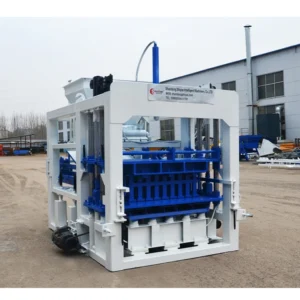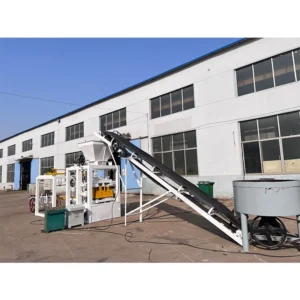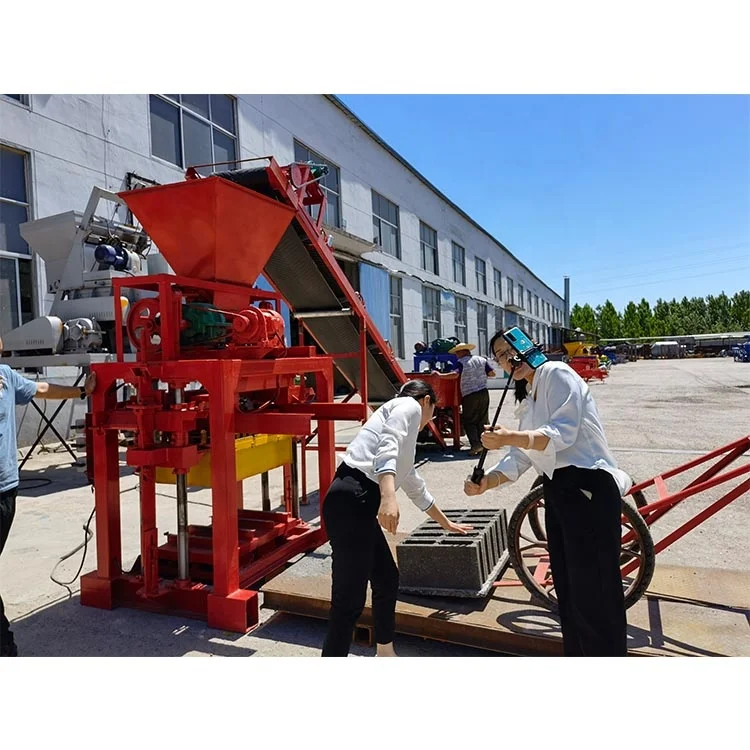
Matched line flow — Every station around the QTJ4-35 is sized so the 35-second press cycle is fed without interruption, preventing the bottleneck that drops real daily throughput.
Technical Specifications
| Parameter | Value |
|---|---|
| Product Type | Concrete Hollow Block Machine |
| Model | QTJ4-35 |
| Overall Dimensions (L×W×H) | 2050×1660×1900 mm |
| Rated Exiting Force | 35 KN |
| Main Vibration Form | Platform Vibration |
| Vibration Frequency | 2800 r/min |
| Pallet Size | 850×450 mm |
| Molding Cycle | 35 s (basis not stated in source) |
| Overall Power | 9.7 kW |
| Total Mass | 1500 kg |
| Demolding Method | Vibration |
| Factory Area | 260 m² |
| Applied Products | Concrete blocks, hollow/solid blocks, pavers, interlocking blocks, curbstone, colored pavers |
| Raw Material | Crushed stone, sand, cement, dust, fly ash, gravel, slag, and other raw materials |
| Voltage & Frequency | Configurable (basis to be confirmed) |
| Control System | Available in manual or semi-automatic configurations |
| Mould Format | Various formats available (basis to be confirmed) |
| Warranty | 1 year (machine body, excluding spare parts) |
Application Suitability
| Application | Material or Output |
|---|---|
| Small-scale hollow block plant | Crushed stone, sand, cement, and fly ash mixes |
| On-site contractor production | Gravel, slag, and dust for solid blocks and curbstones |
| Paver and interlocking brick line | Colored concrete mixes for paving blocks and interlocking formats |
Why the Mixer and Pallet Feeder Define Your Daily Output
The press cycle is only the starting point; the rest of the line dictates what actually leaves the plant.
When buyers look at a Concrete Hollow Block Machine production line, they often fixate on the 35-second molding cycle. But if the upstream mixer discharges every 45 seconds, or the pallet feeder jams every third cycle, the press sits idle. I have seen plants where the QTJ4-35 was the most expensive piece of equipment, yet the daily output was dictated by a mismatched conveyor belt. Planning the line means matching every station’s interval to the press’s rhythm [NEED_CITE: industrial line balancing principles for manufacturing].
Station-to-Station Cycle Synchronization
The QTJ4-35 operates on a 35-second molding cycle. For the line to run without the press waiting, the mixer must discharge a fresh batch in under 35 seconds, and the pallet feeder must advance a clean 850×450 mm pallet into position within that same window. If the pallet return loop is slower than the press output, wet blocks stack up on the discharge side, forcing the operator to stop the machine and clear the congestion.
Pallet Size and Curing Area Footprint
The 850×450 mm pallet size is not just a press parameter; it determines the spacing of the curing racks and the type of forklift required to move them. If the curing area is designed for a different pallet dimension, the entire flow from the press to the stacking zone breaks down. A Concrete Hollow Block Machine production line must be laid out so that the pallets leaving the press fit directly into the existing or planned curing infrastructure without manual rehandling.
Power Draw Across the Entire Line
The QTJ4-35 draws 9.7 kW, but that is only the press itself. The mixer motor, the belt conveyor, the pallet return system, and any automatic stacking station add significant load. When planning the electrical supply, the total connected load must account for all stations starting simultaneously or in sequence [NEED_CITE: electrical load calculation standards for block plants]. Undersizing the main breaker because you only looked at the press plate will trip the system during startup.
Floor Space and Station Layout
The 260 m² factory area is a baseline for the press, mixer, and basic curing. However, a complete line needs space for raw material stockpiles, a water supply, and a finished block staging area. The layout must ensure that the forklift path from the curing zone to the dispatch area does not cross the raw material feed path, which would create congestion and safety hazards around the Concrete Hollow Block Machine production line.
The Cost of Ignoring Upstream and Downstream
Buying the press alone and sourcing the rest locally often leads to a line where the stations do not communicate. If the mixer discharge gate is manual, the operator’s timing will never match the press cycle perfectly, leading to either dry mix waiting in the hopper or the press running empty. Similarly, if the pallets are not returned automatically, you need extra labor just to move wood or PVC boards back to the start. These hidden inefficiencies are why real output falls far below the theoretical cycle-time calculation [NEED_CITE: common causes of block plant downtime].
Why Source the Line as One System
When the QTJ4-35 is specified as part of a complete package, the pallet feeder speed, the mixer discharge interval, and the stacking station capacity are all calculated against the same 35-second baseline. This means the voltage and control language are confirmed for every motor and sensor, not just the main press. The layout drawing shows the exact placement of each station, ensuring the 9.7 kW press and its supporting equipment fit the 260 m² footprint without last-minute cable runs or foundation modifications.
Documentation & Verification
- Line layout and capacity calculation stating the block format assumed at each station.
- Pallet specification matched to the 850×450 mm size and the buyer’s curing rack dimensions.
- Voltage and control language confirmation for the press, mixer, and all supporting motors.
- Station-to-station cycle time analysis showing buffers and speed adjustments.
- Factory test record on the buyer’s specific raw material mix before dispatch.
Installation, Commissioning & Support
- Foundation plan for the 2050×1660×1900 mm press and heavy vibration loads.
- Electrical schematic for the 9.7 kW press and additional line motors.
- Assembly and alignment of the 850×450 mm pallet feed and return loops.
- First-run parameter setting for the 2800 r/min vibration frequency and 35-second cycle.
- Operator training on manual or semi-automatic control sequences and mould changes.
- Wear parts list for the vibration platform and hydraulic exiting force components.
Planning Your Line Inquiry
To move from a single machine quote to a coordinated Concrete Hollow Block Machine production line, please provide your target block format and the daily volume you need to sell. We also need to know your local raw material availability and the exact dimensions of your existing curing area and forklift capacity. Finally, confirm your site voltage and preferred control language so every station in the line arrives ready to run.
Frequently Asked Questions
Q: How is real daily output calculated when every station has its own cycle time?
A: Real output is determined by the slowest station in the Concrete Hollow Block Machine production line. If the press cycles in 35 seconds but the mixer takes 45 seconds, the line output is limited by the mixer. We calculate the daily volume by multiplying the bottleneck station’s rate by the actual running hours, accounting for mould changes and pallet handling.
Q: How should pallet size be chosen to match existing curing racks?
A: The 850×450 mm pallet size dictates the spacing of your curing racks and the forks used to move them. If your existing racks are built for a different size, you will face manual rehandling. We specify the pallets based on your current curing infrastructure and the forklift capacity at your site to ensure a smooth flow from press to cure.
Q: What happens if the mixer discharge rate does not match the press cycle?
A: If the mixer is slower than the press, the QTJ4-35 will sit idle waiting for material, dropping output. If the mixer is too fast, the hopper overflows or the mix dries out before pressing. We match the mixer discharge interval to the press molding cycle so the material arrives exactly when the press is ready to compact.
Q: Which supporting stations are typically omitted from quotations?
A: Many quotes only include the press, leaving out the pallet return loop, the raw material batching system, and the stacking station. Without these, the Concrete Hollow Block Machine production line relies on manual labor to move boards and stack blocks, which limits throughput and increases labor costs significantly.
Q: How do we plan the floor area to include all stations?
A: The 260 m² is a baseline, but a full line needs space for raw material stockpiles, the mixer, the curing zone, and finished block staging. We provide a layout drawing that positions each station to minimize forklift travel and ensure the 9.7 kW press and its supporting equipment operate without congestion or safety hazards.