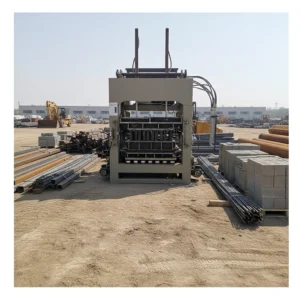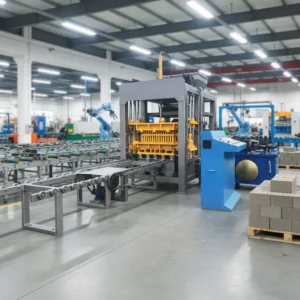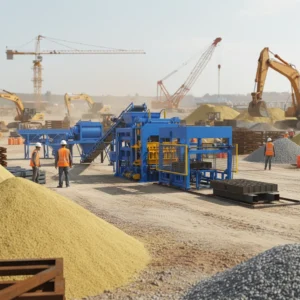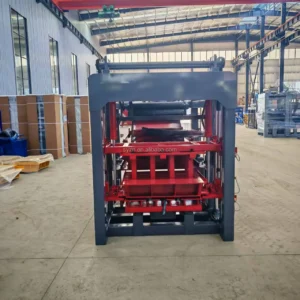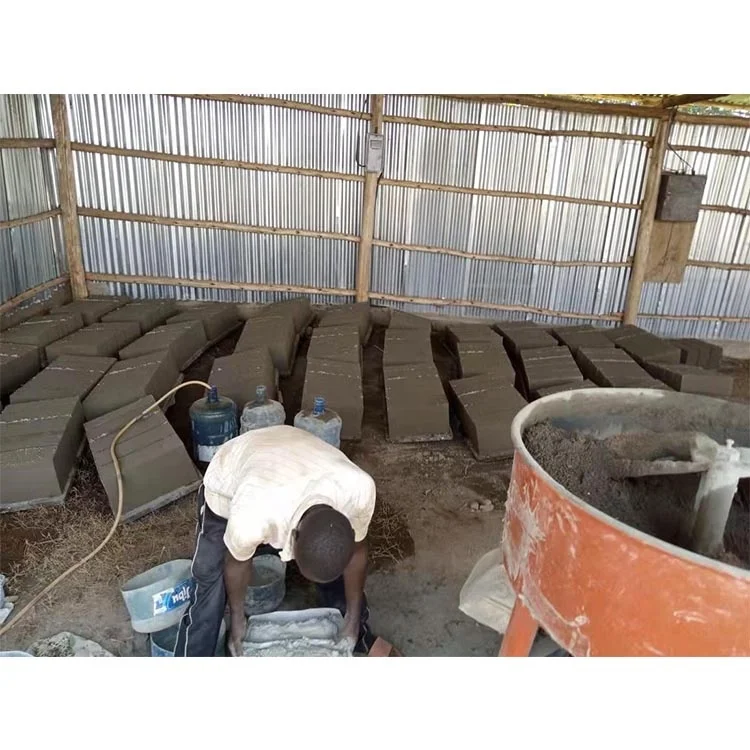
Matched Line Configuration — belt conveyor, JQ350 mixer and pallet system are specified against the 35-second press cycle so the host machine never idles waiting for material or pallets.
Technical Specifications
| Parameter | Value |
|---|---|
| Product Type | Automatic Concrete Block Making Machine with Belt Conveyor |
| Model | QTJ4-35 |
| Overall Dimensions (L×W×H) | 1350×1460×1800 mm |
| Molding Cycle | 35 s |
| Vibration Frequency | 2800 r/min |
| Exciting Power (Vibration Force) | 30 kN |
| Total Power | 11.15 kW |
| Mixer Model | JQ350 |
| Pallet Size | 850×450×20 mm |
| Net Weight | 1500 kg |
| Output Capacity (400×200×200 mm hollow block) | 4 pcs/mould, 408 pcs/hr, 3264 pcs/8 hr |
| Output Capacity (400×150×200 mm hollow block) | 5 pcs/mould, 510 pcs/hr, 4080 pcs/8 hr |
| Output Capacity (240×115×53 mm solid brick) | 18 pcs/mould, 2100 pcs/hr, 17000 pcs/8 hr |
| Automation Level | Semi-automatic with belt conveyor feeding |
| Stacking Method | Manual |
| Applied Products | Concrete hollow blocks (8 inch, 6 inch), solid bricks |
Application Suitability
| Application | Material or Output |
|---|---|
| Small-scale block plants | Crushed stone, sand, cement, fly ash |
| On-site construction production | Hollow blocks (8 inch, 6 inch) for local building projects |
| First block plant startups | Solid bricks and hollow blocks with lower capital investment |
| Building material distributors | Hollow block and solid brick added to existing product ranges |
| Housing project contractors | Local block production from site-available aggregates |
Why "Output per Hour" Means Nothing Without the Rest of the Line
The press only runs as fast as the slowest station feeding it.
When I planned a small block line for a project in West Africa, the buyer focused entirely on the QTJ4-35 molding cycle of 35 seconds. What he didn’t ask was whether the mixer could keep up, or whether the belt conveyor would deliver a full batch before the next press stroke. On paper, the numbers looked fine. In practice, the conveyor arrived half a beat late, the press sat idle between cycles, and daily output fell noticeably short of the quoted figure. After that experience, I started timing every station in the block production line equipment with a stopwatch before signing off on any line layout [NEED_CITE: cycle time synchronization in small-scale block production lines].
The problem is common: sellers quote the press capacity in cycles per hour based on a single block format, without stating how the mixer, conveyor and pallet return must be matched to sustain that rhythm over an eight-hour shift.
How the Mixer and Conveyor Keep Pace with the Press
The JQ350 mixer is paired to the QTJ4-35 output tier, producing a batch volume that aligns with what the press consumes every 35 seconds. The belt conveyor then bridges the gap between mixer discharge and press hopper, carrying material at a rate that prevents the hopper from running dry mid-cycle. When either station lags, the concrete block making machine supporting equipment chain breaks down and the press waits — burning time without producing blocks. This is why the block production line equipment must be quoted as a connected system, not as isolated machines [NEED_CITE: material flow synchronization in concrete block plants].
Pallet Handling as the Hidden Bottleneck
The pallet size of 850×450×20 mm determines not only what fits inside the press but also how pallets stack in the curing area and whether your existing forklift can handle them. Many quotations list the pallet dimension without confirming material or quantity, leaving the buyer to source pallets locally at higher cost. On a semi-automatic line like this, pallets move manually from press to curing rack and back, so the pallet specification must account for the full daily volume — not just the number sitting under the press at any one moment. Getting this wrong means pallets run out mid-shift or the curing racks cannot accept the loaded boards.
Reading the Numbers That Actually Matter
The vibration force of 30 kN at 2800 r/min is the primary driver of block density, but its effectiveness depends entirely on the mix design and local aggregate gradation. A fine sand mix responds differently than a crushed stone blend, and if the vibration parameters are not adjusted to match, block strength will vary from batch to batch. The total power of 11.15 kW covers the press, mixer and conveyor together, which is important to verify against your site’s available electrical supply before ordering. Voltage, frequency and control language must all be confirmed in advance — a mismatch here delays commissioning by days or weeks once the block production line equipment arrives on site. The molding cycle of 35 seconds applies to the press stroke itself; actual throughput depends on how quickly the operator loads pallets, clears finished blocks and changes moulds between formats.
The Cost of Treating the Press as a Standalone Purchase
Buyers who purchase the press alone and add supporting equipment later frequently discover that the mixer they chose is undersized, or that the belt conveyor runs at a fixed speed that does not match the 35-second cycle. The result is a line that technically works but never reaches its stated capacity. Pallets sourced locally may be the wrong thickness, causing them to jam in the press or crack under vibration. These are not equipment failures — they are configuration errors that show up only after the line is running [NEED_CITE: common causes of block line underperformance].
Why the Line Is Quoted as One System
Every station in this small-scale block production line equipment setup is specified against the others, so the mixer output, conveyor speed and pallet count all align with the press cycle. The line layout drawing shows how each station connects and where cycle times must match, rather than leaving those details for the buyer to work out on site. Mould options cover the hollow block and solid brick formats your market actually sells, with capacity stated per format so there is no guesswork about daily output. Voltage, frequency and PLC display language are confirmed before production begins, not after the containers are loaded. Wear parts and mould replacements are listed upfront so the first reorder does not become a sourcing problem.
Documentation & Verification
- Line layout drawing showing station connections and cycle time for each format
- Capacity calculation sheet stating block format assumed for every output figure
- Pallet specification with material, thickness and quantity matched to curing method
- Factory test record run on buyer’s target block format before dispatch
- Voltage, frequency and control language confirmation sheet signed before production
- Operation and maintenance manual with wear parts and mould replacement list
Installation, Commissioning & Support
- Foundation plan based on 1350×1460×1800 mm footprint and 1500 kg net weight
- Electrical supply check against 11.15 kW total power before line connection
- Belt conveyor alignment verified with mixer discharge and press hopper on site
- Vibration frequency set to 2800 r/min and tested with buyer’s local aggregate
- Operator training covering mould change, pallet handling and daily maintenance routines
- Wear parts list covering high-friction components for first reorder planning
What to Share Before Requesting a Quotation
To size this block production line equipment correctly, we need to know which block formats your market sells most, your target daily output per format, and what raw materials are available locally — including aggregate type and cement grade. Share your site voltage and frequency so the electrical system can be configured before production, and let us know what forklift and curing rack setup you already have so the pallet specification matches your existing equipment.
Frequently Asked Questions
Q: Which supporting stations are included in the line and which must I supply separately?
A: The line includes the QTJ4-35 press, JQ350 mixer, belt conveyor and pallet specification. Stacking is manual, so automatic stacking and cubing equipment are not part of this configuration. Curing racks and forklifts are buyer-supplied. The quotation lists every included station so there are no surprises on arrival.
Q: How does the mixer and conveyor capacity match the press cycle?
A: The JQ350 mixer batch volume is calculated against the 35-second molding cycle, and the belt conveyor is set to deliver material before the press hopper empties. When all three are specified together, the press does not idle between strokes waiting for the next batch to arrive from upstream.
Q: Is the pallet size compatible with my existing curing racks and forklift?
A: The standard pallet dimension is 850×450×20 mm, but material and thickness must be confirmed against your curing method and forklift capacity. Share your current setup details so the pallet specification can be adjusted before the line ships, avoiding a mismatch that would require a separate local purchase.
Q: What block formats can the line produce, and what is the realistic output?
A: The line produces 400×200×200 mm and 400×150×200 mm hollow blocks as well as 240×115×53 mm solid bricks. Output is rated at 408 pcs/hr for the larger hollow block, 510 pcs/hr for the smaller hollow block, and 2100 pcs/hr for solid bricks, each based on the stated format and a 35-second cycle.
Q: What voltage and control details should I confirm before the line ships?
A: Voltage, frequency and control language are not stated as defaults and must be confirmed to match your site supply and operator requirements. This confirmation happens before production begins so that commissioning is not delayed after the concrete block making machine supporting equipment arrives at your facility [NEED_CITE: electrical standards for exported industrial machinery].