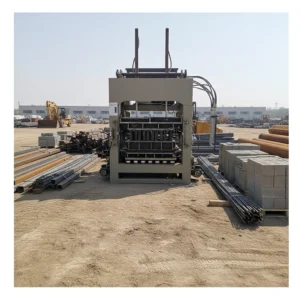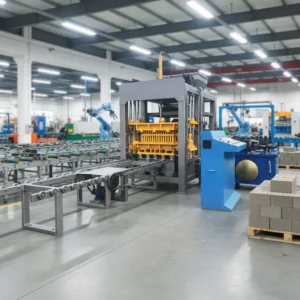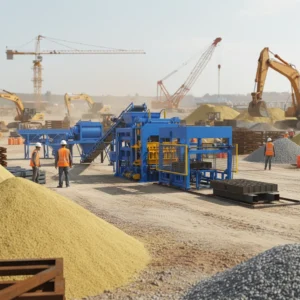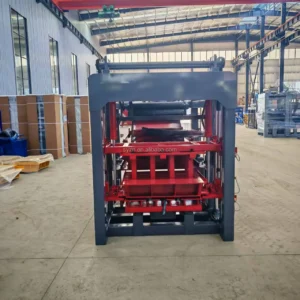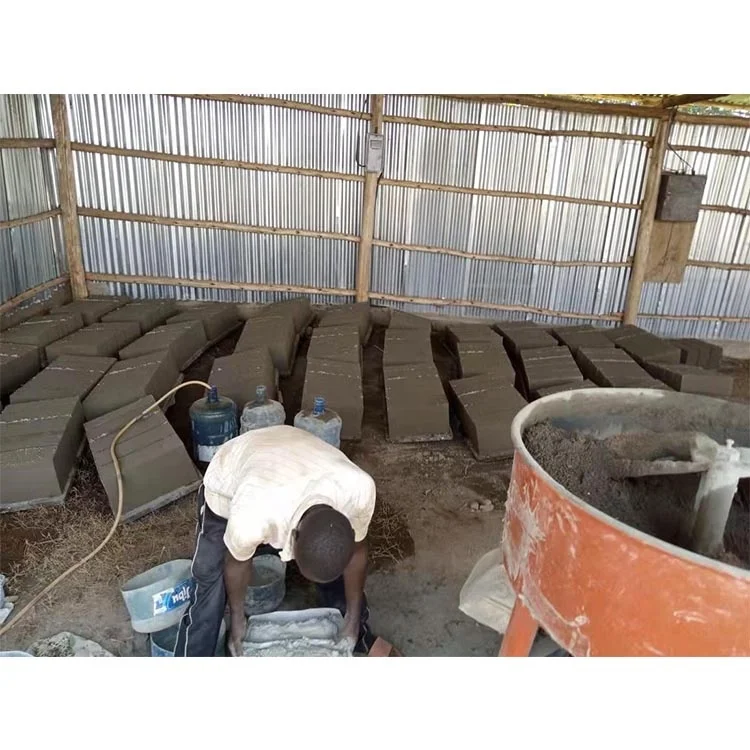
Matched Line Integration — every station from mixer to curing rack is timed against the QTJ4-35 press cycle so the host is never left waiting for material or pallets.
Technical Specifications
| Parameter | Value |
|---|---|
| Model | QTJ4-35 |
| Product Type | Automatic Concrete Block Making Machine |
| Overall Dimensions (L×W×H) | 1350×1460×1800 mm |
| Molding Cycle | 35 s |
| Vibration Frequency | 2800 r/min |
| Exciting Force | 30 kN |
| Total Power | 11.15 kW |
| Mixer Model | JQ350 |
| Pallet Size | 850×450×20 mm |
| Net Weight | 1500 kg |
| Applied Products | Concrete blocks, hollow block (8 inch, 6 inch), solid brick |
| Raw Materials | Crushed stones, sand, cement, dust, fly ash |
| Output Capacity (Hollow Block 400×200×200 mm) | 408 pcs/h, 3264 pcs/8hr (based on 4 pcs/mould) |
| Output Capacity (Hollow Block 400×150×200 mm) | 510 pcs/h, 4080 pcs/8hr (based on 5 pcs/mould) |
| Output Capacity (Solid Brick 240×115×53 mm) | 2100 pcs/h, 17000 pcs/8hr (based on 18 pcs/mould) |
| Automation Level | Semi-automatic with belt conveyor |
Application Suitability
| Application | Material or Output |
|---|---|
| Small to medium block plants | Hollow block production from crushed stone, sand, and cement |
| On-site construction production | Solid brick forming using local aggregate and fly ash |
| Entry-level entrepreneur setup | Mixed format output across 8-inch and 6-inch hollow blocks |
What the Quoted Cycle Time Actually Requires Upstream
The 35-second press cycle only holds if the mixer discharges a full batch and the belt conveyor delivers it before the next mould closes.
When I was buying equipment for a brick plant, the supplier quoted the host press cycle without mentioning that the JQ350 mixer needed a longer batch time than the press needed to form. The press sat idle while the mixer caught up, and the whole concrete block making machine production line produced far fewer blocks per shift than the brochure promised. This mismatch between stations is the most common reason output disappoints after installation [NEED_CITE: typical mixer batch cycle versus press cycle mismatch in block plants].
How Each Station Feeds the Next
The concrete block making machine production line starts with raw material feeding into the JQ350 mixer. The mixer must complete its batch and discharge onto the belt conveyor within a window that leaves the press hopper full before the 35-second molding cycle finishes. If the conveyor speed or mixer discharge gate is undersized, the press waits. Every station is specified together so these timing dependencies are resolved before the line ships.
Pallet Return and Curing Area Coordination
After forming, each pallet carrying wet blocks must travel to the curing area and an empty pallet must return to the press station before the next cycle. The 850×450×20 mm pallet size dictates the curing rack spacing and the forklift capacity needed for handling. If the pallet return loop is longer than the press cycle, the host stops [NEED_CITE: pallet circulation rate versus press cycle dependency]. Specifying the pallet handling path alongside the press ensures the return speed keeps pace.
Reading the Specs That Govern Line Balance
The vibration force of 30 kN at 2800 r/min determines how densely the concrete is compacted in the mould, which in turn affects block strength and demoulding quality. The total power draw of 11.15 kW covers the press alone; the mixer, conveyor, and any pallet feeding mechanism add to the connected load and must be included in site electrical planning. Pallet thickness of 20 mm must match the curing rack slot width, and the 1500 kg machine weight requires a level concrete pad that can absorb vibration without cracking over time.
What Happens When Stations Are Specified Separately
Buying the press from one supplier and the mixer and conveyor from another often leads to a line where each station works perfectly alone but the timing does not align. The mixer batch size may be too small for the mould volume, the conveyor belt may run too slow, or the pallet stack may not feed at the rate the press demands. The result is a concrete block making machine production line that runs below its rated cycle for most of the shift, with operators manually intervening to keep material flowing [NEED_CITE: line integration failures from multi-supplier sourcing].
Why a Line-Level Quotation Changes the Outcome
Our approach treats the QTJ4-35 as one node in a connected sequence. The line layout drawing shows material flow from batching through mixing, conveying, pressing, and pallet transfer to curing, with cycle times stated at each station. Configuration is set against the buyer’s actual mix design and local aggregate rather than a catalogue default, so the vibration force and cycle time produce consistent block density. Mould design covers the formats the buyer’s market sells, and pallet specification accounts for the curing racks and forklift already on site.
Documentation & Verification
- Line layout drawing with station positions and total footprint including curing area
- Capacity calculation stating the block format each output figure assumes
- Pallet specification confirming material, thickness, and rack compatibility
- Electrical schematic with voltage, frequency, and total connected load for all stations
- Factory test record on buyer’s target block format before dispatch
Installation, Commissioning & Support
- Level concrete pad sized for 1350×1460 mm footprint and 1500 kg vibration load
- Dedicated power circuit for 11.15 kW press plus separate feeds for JQ350 mixer and conveyor
- Voltage and frequency confirmed before production to match site supply
- On-site commissioning with cycle time verified against actual mixer batch discharge rate
- Operator training covering mould change procedure and pallet return loop management
- Wear parts list covering vibration components and hydraulic elements with lead times
What to Prepare Before Requesting a Line Quote
Share the target block format and the daily output you need so the capacity calculation reflects your actual product mix. Provide your local aggregate type and mix proportions so the vibration parameters can be set correctly. Confirm your site voltage, frequency, and the curing rack dimensions you already have or plan to build so the pallet specification aligns from the start.
Frequently Asked Questions
Q: How is the line capacity calculated and which block format does each output figure assume?
A: Each output figure is tied to a specific block format and mould cavity count. The 408 pieces per hour assumes 400×200×200 mm hollow blocks at 4 per mould, while 2100 pieces per hour assumes 240×115×53 mm solid bricks at 18 per mould. These figures hold only if the mixer and conveyor sustain the 35-second cycle without interruption.
Q: Does the quoted power include the mixer, conveyor and all supporting stations?
A: The 11.15 kW figure covers the QTJ4-35 press only. The JQ350 mixer and belt conveyor each draw additional power. A full line electrical schematic listing every station’s connected load is provided so you can size your site transformer and distribution panel correctly before shipment.
Q: How must pallet size and material be matched to the curing area and forklift?
A: The 850×450×20 mm pallet must fit the curing rack slot width and be within the forklift’s load rating when stacked with wet blocks. Pallet material affects weight and durability under repeated vibration. Confirming your existing rack dimensions and forklift capacity before ordering prevents a mismatch on arrival.
Q: What happens if the mixer batch cycle does not match the 35-second press cycle?
A: The press hopper runs empty and the host waits, reducing actual output below the rated cycle. The JQ350 mixer batch size and discharge time must be calculated against the mould volume and press speed so material arrives before the next cycle begins. This timing is verified during line layout planning.
Q: Is the belt conveyor and pallet feeding included in the line quotation or supplied separately?
A: The belt conveyor is included as a standard station in the line. Pallet feeding and return mechanisms are specified based on the automation level selected. Each item is listed individually in the quotation so the scope of supply is clear before production begins.