
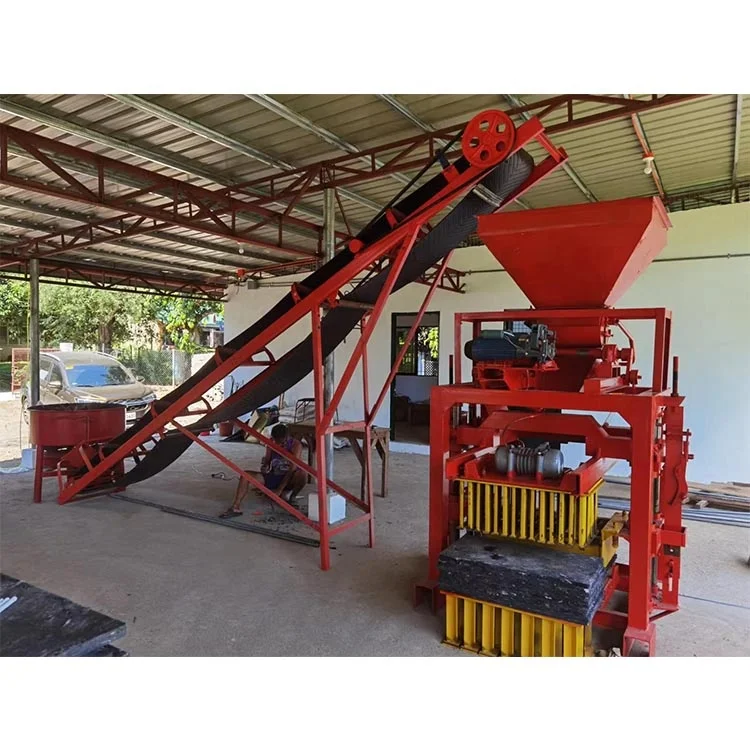
Line balance over press speed — every station from mixer to curing rack is timed against the QTJ4-35’s 35-second molding cycle so the press never idles waiting for a pallet or a batch.
Technical Specifications
| Parameter | Value |
|---|---|
| Product Type | Manual Concrete Block Making Machine |
| Model | QTJ4-35 |
| Overall Dimensions (L×W×H) | 2050×1660×1900 mm |
| Total Mass | 1500 kg |
| Rated Power | 9.7 kW |
| Vibration Force | 35 kN |
| Main Vibration Form | Platform Vibration |
| Vibration Frequency | 2800 r/min |
| Pallet Size | 850×450 mm |
| Molding Cycle | 35 s (basis not stated in source — confirm block format / material / thickness) |
| Demolding Method | Vibration |
| Recommended Factory Area | 260 m² |
| Applied Products | Concrete blocks, hollow/solid blocks, pavers, interlocking blocks, curbstone, colored pavers |
| Raw Material | Crushed stone, sand, cement, dust, fly ash, gravel, slag |
| Control System | Manual / Semi-automatic (basis to be confirmed) |
| Stacking Method | Manual |
| Warranty | 1 year (excluding spare parts) |
Application Suitability
| Application | Material or Output |
|---|---|
| Hollow block production for low-rise residential walls | Crushed stone, sand, and cement blends |
| Solid block manufacturing for load-bearing partitions | Gravel, fly ash, and cement mixes |
| Paver and interlocking brick runs for walkways and driveways | Fine aggregate with pigment additives |
| Curbstone forming for site infrastructure | Coarse aggregate with higher cement ratio |
| On-site block production for remote construction projects | Locally sourced sand, dust, and slag |
Why a 35-Second Cycle Doesn’t Guarantee 8,000 Blocks a Day
The QTJ4-35 block making machine production line only delivers rated output when every upstream and downstream station keeps pace with the press.
A 35-second molding cycle looks promising on paper, but I have watched small plant operators lose half their shift because the mixer couldn’t feed fast enough or the pallet return loop bottlenecked at the curing rack. When the pallet feeder jams or the operator is still hauling wet blocks by hand, the press sits empty. The cycle time on the nameplate assumes a continuous flow of prepared mix, clean pallets, and clear curing space — conditions that must be engineered into the line, not left to chance [NEED_CITE: block plant cycle time assumptions versus real-world throughput].
Matching Mixer Batch Size to the Press Appetite
The QTJ4-35 consumes a fresh batch every 35 seconds across an 850×450 mm pallet. A pan mixer that discharges once every two minutes will leave the press waiting for nearly one-third of its available time. Sizing the mixer to drop a full pallet charge every cycle — or pairing two smaller mixers in alternating rotation — keeps material flowing without forcing the operator to rush the mix. The rated power of 9.7 kW already accounts for vibration and demolding; the mixer and conveyor motors sit on separate circuits that must be planned before the first foundation bolt is set.
Pallet Circulation and the Hidden Curing Bottleneck
With manual stacking, each cured pallet must be wheeled or forked to the yard before a fresh pallet can re-enter the press. If the curing rack spacing doesn’t match the 850×450 mm pallet, or if the forklift can’t reach the top tier, pallets pile up on the floor and the line stalls. Planning the curing area layout — rack height, aisle width, forklift turning radius — before the QTJ4-35 block making machine production line ships prevents a situation where the press is technically running but physically blocked [NEED_CITE: pallet circulation planning for small-scale block plants].
Reading the Vibration Specs Beyond the Label
Platform vibration at 2800 r/min with 35 kN force is the compaction engine of this machine. The frequency sets how quickly the mix particles settle, while the force determines how tightly they pack. A mix with too much fines content will over-consolidate under these parameters, producing dense but brittle blocks. A coarser aggregate may need the full 35-second cycle just to reach target density. Adjusting the mix design to match the vibration profile — rather than adjusting the machine to compensate for a poor mix — is the path to consistent block strength without adding cement cost.
When Stations Fall Out of Sync
A mixer that finishes early doesn’t help if the pallet feeder is two cycles behind. A curing rack that’s full doesn’t matter if the operator can’t clear it fast enough. I have seen lines where each individual station was correctly specified, but the sequence between them was never mapped — so the slowest station dictated the real output. Building a simple cycle chart that traces one pallet from raw mix to stacked block reveals where seconds accumulate into lost hours, and that chart should be part of the line proposal before any equipment is ordered [NEED_CITE: station-to-station timing in manual block lines].
Why Sourcing the Full Line Matters
Block machinery is our single focus, which means the QTJ4-35 press, its pallets, moulds, and handling equipment are specified as one matched system rather than assembled from unrelated suppliers. The line layout we provide states the block format behind every capacity figure, so there is no ambiguity about daily output. Mould design covers the formats your market actually sells, and automation level is selectable — start with manual pallet handling today and add semi-automatic feeding later without replacing the press. Voltage, frequency, and PLC display language are confirmed before production begins, not discovered on arrival.
Documentation & Verification
- Line layout drawing with capacity stated per block format and pallet size
- Machine specification sheet matching the exact configuration ordered
- Mould drawing and format list for every block type in the quotation
- Pallet material and thickness spec aligned with curing rack spacing
- Factory test record run on your target mix before dispatch
- Voltage, frequency, and control language confirmation document
Installation, Commissioning & Support
- Foundation plan for the 2050×1660 mm footprint with vibration isolation pads
- Dedicated 9.7 kW circuit with voltage and frequency matched to site supply
- Pallet guide rail alignment checked against 850×450 mm pallet tolerance
- Mixer and feeder sequence timed to the 35-second press cycle on-site
- Operator training covering mould change, mix adjustment, and daily greasing points
- Wear parts list with reorder codes for vibration springs and platform liners
What to Include With Your Inquiry
Tell us the block formats you need to produce, the daily volume you’re targeting, and the raw materials available at your site. Include your workshop dimensions and the voltage/frequency standard in your area. If you already own a mixer, forklift, or curing racks, share their specifications so we can confirm compatibility or flag where the line needs a different component.
Frequently Asked Questions
Q: How is daily output calculated, and which block format is the cycle time based on?
A: The 35-second cycle is a machine-level figure that must be mapped to a specific block format, mix design, and pallet layout. Our capacity calculation states the assumed block size — for example, 390×190×190 mm hollow blocks at four per pallet — so you can see exactly how many pieces per shift the line delivers under those conditions.
Q: What supporting equipment completes the line around the QTJ4-35?
A: Beyond the press itself, a balanced line includes a pan mixer sized to the cycle rate, a pallet feeder or manual pallet cart, a raw material batching station, and curing racks dimensioned for 850×450 mm pallets. Each station’s throughput must match or exceed the press cycle to avoid idle time.
Q: How do I confirm pallet size matches my existing curing area and forklift?
A: Measure your curing rack shelf spacing and your forklift fork width against the 850×450 mm pallet. If racks are narrower or the forklift can’t reach the top tier, we adjust pallet dimensions or recommend rack modifications before the line ships, avoiding a situation where pallets can’t circulate.
Q: What voltage and frequency options are available, and is PLC display language configurable?
A: Voltage and frequency are confirmed during the proposal stage to match your local grid — common ranges include 220V/380V/440V at 50 or 60 Hz. If a PLC is included in your automation level, the display language is set before dispatch so operators can read parameters from day one.
Q: How are raw material feeding and mixing stations sized to keep pace with the press cycle?
A: We calculate the mix volume consumed per cycle based on your block format and pallet load, then specify a mixer that discharges that volume within the 35-second window. Feeder conveyor speed and hopper capacity are matched so the mixer never waits for material and the press never waits for mix.


