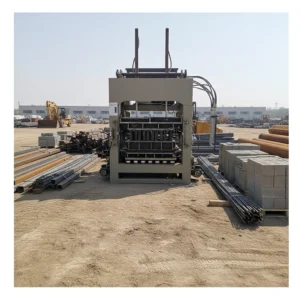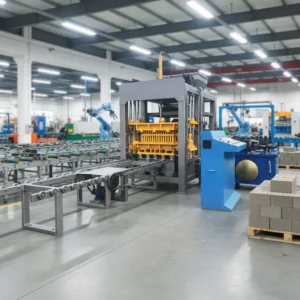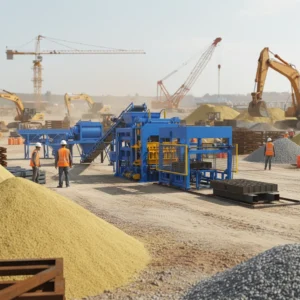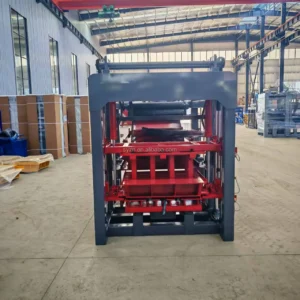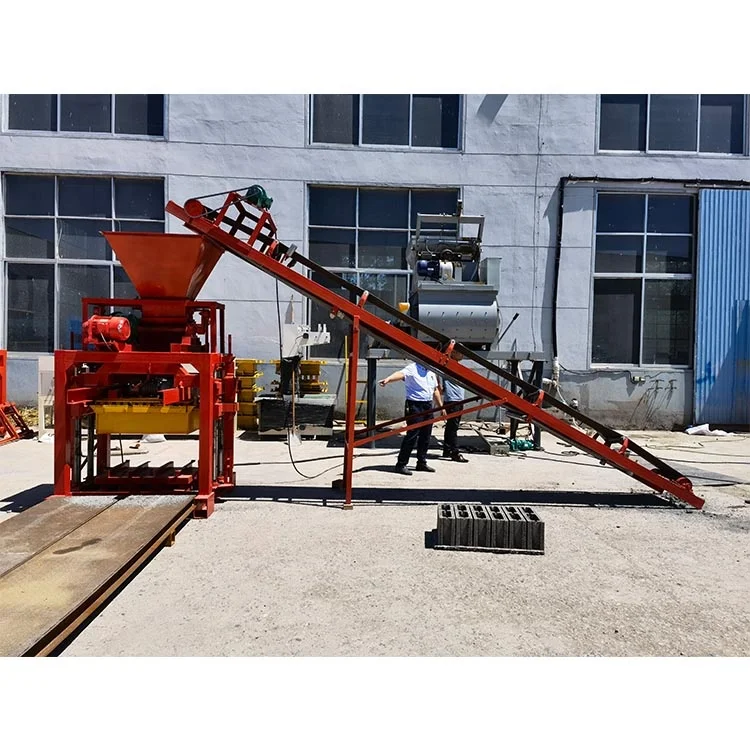
Matched System Line — the QTJ4-35 block machine production line is specified so mixer output, conveyor speed, press cycle and pallet handling align, eliminating station bottlenecks before the first block is made.
Technical Specifications
| Parameter | Value |
|---|---|
| Product Type | Semi-Automatic Hydraulic Block Making Machine |
| Model | QTJ4-35 |
| Overall Dimensions (L×W×H) | 1350×1460×1800 mm |
| Molding Cycle | 35 s |
| Vibration Frequency | 2800 r/min |
| Vibration Force | 30 kN |
| Total Power | 11.15 kW |
| Mixer Model | JQ350 |
| Pallet Size | 850×450×20 mm |
| Total Weight | 1500 kg |
| Automation Level | Semi-automatic |
| Stacking Method | Manual with trolley |
| Output Capacity | 408 pcs/h (basis: 400×200×200 mm hollow block, 4 pcs/mould) |
| Output Capacity | 510 pcs/h (basis: 400×150×200 mm hollow block, 5 pcs/mould) |
| Output Capacity | 2100 pcs/h (basis: 240×115×53 mm solid brick, 18 pcs/mould) |
| Daily Output (8h) | 3264 pcs (basis: 400×200×200 mm hollow block) |
| Daily Output (8h) | 4080 pcs (basis: 400×150×200 mm hollow block) |
| Daily Output (8h) | 17000 pcs (basis: 240×115×53 mm solid brick) |
| Control System | Semi-automatic PLC operation (model and language options — basis not stated in source) |
| Voltage & Frequency | Basis not stated in source — confirm before production |
| Assembly State | Shipped assembled, nude packing in 20GP container |
Application Suitability
| Application | Material or Output |
|---|---|
| Hollow block production | Crushed stone, sand, cement, fly ash — 400×200×200 mm and 400×150×200 mm formats |
| Solid brick production | Stone dust, sand, cement — 240×115×53 mm format |
| Paver and curbstone production | Fine aggregate and cement blends with pigmentation |
| On-site contractor block production | Local aggregate sources with mobile semi-automatic setup |
| Start-up block plant | Multi-format output with limited initial investment |
Why the Line Matters More Than the Press Alone
A standalone press rated at 408 pieces per hour (based on 400×200×200 mm hollow blocks) means nothing when the mixer cannot keep up.
I spent years doing after-sales work across Latin America, and the most frustrating calls were never about broken machines. They were about machines working perfectly while the rest of the line stalled. One customer had installed only the host press, pairing it with an undersized mixer that discharged slower than the 35-second molding cycle could consume. Pallets piled up on the floor waiting for material. By the end of the shift, daily output fell well short of what the quotation promised. That is not a machine problem — it is a line problem. When evaluating a block machine production line, every station from raw material feeding through curing must be calculated against the same cycle clock [NEED_CITE: block production line cycle synchronization standards].
How Stations Connect on the QTJ4-35 Line
The JQ350 mixer is matched to the 35-second press cycle, ensuring fresh material reaches the hopper before the next mold closes. A belt conveyor bridges the mixer discharge to the press feed, calibrated so material flow does not surge or starve. This station-to-station timing is the core discipline of any block machine production line — the press must never wait, and material must never overflow.
Pallet Flow and Manual Handling Reality
Pallets measuring 850×450×20 mm feed manually into the press and exit with freshly molded blocks onto a trolley system. The trolley carries loaded pallets to the curing area, where spacing and rack height must align with pallet dimensions. When pallet size is chosen without checking the buyer’s existing drying space or forklift capacity, pallets end up stacked on the ground and blocks crack during manual transport [NEED_CITE: pallet handling best practices in semi-automatic block plants].
Reading the Numbers Behind Output Claims
Vibration force at 30 kN combined with bed mould vertical vibration and upper mould compression vibration determines block density and wall integrity. This force level is matched to standard concrete mixes using crushed stone and sand, but local aggregate with high fines content or unusual moisture retention may require adjustment. The 2800 r/min vibration frequency works within the 35-second cycle to compact material before the hydraulic head applies final pressure. Mould interchangeability across hollow block, solid brick, paver and curbstone formats on one machine frame means the operator can switch production without changing the press — only the mould and pallet setup.
What Happens When Line Stations Are Mismatched
When a buyer purchases the press alone and sources the mixer locally, the two machines rarely synchronize. A mixer that discharges every 50 seconds against a 35-second press cycle means the press idles through nearly half its shifts. Over months of production, that gap compounds into missing delivery schedules and losing contracts to competitors who quoted lower capacity but delivered it consistently. Conveyor width and speed also matter — too narrow and material bridges in the chute; too slow and the press hopper runs dry mid-cycle [NEED_CITE: consequences of mismatched station throughput in block production].
Why Sourcing the Full Line Reduces Risk
Block machinery is the single focus here, so the QTJ4-35 press, JQ350 mixer, conveyor, pallets and trolley are specified as one matched system rather than assembled from separate suppliers. Configuration starts with the buyer’s actual mix design and local aggregate, not a catalogue default. Mould design covers the formats the buyer’s market actually sells, including custom drawings. Voltage, frequency and PLC display language are confirmed before production, so commissioning is not delayed by electrical incompatibility. Factory testing runs the complete line through a full cycle sequence before disassembly and container loading.
Documentation & Verification
- Line layout showing station positions and capacity calculation per block format
- Machine specification sheet with vibration force, cycle time and power data
- Mould drawing and format list for every block type in the quotation
- Pallet specification matched to curing area dimensions and handling equipment
- Voltage, frequency and PLC language confirmation record before production
- Factory test record demonstrating full cycle operation before shipment
Installation, Commissioning & Support
- QTJ4-35 ships assembled in a 20GP container, reducing on-site reassembly to utility connections
- 11.15 kW total power draw requires dedicated circuit with correct breaker rating at site
- Foundation must be level and cured before press placement to maintain mould alignment
- JQ350 mixer positioned and conveyor tensioned during commissioning for matched material flow
- Operator training covers mould change procedure, pallet loading sequence and daily maintenance checks
- Wear parts and mould list provided so first replacements can be ordered before stock runs out
What to Include in Your Inquiry
To configure the QTJ4-35 block machine production line correctly, share the block formats your market sells, the daily output you need per format, your local raw material source and its typical gradation, your available curing area dimensions, and the voltage and frequency at your site. If you already have pallets, forklifts or curing racks, provide their specifications so pallet size and quantity can be matched rather than guessed.
Frequently Asked Questions
Q: How is daily output calculated per block format and what mould configuration is assumed?
A: Output is stated per format with mould cavity count and cycle time behind each figure. For 400×200×200 mm hollow blocks, the 4-cavity mould at a 35-second cycle yields 408 pieces per hour and 3264 pieces over an 8-hour shift. Different formats produce different counts because cavity numbers and block dimensions change.
Q: Which line stations are included in the quotation and which are optional?
A: The standard quotation covers the QTJ4-35 press, JQ350 mixer, belt conveyor, pallets and manual trolley. Automatic stacking, curing rack systems and cubing equipment are configured separately based on the buyer’s automation level preference and plant layout.
Q: How do I confirm pallet size and quantity against my curing area and existing forklift?
A: The standard pallet measures 850×450×20 mm. Confirm your curing rack spacing, floor area available for drying and forklift fork dimensions before production. Pallet quantity typically ranges from 300 to 500 pieces depending on curing cycle length and shift pattern.
Q: What voltage, frequency and control language does the line ship with?
A: These are confirmed during the quotation stage based on your site electrical supply and operator language. The PLC display and motor wiring are set before factory testing so no rewiring or reprogramming is needed after arrival.
Q: How does the semi-automatic line handle pallet feeding and block stacking, and what is the upgrade path?
A: Pallets are loaded manually and blocks are removed from the press via trolley to the curing area. The upgrade path adds automatic pallet feeding and stacking stations to the existing press frame, reducing labor while keeping the same mould and vibration configuration.