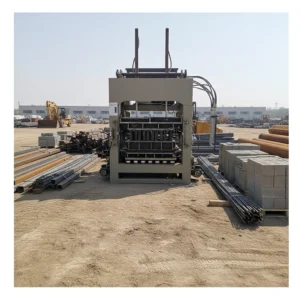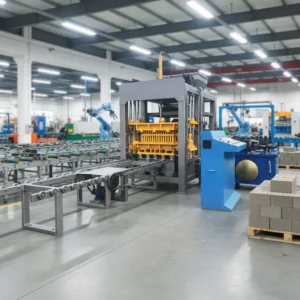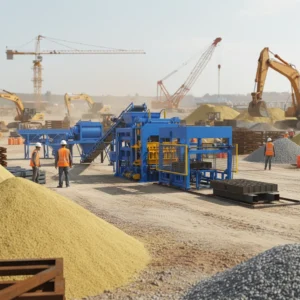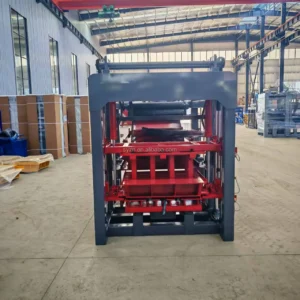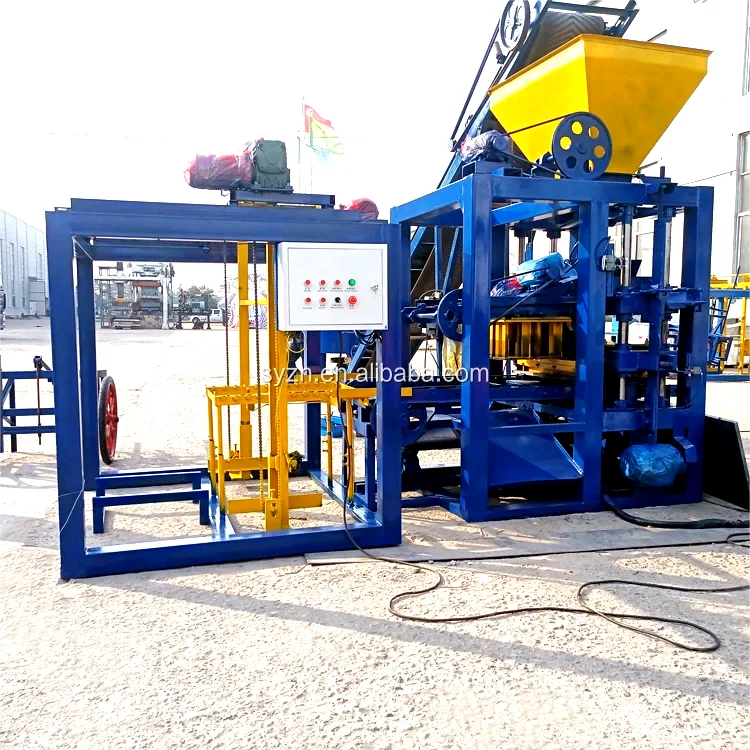
Block line as a matched system — the QTJ4-26 semi-automatic block machine is specified alongside the JQ350 mixer, pallet feeder and curing rack layout so material flow and cycle times align across every station, not sold as a standalone press with gaps left for the buyer to fill.
Technical Specifications
| Parameter | Value |
|---|---|
| Model | QTJ4-26 |
| Product Type | Semi-Automatic Concrete Block Making Machine |
| Overall Dimensions (L×W×H) | 2060 × 1730 × 2580 mm |
| Molding Cycle | 26 s |
| Vibration Frequency | 4200 r/min |
| Vibration Force (Exciting Power) | 35.5 kN |
| Rated Power | 11.95 kW |
| Mixer Model | JQ350 |
| Pallet Size | 850 × 450 × 20 mm |
| Net Weight | 1800 kg |
| Guide System | Four guide pillars |
| Mould Movement | Automatic |
| Applied Products | Concrete hollow blocks (8 inch, 6 inch), solid bricks |
| Raw Materials | Crushed stones, sand, cement, dust, fly ash |
| Automation Level | Semi-automatic |
| Output (Hollow Block 390×190×190 mm) | 480 pcs/h, 3800 pcs/8 hr (4 pcs/mould) |
| Output (Hollow Block 400×150×200 mm) | 600 pcs/h, 4800 pcs/8 hr (5 pcs/mould) |
| Output (Solid Brick 240×115×53 mm) | 2100 pcs/h, 17000 pcs/8 hr (18 pcs/mould) |
Application Suitability
| Application | Material or Output |
|---|---|
| Small-scale block plant | Hollow blocks from crushed stone, sand and cement |
| On-site contractor production | Solid bricks and hollow blocks for housing projects |
| First block plant setup | Fly ash and local aggregate-based concrete products |
| Format expansion for existing plants | Pavers and kerbstones via optional mould change |
What the Concrete Block Making Machine Production Line Leaves Out When Quoted as a Single Press
A press cycle of 26 seconds is meaningless if the mixer cannot feed fast enough or pallets are not returned in time.
When a concrete block making machine production line is quoted by press price alone, the supporting stations — mixer, pallet feeder, stacking and curing rack — are often excluded. The buyer discovers after installation that blocks are being stacked by hand, the mixer runs dry between batches, or the forklift cannot fit the pallet size. Real daily output then falls far below the quoted cycle rate, and the blame is placed on the operator rather than the line design [NEED_CITE: common block line integration gaps in small-scale plants].
Matching the Mixer Feed Rate to the 26-Second Press Cycle
The JQ350 mixer is paired with the QTJ4-26 so that a full batch is ready before the press completes its current mould cycle. If the mixer is undersized, the press sits idle waiting for material, cutting actual output in half despite the 480 pieces per hour figure for 390×190×190 mm hollow blocks. Line layout planning must account for material flow direction, from aggregate storage through the mixer to the press hopper, so no station becomes the bottleneck in the concrete block making machine production line.
Pallet Return and Curing Rack Alignment
The 850×450×20 mm pallet size must match both the curing rack spacing and the forklift the buyer already operates. A pallet that is too wide for the rack forces a complete redesign of the curing area. A pallet material that warps under local humidity causes uneven block curing and rejects [NEED_CITE: pallet material selection for concrete block curing environments]. Specifying pallets alongside the press prevents these hidden mismatches.
Reading the Specifications Against Local Conditions
The vibration force of 35.5 kN at 4200 r/min is calibrated for standard concrete aggregate. When local stone dust carries a high clay content, the same force may not achieve target density, resulting in blocks that fail compressive strength tests. The four guide pillar system keeps mould travel consistent, but the mix design itself must be confirmed against the vibration profile before the line is locked in.
The Hidden Cost of Ignoring Line Integration
When supporting equipment is sourced separately, the pallet return conveyor may not align with the press discharge height, requiring field fabrication that delays commissioning. A mixer placed too far from the press hopper causes the semi-dry mix to segregate before reaching the mould. These issues do not show up on any single machine’s quotation but they define whether the line produces at rated capacity or at half [NEED_CITE: field integration issues in semi-automatic block lines].
Why Source the Full Line from One Supplier
The QTJ4-26 and its supporting stations are specified as a matched system rather than assembled from separate suppliers, so cycle times, pallet dimensions and power requirements are verified together before production. Configuration is set against the buyer’s actual mix design and local aggregate, not a catalogue default. Line layout drawings show station positions and material flow direction. Voltage, frequency and control language are confirmed before manufacturing begins, preventing commissioning delays after arrival.
Documentation & Verification
- Line layout drawing with station positions and material flow direction for the QTJ4-26 setup
- Capacity calculation stating which block format each output figure assumes
- Pallet specification including material type and curing rack compatibility
- Voltage and control panel language confirmation before production starts
- Factory test record on the buyer’s target block format before dispatch
- Hydraulic and electrical schematic matching the shipped configuration
Installation, Commissioning & Support
- Foundation plan based on 2060×1730 mm press footprint and vibration isolation requirements
- Dedicated power circuit sized for the 11.95 kW combined load across press and JQ350 mixer
- Pallet feeder alignment verified against 850×450 mm pallet tolerance on site
- First-run parameter tuning against local aggregate mix design and target block density
- Operator training covering mould change procedure and daily vibration box inspection
- Wear parts list covering mould liners, guide pillar bushings and vibration motor bearings
Preparing Your Line Inquiry
To receive a line proposal that reflects actual production conditions rather than catalogue figures, share your target block formats with dimensions, your local aggregate type and any available mix design data, and the voltage and frequency standard at your site. Include the curing area dimensions and forklift specifications so pallet size can be confirmed against your existing setup.
Frequently Asked Questions
Q: How is daily output calculated and which block format does each figure assume?
A: Each output figure is tied to a specific mould and block size. The 3800 pieces per 8-hour shift applies to the 390×190×190 mm hollow block at 4 pieces per mould. The 4800 pieces per shift assumes the 400×150×200 mm block at 5 pieces per mould. Solid brick output of 17000 per shift uses the 240×115×53 mm mould at 18 pieces per cycle.
Q: What supporting equipment is included in the line quotation?
A: The quotation can include the JQ350 mixer, pallet feeder, and guidance on curing rack setup. Each item is listed separately so the buyer sees exactly which stations are covered and which remain the buyer’s scope, avoiding surprises at installation.
Q: How does the 850×450 mm pallet align with my curing area and forklift?
A: Pallet dimensions are checked against your curing rack spacing and forklift tine width before the order is confirmed. If your existing rack cannot accept this size, pallet specification and rack layout are adjusted together in the line drawing.
Q: What voltage and frequency does the line require?
A: Voltage and frequency must be confirmed against your site supply before production. The control panel language is also set at this stage so the operator interface is readable on day one of commissioning.
Q: How are station cycle times matched so the press is not left waiting?
A: The JQ350 mixer batch size and discharge rate are calculated against the 26-second moulding cycle. Pallet return speed is set so a fresh pallet is in position before the press completes its cycle. The line layout drawing shows these timing relationships across all stations.