
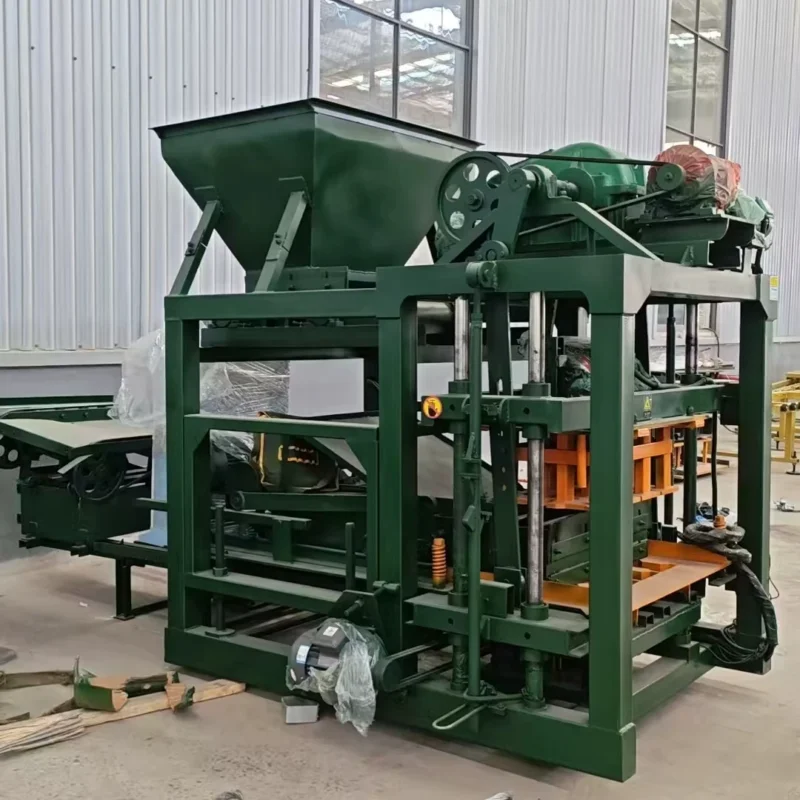
Matched System Sizing — every station from the JQ350 mixer through pallet return is timed to the QTJ4-25 press cycle so no single link chokes the line.
Technical Specifications
| Parameter | Value |
|---|---|
| Model | QTJ4-25 |
| Product Type | Motor Concrete Block Making Machine |
| Product Capacity | 4 pcs/mould (based on 400×200×200mm hollow block) |
| Output Capacity | 960 pcs/h, 7680 pcs/day (based on 400×200×200mm hollow block, 4 pcs/mould, 25 s cycle) |
| Molding Cycle | 25 s |
| Vibration Frequency | 2800 r/min |
| Exciting Power (Vibration Force) | 60 kN |
| Rated Power | 17.9 kW |
| Pallet Size | 850×550×20 mm |
| Overall Dimensions (L×W×H) | 6400×1500×2700 mm |
| Total Mass | 2500 kg |
| Automation Level | Semi-automatic |
| Control System | Motor-driven (PLC not specified in source — confirm before order) |
| Configuration | Host machine 1 set, Block mould 1 set, JQ350 mixer |
| Mould Format | Hollow, solid, paver, curbstone (mould change required) |
| Voltage & Frequency | (basis not stated in source — confirm voltage / frequency / phase) |
| Hydraulic Pressure | (basis not stated in source — confirm if hydraulic station equipped and pressure rating) |
| Certification | (basis not stated in source — confirm CE or other) |
Application Suitability
| Application | Material or Output |
|---|---|
| Hollow block production for building walls | Crushed stone, sand, cement, water — 400×200×200mm format |
| Solid block production for load-bearing structures | Dense aggregate mix with cement binder |
| Paving block production for walkways and yards | Fine aggregate surface layer on coarse base mix |
| Curbstone production for road edges | High-density mix with extended vibration and compression |
| On-site block production for housing projects | Local sand and gravel with portable JQ350 mixer feeding the press |
What "7,680 Blocks per Day" Actually Requires From the Rest of the Line
That daily figure holds only when the mixer, pallet circulation, and curing area all keep pace with a 25-second press cycle.
I once watched a QTJ4-25 block making machine production line stall every third cycle because the JQ350 mixer needed a full minute to discharge one batch — the press sat idle while the operator waited for wet mix. The buyer had been told the press could do nearly 8,000 blocks a shift, but real output hovered around half that. The bottleneck was never the press; it was everything around it. [NEED_CITE: common causes of block line throughput loss in semi-automatic plants]
How the Mixer and Press Cycle Must Align
The QTJ4-25 completes a moulding cycle every 25 seconds, producing four 400×200×200mm hollow blocks per stroke. The JQ350 mixer included in the standard configuration must deliver a fresh batch to the host machine hopper within that same window, or the press waits. When spec’ing the QTJ4-25 block making machine production line, I always check whether the mixer discharge rate, conveyor belt speed, and hopper volume form a continuous feed loop — because a 17.9 kW press drawing no material earns nothing.
Where Pallet Circulation Becomes the Real Constraint
Each cycle consumes one 850×550×20 mm pallet, and that pallet must travel through vibration, pressing, wet-block carry-off, and curing before returning empty to the press infeed. If the curing rack is undersized or the return conveyor is missing, pallets pile up at the stacking end and the line halts. A typical semi-automatic setup needs a pallet pool large enough to cover the entire curing duration plus a buffer for return transit — [NEED_CITE: pallet pool sizing for continuous block production]. The pallet quantity and material spec are therefore not optional extras; they are part of the cycle calculation.
Reading the Numbers That Matter for Block Density
The 60 kN vibration force at 2,800 r/min acts through the bed mould in vertical vibration, compacting the aggregate mix from below while upper compression settles the face. For hollow blocks, this combination determines wall thickness consistency and compressive strength after curing. The 25-second cycle is calibrated around a standard crushed-stone and cement mix; lighter materials such as fly ash or pumice may require longer vibration to reach target density, which shifts the achievable cycles per hour downward. Mould change between hollow, solid, paver, and curbstone formats involves physical swap and re-alignment, so format flexibility depends on how many changeovers the shift schedule allows.
The Cost of Ignoring Downstream Stations
When a buyer treats the press as the whole purchase, the curing area is often an afterthought. Wet blocks stacked on pallets need flat, level ground and enough space to hold at least one full day’s output. If the yard is too small, pallets cannot return fast enough, and the operator starts stacking blocks by hand off the pallet to free it — introducing cracks and rejects. [NEED_CITE: block breakage rates from premature pallet stripping in small plants] Voltage mismatch is another silent delay: if the 17.9 kW motor arrives wired for a frequency the site does not supply, commissioning stalls until a replacement motor or transformer arrives.
Why Buyers Who Plan the Full Line Fare Better
Every QTJ4-25 block making machine production line we ship is spec’d against the buyer’s actual mix, block format, and site conditions rather than a default catalogue sheet. The JQ350 mixer is matched to the host machine hopper height and feed rate so the press is not left waiting. Pallet size and quantity are confirmed against the buyer’s curing area dimensions and existing forklift capacity. Voltage, frequency, and phase are locked in before production begins, not discovered at container opening. Mould drawings are reviewed against the buyer’s market formats, and custom moulds can be built to buyer-supplied drawings. Installation includes operator training on mould change, daily maintenance, and mix adjustment for consistent block density.
Documentation & Verification
- Line layout drawing showing mixer, press, and pallet return positions with cycle time annotations
- Capacity calculation sheet stating the exact block format behind the 960 pcs/h figure
- Mould drawing and format list confirming hollow, solid, paver, and curbstone coverage
- Pallet specification matched to your curing area and forklift load rating
- Factory test record run on your target mix before dispatch
- Voltage, frequency, and phase confirmation document signed before production
Installation, Commissioning & Support
- Foundation pad sized to 6400×1500 mm footprint with vibration isolation for the 60 kN exciting force
- Dedicated 17.9 kW circuit with confirmed voltage, frequency, and phase before energizing
- JQ350 mixer positioned and aligned to host machine hopper for uninterrupted feed during commissioning
- First-run block density checks across hollow and solid formats to validate vibration and mix settings
- Operator training on mould change procedure and daily wear-part inspection schedule
- Spare mould and hydraulic wear parts list supplied with recommended reorder intervals
What We Need From You to Quote Accurately
Tell us which block format you sell most — hollow, solid, paver, or curbstone — and the daily volume your market absorbs. Share your local aggregate type, cement grade, and whether you already have a curing yard and forklift on site. Confirm your site voltage, frequency, and the language your operators need on any control display. With those details, we can size the mixer, pallet pool, and handling stations so the QTJ4-25 press runs at its stated rhythm.
Frequently Asked Questions
Q: How is the 960 pcs/h output calculated, and what block format does it assume?
A: That figure assumes four 400×200×200mm hollow blocks per mould at a 25-second cycle, running continuously with no downtime for mould change or pallet shortage. Any other format — solid block, paver, curbstone — produces fewer pieces per mould or requires a different cycle length, so the real hourly count shifts. We provide a per-format capacity table with every line proposal.
Q: Which supporting stations are included in the standard line, and which are optional?
A: The standard package covers the QTJ4-25 host machine, one block mould, and the JQ350 mixer. Pallet feed conveyor, automatic stacking, and curing rack handling are available as add-on stations. We match each optional station to the press cycle so adding automation later does not require re-engineering the base line.
Q: How many pallets should I budget for continuous production?
A: The pallet count depends on your curing duration and return transit time. A typical one-shift plant running 850×550×20 mm pallets needs enough to fill the curing racks plus a buffer for blocks still drying. We calculate the pool size once you share your curing area dimensions and daily target output.
Q: What raw material feed setup is needed to match the JQ350 mixer with the press?
A: The JQ350 discharges into the host machine hopper through a short belt conveyor or gravity chute. The mixer batch time must stay within the 25-second moulding cycle to avoid press idle time. We confirm feed height, conveyor speed, and hopper volume during line layout so the mixer and press stay synchronized.
Q: What happens if my site voltage does not match the standard motor rating?
A: The 17.9 kW rated power is configured to your confirmed voltage, frequency, and phase before production starts. If your site supply differs, we adjust the motor winding or specify a matching transformer. This confirmation is part of our pre-production checklist to prevent commissioning delays on arrival.


