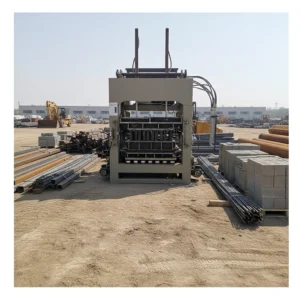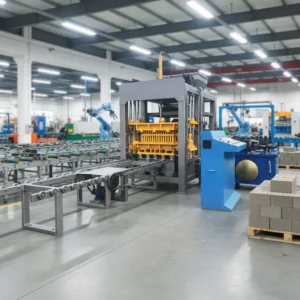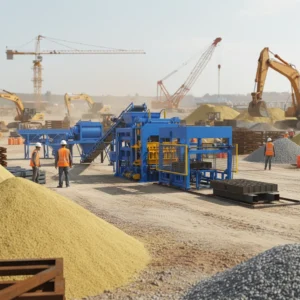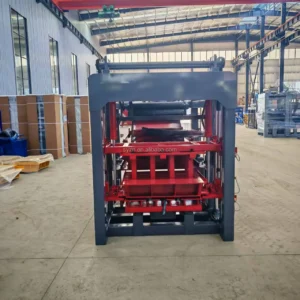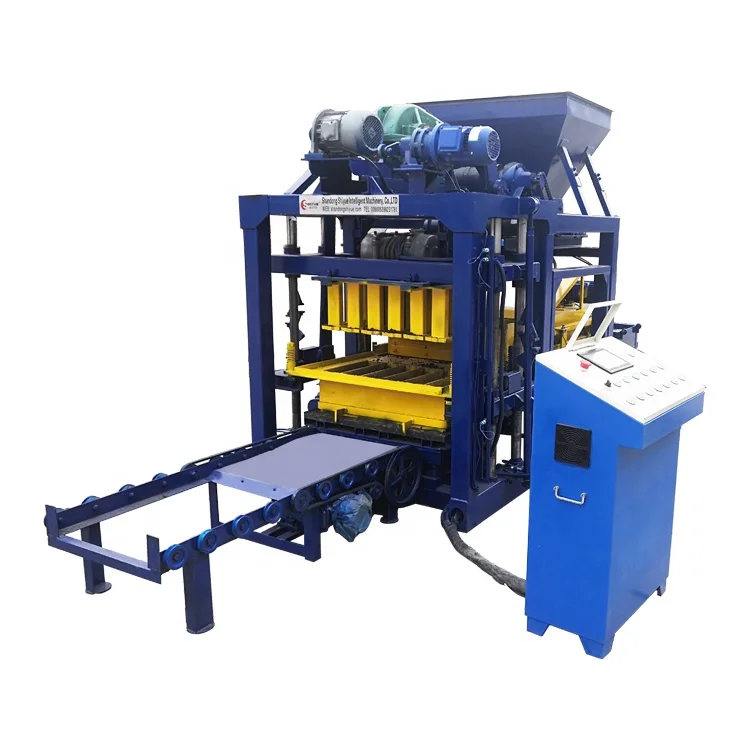
Matched System Configuration — The QTJ4-25 operates within a complete block production line where the JQ350 mixer, PLC-controlled press, and pallet handling are specified together to prevent cycle mismatches across stations.
Technical Specifications
| Parameter | Value |
|---|---|
| Product Type | Automatic Concrete Block Making Machine |
| Model | QTJ4-25 |
| Overall Dimensions (L×W×H) | 6400×1500×2700 mm |
| Molding Cycle | 25 s |
| Vibration Frequency | 2800–5100 r/min |
| Exciting Power (Vibration Force) | 60 kN |
| Rated Power | 17.9 kW |
| Mixer Model | JQ350 |
| Pallet Size | 850×550×20 mm |
| Net Weight | 2500 kg |
| Control System | PLC |
| Automation Level | Automatic (plate-supplying, material-disturbing, brick-discharging) |
| Applied Products | Hollow block (8 inch, 6 inch), solid brick |
| Raw Materials | Crushed stones, sand, cement, dust, fly ash |
| Output Capacity | 480 pcs/h based on 390×190×190 mm hollow block, 4 pcs/mould |
| Output Capacity | 600 pcs/h based on 400×150×200 mm hollow block, 5 pcs/mould |
| Output Capacity | 2100 pcs/h based on 240×115×53 mm solid brick, 18 pcs/mould |
| Hydraulic Pressure | (basis to be confirmed) |
| Voltage & Frequency | (basis to be confirmed) |
| Mould Change Time | (basis to be confirmed) |
| Stacking Method | (basis to be confirmed) |
| CE Conformity | (verify per unit) |
Application Suitability
| Application | Material or Output |
|---|---|
| Hollow block production for masonry walls | Crushed stone, sand, cement mix forming 6-inch and 8-inch blocks |
| Solid brick manufacturing | Sand, fly ash, and cement blends for 240×115×53 mm standard bricks |
| Small-to-medium block plant setups | Complete line from JQ350 mixing through PLC-controlled forming |
| On-site contractor production | Locally sourced aggregates including dust and fly ash |
What the "Cycle Time" Figure Hides About Your Daily Output
A 25-second cycle on the press means nothing if the upstream mixer cannot feed fast enough or pallets are not returning in time.
I have stood on job sites in Lagos and Dhaka watching operators wait for the mixer to finish a batch while the block production line equipment sat idle. The press was rated for a certain output, but nobody calculated whether the JQ350 mixer could deliver material at the same rhythm [NEED_CITE: mixer throughput matching press cycle demand]. When stations are sourced separately, the bottleneck simply moves from one end of the line to the other. Daily throughput ends up far below what the quotation promised.
Keeping Every Station in Step
The concrete block making machine line built around the QTJ4-25 connects raw material feeding, JQ350 mixing, and pallet circulation so the 25-second molding cycle is never starved. Each station is sized to the press demand rather than selected from a catalogue default, which means the mixer output rate and pallet return speed are verified against your target block format before production begins.
Where the Bottleneck Actually Lives
In most small-to-medium block plants, the constraint is not the press itself. It is the pallet handling loop or the mixer discharge timing. When the pallet feeder runs out of boards before the stacker clears the wet output, the PLC halts the entire sequence. On sites across West Africa I have seen pallet return gaps that turned a nominal 480-piece-per-hour line into something closer to half that figure [NEED_CITE: pallet circulation impact on block line throughput]. Sizing the pallet pool to your curing rack capacity and forklift turnaround time is part of the line calculation, not an afterthought.
Reading the Numbers That Matter
Vibration force and frequency define how densely the mix is compacted. The QTJ4-25 delivers 60 kN of exciting power across an adjustable 2800–5100 r/min range, allowing operators to tune compaction to local aggregate characteristics. A mix high in fine dust needs a different frequency setting than one dominated by coarse crushed stone, and the PLC stores these profiles so shift changes do not mean recalibration from scratch. The 850×550×20 mm pallet dimension must align with your existing curing rack spacing — if the rack was built for a different pallet width, every board has to be repositioned by hand before stacking.
When the Line Was Never Really a Line
Buyers sometimes receive a quotation that covers the press and nothing else. Pallets, stacking, and curing rack handling arrive as separate purchases, often from different suppliers with no shared timing protocol. The result is a concrete block making machine line in name only — operators manually carry pallets from the press to the yard, and the 25-second cycle stretches into something much longer because nobody is clearing the discharge end [NEED_CITE: manual pallet handling impact on block line output]. The investment in automation at the press is wasted when upstream and downstream stations cannot keep pace.
Why Configuration Starts Before the Quotation
Block machinery works as a matched system only when every station is specified against the buyer’s actual conditions. The JQ350 mixer is paired with the QTJ4-25 because its batch volume and discharge rate align with the press demand across both hollow and solid formats. Pallet material and thickness are selected based on your curing environment and handling equipment, not a default warehouse stock. Voltage, frequency, and PLC display language are confirmed before the control cabinet is wired, so commissioning is not delayed by a language barrier or a transformer that was never ordered. Installation support covers line layout, station alignment, and operator training so the first production run happens on schedule.
Documentation & Verification
- Line layout drawing with capacity calculation stated per block format
- Machine specification sheet covering QTJ4-25 press and JQ350 mixer
- Hydraulic and electrical schematics for on-site troubleshooting
- Voltage and PLC control language confirmation record before wiring
- Factory test record on your target block format before dispatch
- Wear parts and mould list with recommended replacement intervals
Installation, Commissioning & Support
- Foundation must accommodate the 6400×1500 mm footprint with level tolerance for the press frame
- Dedicated circuit required for 17.9 kW rated power at confirmed voltage and frequency
- Pallet size 850×550×20 mm verified against curing rack spacing before first run
- PLC parameters set to your mix design during on-site commissioning
- Operator training covers mould change procedure and vibration frequency adjustment
- Wear parts list provided with sourcing options for hydraulic and vibration components
Before You Request a Quote
To configure a concrete block making machine line around the QTJ4-25, share your target block formats and the daily volume you need for each one. Let us know what local aggregates are available — send a sample if possible — along with your site voltage and frequency, curing area dimensions, and any existing forklifts or racks the pallets must fit.
Frequently Asked Questions
Q: How does the 25-second cycle time hold up when the full line is connected?
A: The cycle holds when the JQ350 mixer discharge rate and pallet return speed are matched to the press. Bottlenecks usually form at pallet circulation — if wet blocks are not cleared fast enough, the PLC pauses the sequence. Line layout calculations address this before equipment ships.
Q: Which supporting stations are included versus purchased separately?
A: The quotation covers the QTJ4-25 press, JQ350 mixer, and automatic plate-supplying and brick-discharging functions. Pallet inventory, curing rack handling, and stacking method depend on your site layout and are specified during the configuration stage.
Q: How should the 850×550 mm pallet be evaluated before ordering?
A: Check your curing rack slot width and forklift fork dimensions. If the rack was built for a different pallet size, every board must be manually adjusted before storage. Confirming pallet specs early avoids costly rework on the curing yard.
Q: Is the PLC interface configurable for different operator languages?
A: The PLC display language is confirmed during the order stage, before the control cabinet is wired. Voltage and frequency are also locked in at this point to prevent commissioning delays caused by incompatible power supply or unreadable screens.
Q: Can a factory test run use my actual mix design?
A: A trial run with your local aggregate sample is arranged before shipment whenever possible. The vibration frequency and material feed settings are adjusted to your mix so the factory test record reflects realistic production conditions.