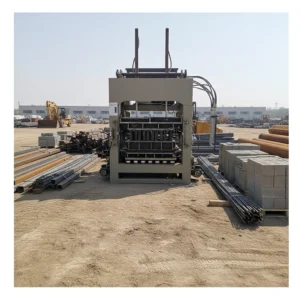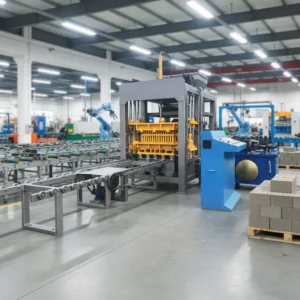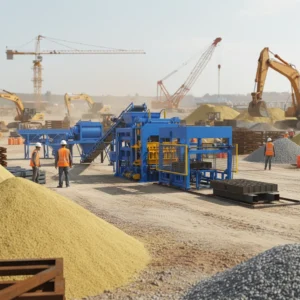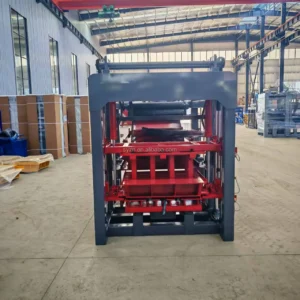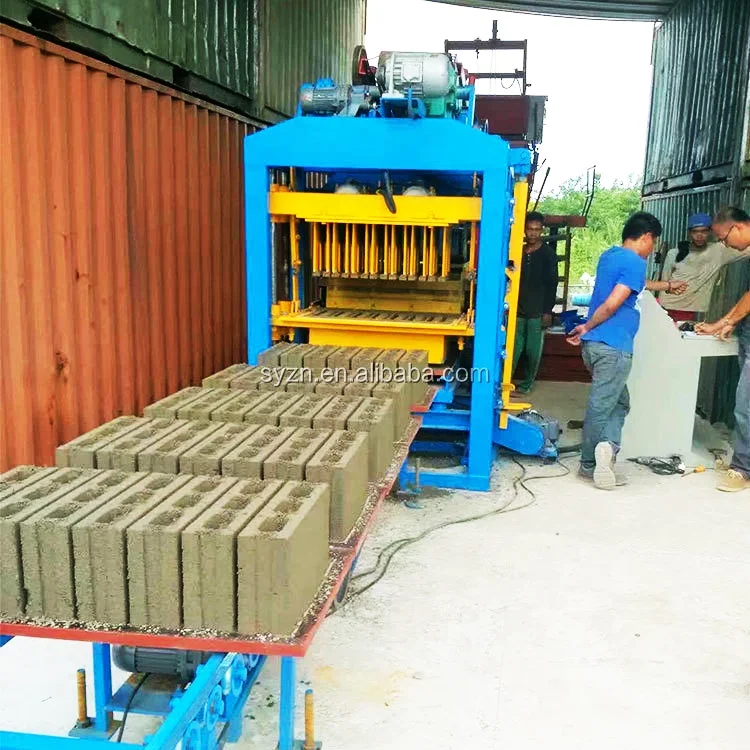
Pallet Handling Sync — The QTJ4-25 line is specified as a complete system where mixer, conveyor, and pallet feeding match the 25-second press cycle, not sold as an isolated machine.
Technical Specifications
| Parameter | Value |
|---|---|
| Product Type | Semi-Automatic Concrete Block Making Machine |
| Model | QTJ4-25 |
| Overall Dimensions (L×W×H) | 6400×1500×2700 mm |
| Net Weight | 2500 kg |
| Molding Cycle | 25 s |
| Vibration Frequency | 2800–5100 r/min |
| Exciting Force | 60 kN |
| Total Power | 17.9 kW |
| Mixer Model | JQ350 |
| Pallet Size | 850×550×20 mm |
| Hydraulic Station | Included (high pressure) |
| Assembly State | Requires mixer, conveyor, host, pallets, and trolley |
| Output Capacity | Hollow block 390×190×190 mm: 4 pcs/mould, 480 pcs/h, 3800 pcs/8hr |
| Output Capacity | Hollow block 400×150×200 mm: 5 pcs/mould, 600 pcs/h, 4800 pcs/8hr |
| Output Capacity | Solid brick 240×115×53 mm: 18 pcs/mould, 2100 pcs/h, 17000 pcs/8hr |
Application Suitability
| Application | Material or Output |
|---|---|
| Hollow block production for masonry walls | Crushed stone, sand, cement (8 inch / 6 inch formats) |
| Solid brick production for load-bearing structures | Sand, cement, fly ash blends |
| On-site block manufacturing for housing projects | Local aggregate mixed with cement and dust |
| Small-scale paver and brick plant startup | Variable raw material feed with JQ350 pan mixer |
Why "Cycles per Hour" Tells Only Half the Story
The block production line equipment is only as fast as its slowest supporting station.
I have seen plants where the press ran its full 25-second cycle without issue, but the curing area was stacked by hand because pallet handling was never part of the original quote. The host machine stopped multiple times per shift waiting for workers to clear finished blocks, and daily output fell far short of the 480 pieces per hour rated for 390×190×190 mm hollow blocks [NEED_CITE: line bottleneck impact on rated capacity]. The concrete block making machine with supporting equipment must be specified together, or the cycle time figure becomes meaningless on the factory floor.
How Line Stations Must Track the 25-Second Press Cycle
The JQ350 pan mixer must deliver a fresh batch to the conveyor hopper before each molding cycle completes. If the mixer is undersized or the belt speed is too slow, the press idles between cycles and the block production line equipment never reaches its rated output. Every station from raw material feeding through the host machine must be timed against that 25-second window.
Pallet Circulation and Curing Area Synchronization
With an 850×550×20 mm pallet size, the number of pallets in circulation must cover the distance from the press to the curing racks and back. If pallets do not return in time, the press halts [NEED_CITE: pallet return loop design for semi-automatic block lines]. The trolley and manual rack system must be planned around the same pallet dimensions so that forklifts already on site can handle loaded racks without modification.
Matching Vibration and Pressure to Local Aggregate
The 60 kN exciting force combined with the hydraulic station produces consistent block density, but only when tuned to the buyer’s actual mix design. A sand-heavy blend responds differently to the 2800–5100 r/min vibration range than a crushed-stone-dominant mix. The concrete block making machine with supporting equipment must have vibration settings that match what the local quarry delivers, not a catalogue default.
What Undersized Supporting Equipment Costs You
When the conveyor or trolley cannot keep pace, operators resort to manual pallet handling mid-shift. Blocks sit on the press table too long, edges chip during delayed removal, and inconsistent curing times weaken the final product [NEED_CITE: manual handling impact on block strength consistency]. The host machine itself is not at fault — the stations around it were simply never matched to its cycle.
Specification Details That Shape Daily Output
The 17.9 kW total power covers the host, mixer, and conveyor running simultaneously, which matters when sizing the site transformer and dedicated circuit. The 2800–5100 r/min vibration range allows adjustment between hollow blocks, where lower frequency prevents wall collapse, and solid bricks, where higher frequency drives compaction into a denser matrix. The 60 kN exciting force works with hydraulic pressure to compact the mix, and both values must be checked against the buyer’s target block strength requirement. The 2500 kg net weight provides the static mass needed to absorb vibration recoil without requiring a separate reinforced foundation pad beyond standard concrete slab preparation.
Why Sourcing the Complete Line from One Supplier Matters
Block machinery as a single focus means the JQ350 mixer, conveyor, host, pallets, and trolley are specified as one matched system rather than assembled from separate vendors. Line layout and capacity calculations state the exact block format assumed, so the 3800 pieces per 8-hour shift for 390×190×190 mm hollow blocks is an honest figure. Configuration is set against the buyer’s local aggregate and target format, not a standard catalogue page. Automation level is selectable, allowing a buyer to begin with manual pallet handling and add a pallet feeder later. Installation support covers the full line, so commissioning addresses station-to-station timing, not just the press alone.
Documentation & Verification
- Line layout drawing showing station spacing matched to the 850×550 mm pallet footprint
- Capacity calculation sheet listing output per specific block format and molding cycle
- Pallet material and dimension specification aligned to curing rack and forklift requirements
- Hydraulic and electrical schematic confirming 17.9 kW total load for site wiring
- Factory test record run on buyer’s target block format before dispatch
Installation, Commissioning & Support
- Site slab must support 2500 kg host weight plus dynamic vibration load across the 6400×1500 mm footprint
- Dedicated circuit rated for 17.9 kW total draw covering host, JQ350 mixer, and conveyor simultaneously
- Voltage and frequency confirmed before production to match local grid and PLC display language
- Host, mixer, conveyor, and pallet trolley assembled and cycle-timed on site during commissioning
- Operator training covers vibration frequency adjustment across hollow and solid block formats
- Wear parts list and mould inventory supplied for first replacement cycle planning
Preparing a Useful Inquiry
Tell us your target block format and the daily volume you need to hit, along with the raw materials available locally — whether that is crushed stone, sand, fly ash, or a blend. Share your site voltage and frequency, plus the pallet handling and curing equipment you already have, so the line can be configured around existing infrastructure rather than replacing it.
Frequently Asked Questions
Q: How do the JQ350 mixer and conveyor cycle times match the 25-second press cycle to prevent bottlenecks?
A: The JQ350 pan mixer batch size and conveyor belt speed are calculated so that a fresh mix reaches the hopper before the 25-second molding cycle completes. This ensures the concrete block making machine with supporting equipment never idles waiting for material, keeping output aligned with the rated capacity per block format.
Q: What supporting equipment is included versus optional in the line quotation?
A: The standard quotation covers the host machine, JQ350 mixer, conveyor, pallets, and trolley. Automatic stacking, curing rack handling, and cubing systems are optional additions. The line layout document specifies exactly which stations are included so there are no gaps between press output and curing area.
Q: How is the 850×550 mm pallet size selected based on my existing curing area and forklift?
A: Pallet dimensions are confirmed against the curing rack spacing and forklift tine width already on site. An 850×550 mm pallet fits standard rack configurations, but if existing infrastructure uses different dimensions, the pallet specification is adjusted and the block production line equipment layout is redrawn before production begins.
Q: What is the realistic daily output for my specific block format?
A: The QTJ4-25 produces 3800 pieces per 8-hour shift for 390×190×190 mm hollow blocks, 4800 pieces for 400×150×200 mm hollow blocks, and 17000 pieces for 240×115×53 mm solid bricks. These figures assume matched station cycle times and continuous pallet circulation with no manual handling interruptions.