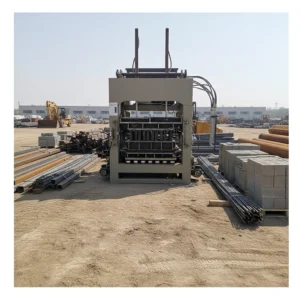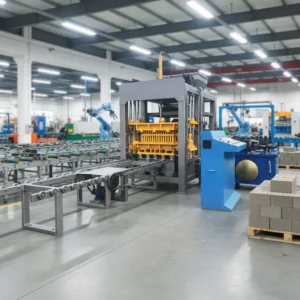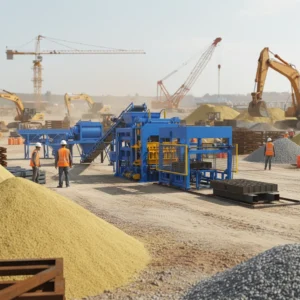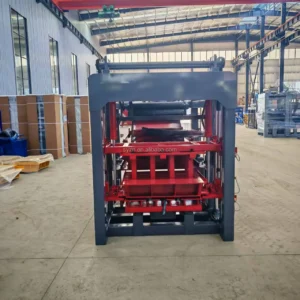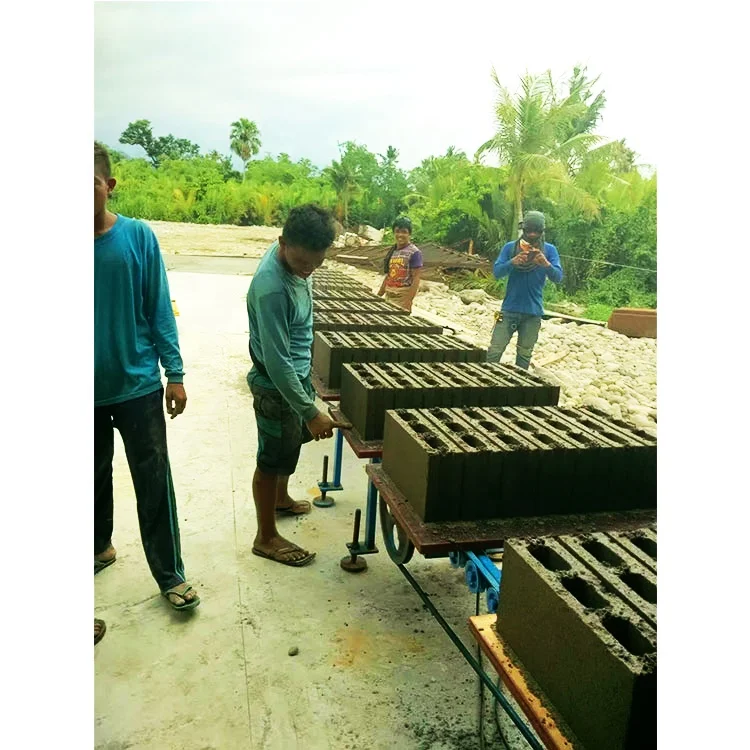
Matched Line Configuration — Every station from raw material feeding through the QTJ4-25 press to pallet return is timed against a single 25-second molding baseline so the press never waits on upstream or downstream equipment.
Technical Specifications
| Parameter | Value |
|---|---|
| Model | QTJ4-25 |
| Product Type | Automatic Concrete Block Making Machine |
| Overall Dimensions (L×W×H) | 6400×1500×2700 mm |
| Molding Cycle | 25 s (basis not stated in source — confirm block format / material / thickness) |
| Vibration Frequency | 2800–5100 r/min |
| Exciting Power / Vibration Force | 60 kN |
| Total Power | 17.9 kW (rated or peak not specified in source) |
| Mixer Model | JQ350 |
| Pallet Size | 850×550×20 mm |
| Net Weight | 2500 kg |
| Control System | PLC control with automatic plate-supplying, material disturbing, and brick discharging |
| Applied Products | Hollow blocks (8 inch, 6 inch), solid brick |
| Output Capacity (Hollow block 390×190×190 mm) | 4 pcs/mould, 480 pcs/h, 3,800 pcs/8 hr |
| Output Capacity (Hollow block 400×150×200 mm) | 5 pcs/mould, 600 pcs/h, 4,800 pcs/8 hr |
| Output Capacity (Solid brick 240×115×53 mm) | 18 pcs/mould, 2,100 pcs/h, 17,000 pcs/8 hr |
| Key Features | Automatic plate-supplying, material-disturbing, brick-discharging, PLC-controlled |
Application Suitability
| Application | Material or Output |
|---|---|
| Small to medium-scale hollow block production | Crushed stone, sand, cement, fly ash, stone dust producing 6-inch and 8-inch hollow blocks |
| On-site solid brick manufacturing for housing projects | Local aggregates mixed with cement for 240×115×53 mm solid bricks |
| First block plant setup for entrepreneurs | Locally sourced aggregate and cement combinations for standard block formats |
| Contractor block production at building sites | Fly ash and stone dust blends for hollow and solid formats |
Why Quoted Cycle Rates Fall Short on Real Job Sites
A 25-second press cycle only translates into real daily output when the mixer, pallet feeder, and stacking stations are timed to the same beat.
I once watched a block plant in the Yangtze River Delta run a stand-alone press at full speed for the first hour, then spend the rest of the shift waiting on a mixer that could not keep up and a manual stacking crew that fell further behind every cycle. The owner had paid for a high-capacity machine but received only half the throughput because the supporting equipment was never specified as one coordinated line [NEED_CITE: block production line throughput versus isolated press cycle rate]. When planning an automatic concrete block making machine production line, the cycle time at the press is only the starting point for capacity calculation.
Matching Upstream Mixing to the Press Consumption Rate
The JQ350 mixer supplied with the QTJ4-25 must discharge a fresh batch before the press completes its current cycle, otherwise the material hopper runs dry and the press sits idle. At a 25-second molding cycle, the press consumes a predictable volume of mix per minute; the mixer batch capacity and discharge speed must exceed that consumption rate with margin for material variation across hollow block and solid brick formats. Verifying this balance before shipment prevents the most common bottleneck encountered during on-site commissioning of any automatic concrete block making machine production line.
Pallet Flow and Downstream Handling Alignment
The 850×550×20 mm pallet format defines not only what fits inside the press but also how pallets move through the return conveyor, stacking station, and curing rack system. If the pallet dimensions do not match the curing area rack spacing or the forklift tine width already on site, pallets pile up at the discharge end and the automatic plate-supplying function stalls. Confirming pallet size against the buyer’s existing curing footprint and material handling equipment is a non-negotiable step before the automatic concrete block making machine production line leaves the factory [NEED_CITE: pallet size and curing area compatibility in block plants].
Interpreting Vibration Force and Frequency for Block Density
The QTJ4-25 delivers 60 kN of vibration force across a 2800–5100 r/min frequency range. Higher frequency with lower amplitude produces a denser surface finish suitable for paving formats, while lower frequency with higher amplitude compacts coarse aggregate more effectively for thick-walled hollow blocks. Matching the vibration setting to the buyer’s specific mix design and local aggregate gradation determines whether blocks leave the press at target strength or require cement additions that raise material cost.
The Cost of Skipping Line Integration Checks
When supporting equipment is sourced separately or omitted from the quotation entirely, the press arrives to find a mixer that batches too slowly, a pallet stack that jams the feeder, or a curing area that cannot accept the pallet format. The result is hand-stacking at the discharge end, operators working overtime to move product, and daily output that never approaches the figures quoted per block format [NEED_CITE: block plant downtime causes related to supporting equipment mismatch]. These gaps are invisible on a single-machine quotation and only surface during the first week of production.
Why Sourcing the Full Line from One Supplier Matters
The QTJ4-25 is specified here as the press at the center of a coordinated line, not a stand-alone unit dropped into an unverified setup. The JQ350 mixer batch capacity is matched against the 25-second molding cycle across hollow block and solid brick formats. Pallet dimensions are confirmed against the buyer’s curing area and forklift before production begins. The PLC control language, voltage, and frequency are agreed in writing so commissioning is not delayed by a mismatch discovered at the electrical panel. Mould drawings for each block format are provided with the quotation, and wear parts availability is documented so the first replacement does not halt the line.
Documentation & Verification
- Line layout drawing showing every station with capacity stated per block format
- Machine specification sheet with pallet size 850×550×20 mm confirmed against curing area
- Voltage, frequency, and PLC display language confirmation before production starts
- Factory test record on buyer’s target block format before dispatch
- Wear parts and mould list included with quotation for first replacement planning
- Hydraulic and electrical schematic for on-site commissioning reference
Installation, Commissioning & Support
- Foundation pad leveled to accommodate 6400×1500 mm footprint and 2500 kg static load
- Dedicated power circuit rated for 17.9 kW total draw at confirmed voltage and frequency
- Mixer and pallet feeder connected and timed to 25-second press cycle during commissioning
- PLC control parameters set to buyer’s block format and language preference on first startup
- Operator training covering mould change procedure and automatic plate-supplying sequence
- Wear parts inventory reviewed with local reorder lead times established before line goes live
What to Share Before Requesting a Line Quotation
Provide the target block formats, expected daily output, and the local aggregate and cement types available at the site. Include curing area dimensions, existing forklift specifications, and the voltage and frequency at the installation point. This information allows the line configuration to be built around real site conditions rather than catalogue defaults.
Frequently Asked Questions
Q: How do I verify that the mixer output and pallet feeding speed match the QTJ4-25 press cycle across all my target block formats?
A: Request a line capacity calculation that states mixer batch discharge time and pallet feed interval for each block format separately, not just the fastest cycle. The JQ350 mixer must discharge before the press completes its current cycle for hollow blocks and solid bricks alike, and the pallet feeder must index at the same rate.
Q: What supporting equipment should be included in the line quotation to avoid hand-stacking bottlenecks?
A: The quotation should list automatic stacking, curing rack handling, and pallet return as line items with cycle times matched to the press discharge rate. Omitting these stations means operators manually move every pallet, and real daily output drops well below the quoted per-format capacity.
Q: How should pallet size and material be chosen to fit my existing curing area and forklift?
A: Confirm that the 850×550×20 mm pallet dimension matches your curing rack spacing and forklift tine width before the line ships. A mismatch forces either a facility modification or a separate pallet purchase, both adding cost and delay after the press arrives.
Q: Can the line automation level be set semi-automatic now and upgraded later without replacing the press?
A: The QTJ4-25 supports PLC-controlled automatic plate-supplying and brick discharging from the start, with stacking and cubing stations available as additions. Upgrading downstream automation later requires verifying that the pallet conveyor interface and PLC program reserve capacity for the additional stations.