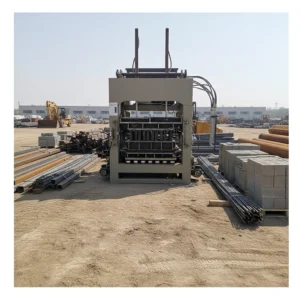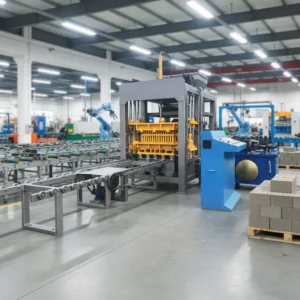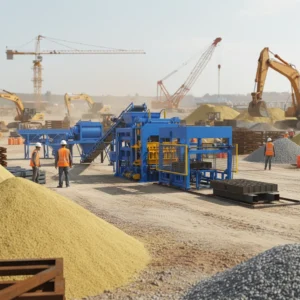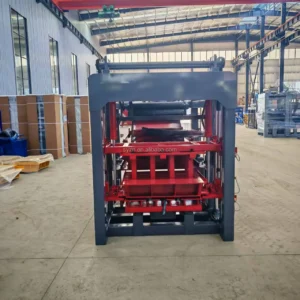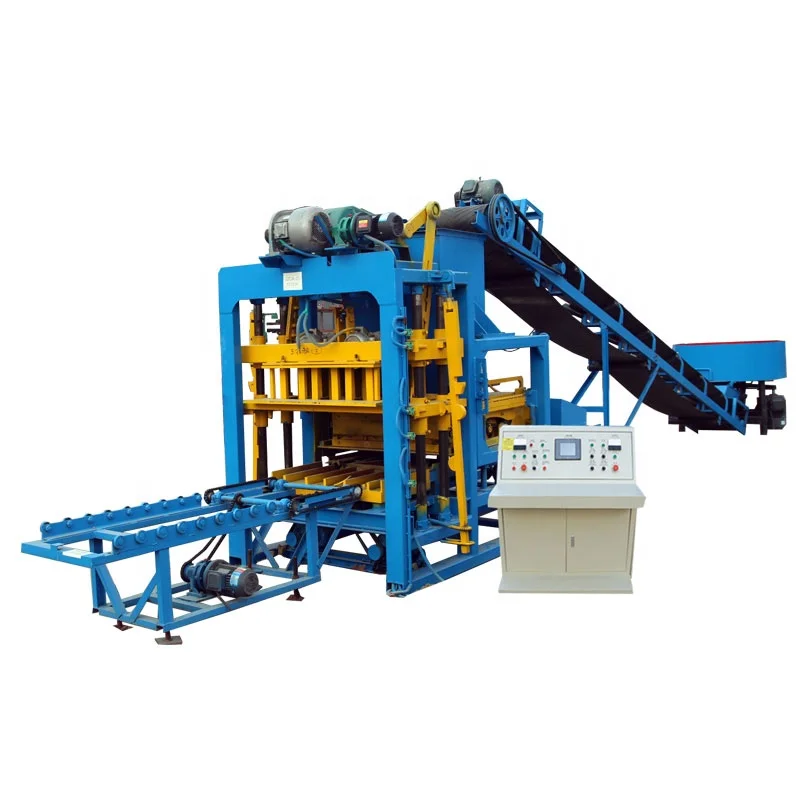
Single-Focus Line Design — every station from the JQ350 mixer through pallet feed and brick discharge is specified against the QTJ4-25 press cycle so no section starves or bottlenecks the next.
Technical Specifications
| Parameter | Value |
|---|---|
| Model | QTJ4-25 |
| Product Type | Automatic Concrete Block Making Machine |
| Overall Dimensions (L×W×H) | 6400×1500×2700 mm |
| Molding Cycle | 25 s |
| Vibration Frequency | 2800–5100 r/min |
| Exciting Power (Vibration Force) | 60 kN |
| Total Power | 17.9 kW |
| Mixer Model | JQ350 |
| Pallet Size | 850×550×20 mm |
| Net Weight | 2500 kg |
| Control System | PLC |
| Automation Level | Automatic (plate-supplying, material-disturbing, brick-discharging) |
| Vibration Type | Flat vibration with squeeze compression |
| Output Capacity (Hollow Block 390×190×190 mm) | 480 pcs/h, 3800 pcs/8 hr |
| Output Capacity (Hollow Block 400×150×200 mm) | 600 pcs/h, 4800 pcs/8 hr |
| Output Capacity (Solid Brick 240×115×53 mm) | 2100 pcs/h, 17000 pcs/8 hr |
| Applied Products | Concrete hollow blocks (8 inch, 6 inch), solid bricks |
| Raw Materials | Crushed stones, sand, cement, dust, fly ash |
| Voltage & Frequency | (basis not stated in source — confirm with buyer’s local standard) |
| Hydraulic Pressure | (basis not stated in source — confirm with manufacturer) |
| Mould Change Time | (basis not stated in source — confirm with manufacturer) |
Application Suitability
| Application | Material or Output |
|---|---|
| Small to medium block production plants | Hollow blocks and solid bricks from crushed stone, sand, and cement |
| First-time block plant entrepreneurs | 8-inch and 6-inch hollow blocks using locally sourced aggregate and fly ash |
| On-site construction contractors | Solid bricks 240×115×53 mm produced directly at the project location |
| Building material distributors expanding format range | Hollow block and solid brick formats added to an existing product catalogue |
Why the Line Around the Press Decides Your Real Daily Output
A block press can only run as fast as the slowest station feeding it or clearing its output.
Many quotations list the press alone, quoting cycles per hour without clarifying which block format that figure assumes. When the mixer cannot keep up with a 25-second molding interval, or pallets are moved by hand instead of fed automatically, the actual output falls well below the brochure number. I have walked into plants where the automatic block making machine production line sat idle for seconds between every cycle simply because the material supply and pallet handling were never designed as one system [NEED_CITE: typical output shortfall causes in block plants]. The QTJ4-25 is specified here with its JQ350 mixer, automatic plate-supplying, material-disturbing, and brick-discharging functions so that each station’s timing is matched to the press from the start.
How Station Synchronization Keeps the Press Running
The QTJ4-25 completes a molding cycle every 25 seconds. For this rhythm to hold, the JQ350 mixer must deliver a fresh batch within that same window, the pallet feeder must slide a new board into position, and the brick-discharging mechanism must clear the finished product before the next press stroke. When these three movements are PLC-controlled as one automatic block making machine production line sequence, the operator monitors rather than manually shuttles material between stations.
What Happens When the Line Is Designed as Separate Purchases
A buyer who sources the mixer, pallet feeder, and stacker from different suppliers often discovers timing mismatches during commissioning. The mixer may deliver faster than the pallet feeder can respond, or the discharge conveyor may not align with the pallet exit height. These mismatches do not show up in individual equipment specifications [NEED_CITE: integration challenges in multi-supplier block lines]. Specifying the entire automatic block making machine production line from one source means the cycle times are validated together before the equipment leaves the factory.
Reading the Specifications That Actually Matter for Line Performance
The 60 kN exciting power combined with flat vibration and squeeze compression determines the density of each block as it leaves the mould. Higher vibration frequency alone does not guarantee stronger blocks if the hydraulic pressure is not matched to the buyer’s specific mix design and local aggregate. The 850×550×20 mm pallet size is not arbitrary — it must align with the curing rack dimensions and forklift capacity the buyer already has on site. A pallet that is too large for the curing area forces a second handling step, and a pallet material that warps under moisture ruins block flatness before curing finishes. The 17.9 kW total power draw dictates the electrical supply specification the site must prepare before the line arrives.
The Hidden Cost of Treating the Press as a Standalone Purchase
When pallet handling and stacking are left out of the quotation, freshly pressed blocks sit on boards that workers must carry by hand to the curing area. This slows the entire cycle because the press waits for a pallet to become available. Labour fatigue builds through the shift, and block damage from manual handling increases [NEED_CITE: manual pallet handling impact on block breakage rates]. The buyer ends up paying for an automatic block making machine production line but running what is effectively a semi-manual operation.
Why Sourcing the Full Line From Shiyue Changes the Equation
Block machinery is our single focus, which means the press, mould, pallet, and handling equipment are specified as one matched system rather than assembled from separate suppliers. We configure each line against the buyer’s actual mix design, local aggregate, and target block format — not a catalogue default. Mould design covers the formats the buyer’s market actually sells, including custom drawings when standard formats do not match. Automation level is selectable, so a buyer can start with the automatic plate-supplying and brick-discharging functions and add further automation later. Installation support includes operator training on the full line, not just the press controls.
Documentation & Verification
- Line layout and capacity calculation stating which block format each output figure assumes
- Pallet specification confirming 850×550×20 mm size and material compatibility with your curing racks
- Voltage, frequency, and PLC display language confirmed in writing before production begins
- Hydraulic and electrical schematic for your site electrician to prepare connections in advance
- Factory test record showing the press running through full molding cycles before dispatch
Installation, Commissioning & Support
- Foundation must support 2500 kg net weight across the 6400×1500 mm footprint with level tolerance for pallet alignment
- Electrical supply must match confirmed voltage and frequency with dedicated circuit for 17.9 kW total draw
- PLC display language set before shipment so operators read instructions in their working language on day one
- JQ350 mixer positioned and calibrated to the 25-second press cycle during on-site commissioning
- Operator training covers automatic plate-supplying, material-disturbing, and brick-discharging sequences
- Wear parts list and mould maintenance schedule provided for planning first replacements
What to Prepare Before Requesting a Quotation
To size the automatic block making machine production line correctly, share the block formats you sell, your target daily output per format, and the raw materials available locally including aggregate grading. Confirm your site voltage, frequency, and the language your operators need on the PLC display. If you already have curing racks and forklifts, provide the pallet dimensions and rack spacing so the line can be configured around your existing handling equipment.
Frequently Asked Questions
Q: How is the line capacity calculated, and which block format does each output figure assume?
A: Each capacity figure is tied to a specific block format. The QTJ4-25 produces 480 pieces per hour based on a 390×190×190 mm hollow block, 600 pieces per hour based on a 400×150×200 mm hollow block, and 2100 pieces per hour based on a 240×115×53 mm solid brick. Switching formats changes the cycle count and mould fill volume, so always confirm which format your daily target refers to.
Q: Which stations are included in the line scope, and which remain the buyer’s responsibility?
A: The quotation covers the QTJ4-25 press, JQ350 mixer, automatic plate-supplying, material-disturbing, and brick-discharging functions. Raw material storage, curing area setup, and forklift handling beyond the discharge point are typically buyer scope. We confirm the boundary in the line layout document before production starts.
Q: How do the mixer output and pallet feed rate match the 25-second press cycle?
A: The JQ350 mixer batch size and discharge speed are selected so that mixed material reaches the press hopper within each 25-second interval. The pallet feeder is timed to the same PLC sequence, placing a fresh board as the finished block clears. This prevents any station from waiting on the next.
Q: What pallet size is specified, and how does it align with my curing area?
A: The standard pallet is 850×550×20 mm. Before production, we confirm this dimension against your curing rack spacing and forklift fork width. If your existing racks require a different size, the pallet specification is adjusted so blocks move directly from press to curing without re-handling.
Q: What on-site utilities must I prepare before the line arrives?
A: You will need a level foundation for the 6400×1500 mm footprint, an electrical supply matching the confirmed voltage and frequency for 17.9 kW total power, and water access for the mixer. The hydraulic and electrical schematic provided beforehand shows exactly where connections are needed so your team can prepare the site ahead of commissioning.