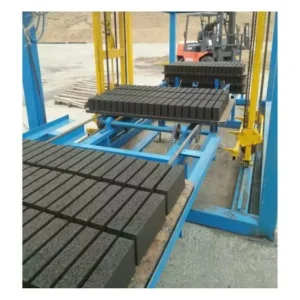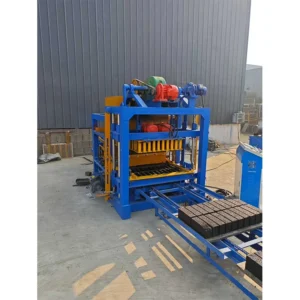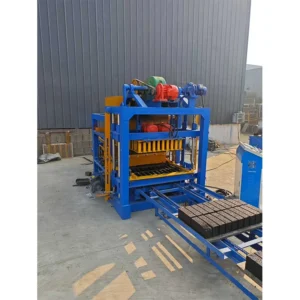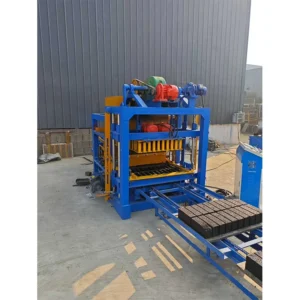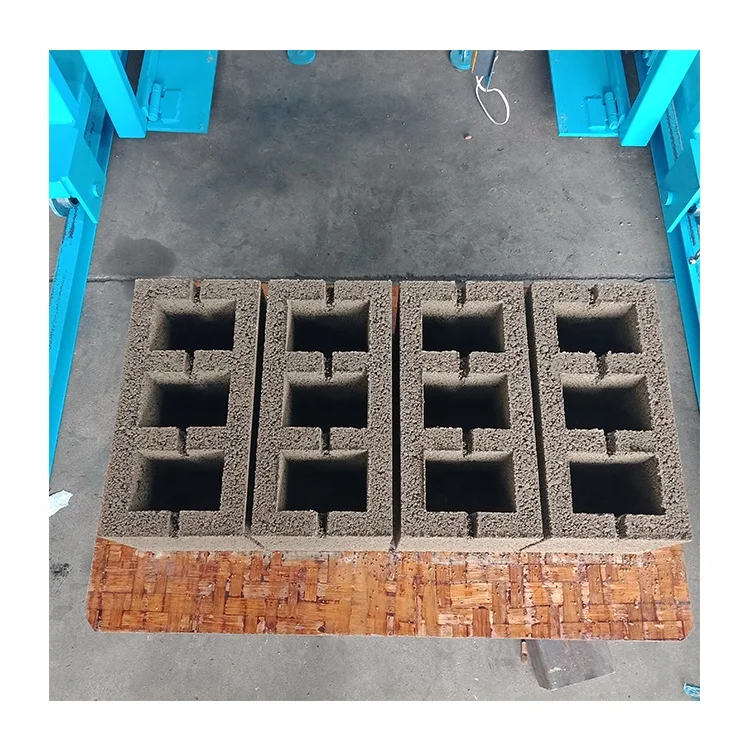
Line-First Engineering — Every QTJ4-25 press we quote ships with a cycle-matched mixer, pallet circuit and stacking plan so the host never sits idle waiting for upstream or downstream stations.
Technical Specifications
| Parameter | Value |
|---|---|
| Product Type | Automatic Concrete Block Making Machine |
| Model | QTJ4-25 |
| Overall Dimensions (L×W×H) | 3000×1800×2680 mm |
| Total Mass | 3.5 T |
| Overall Power | 16.58 kW |
| Vibration Force | 60 kN |
| Vibration Frequency | 2800–4500 r/min |
| Main Vibration Form | Platform Vibration |
| Pallet Size | 850×480 mm |
| Moulding Cycle | 25 s |
| Demolding Method | Mechanical |
| Output (Hollow Block) | 4640 pcs/day based on 400×200×200 mm, 4 pcs/mould, 8-hour shift |
| Output (Multi-cellular Brick) | 11200 pcs/day based on 240×115×90 mm, 9 pcs/mould, 8-hour shift |
| Output (Standard Solid Brick) | 26400 pcs/day based on 240×115×53 mm, 21 pcs/mould, 8-hour shift |
| Factory Area Baseline | 300 m² |
| Warranty | 1 year for the whole machine (excluding spare parts) |
| Voltage & Frequency | Configurable to buyer site supply (basis to be confirmed) |
| Control System | PLC or relay panel (basis to be confirmed) |
Application Suitability
| Application | Material or Output |
|---|---|
| Hollow block production for building walls | Crushed stone, sand, cement, fly ash |
| Standard solid brick for masonry | Sand, gravel, cement, stone dust |
| Paving block and interlocking paver | Crushed stone, slag, cement, pigment |
| Kerbstone and curb units for roadworks | Coarse aggregate, cement, sand |
| On-site block production for housing projects | Local aggregate, cement, water |
Why the Mixer Matters More Than the Press
An automatic block making machine production line lives or dies by the stations that feed it, not the press itself. If the mixer cannot deliver a fresh batch inside the 25-second moulding cycle, every downstream pallet sits empty and daily output collapses.
I once watched a West African plant lose a full shift of production because the pan mixer was sized on total daily volume rather than per-cycle demand. The operator kept the QTJ4-25 running, but the hopper starved every third cycle. Output dropped well below the rated figure, and the owner blamed the press. The real problem was upstream — a mismatch the line layout should have caught before the container was loaded [NEED_CITE: common causes of block line throughput loss in emerging markets].
Matching the Pallet Circuit to the 25-Second Cycle
A complete block production setup must move a loaded pallet from the press to the curing rack and return an empty one within each moulding window. The 850×480 mm pallet size on the QTJ4-25 determines the rack slot width, forklift tine spacing and the transfer table dimensions. If the curing yard is fifty metres away, the return loop needs either a roller conveyor or a dedicated pallet cart fleet sized against the press cycle so the automatic block making machine production line never waits on an empty board.
Raw Material Infeed Without Cross-Traffic
Plant owners often sketch the mixer next to the press and forget the delivery truck. With a 300 m² factory area baseline, raw material storage, the batching station, the press and the wet-block curing zone must be arranged so that aggregate delivery and finished-block dispatch do not share the same aisle. Crossing paths creates forklift bottlenecks that show up as micro-stoppages — three minutes here, five minutes there — and by the end of an eight-hour shift the gap between theoretical and actual output becomes hard to explain to the project manager [NEED_CITE: plant layout principles for small-scale block production].
Reading the Numbers That Actually Matter
The 60 kN platform vibration force works through dual under-mould motors to compact the mix from below while the upper mould head applies mechanical pressure. This combination determines block density and green strength far more than vibration frequency alone. A mix with high fly ash content needs longer vibration dwell at lower amplitude, while a coarse crushed-stone mix demands higher force to achieve interlock — the automatic block making machine production line must be configured around the buyer’s actual aggregate, not a catalogue default.
The 850×480 mm pallet footprint is small enough to handle manually yet large enough for four 400×200×200 mm hollow blocks per cycle. That pallet size also dictates how many boards fit on a standard curing rack tier and what forklift capacity the yard requires. Planning the pallet inventory against curing time and daily output prevents the line from running out of boards mid-shift.
Mechanical demolding means the mould box lifts while the pallet stays flat on the platform — no hydraulic knock-out pins to maintain, but it does require the downstream transfer to accept the block at platform height. Any conveyor or cart feeding the curing area must match that elevation or operators will spend the day bending and lifting.
The Cost of Leaving Stations Off the Quotation
When a quotation lists only the press, the buyer arrives at site and discovers that pallets must be carried by hand, the mixer runs too slow, and the curing racks are the wrong slot width. Each gap triggers a local purchase at premium cost and delays commissioning by weeks. The frustration lands on the machine supplier even though the press itself performs as specified [NEED_CITE: equipment commissioning delays caused by incomplete line scope].
Why Source the Full Line Here
Block machinery is the single focus of our engineering team, so the QTJ4-25 is never quoted in isolation. The mixer, pallet feeder, stacking arrangement and curing rack layout are specified as one matched system with cycle times verified station by station.
Configuration starts from the buyer’s mix design and local aggregate rather than a catalogue default, which protects block strength when the first production batch runs. Moulds are designed for the formats the buyer’s market actually sells, including custom drawings when a standard format does not fit local building codes.
Automation level is selectable — a buyer can begin with manual pallet handling on this semi-automatic press and add automatic stacking later without replacing the host machine. Installation support covers the full line, not just the press, and operator training addresses the entire workflow from batching to curing.
Documentation & Verification
- Line layout drawing with capacity stated per block format at each station
- Pallet specification sheet matched to curing rack slot width and forklift capacity
- Hydraulic and electrical schematics covering every station in the line
- Voltage, frequency and PLC language confirmation for all motors and controls
- Factory test record run on buyer’s target block format before dispatch
Installation, Commissioning & Support
- 16.58 kW total load requires dedicated circuit with confirmed voltage and frequency at every station
- 300 m² baseline area must include mixer pad, curing yard and pallet return path before foundation pour
- Mechanical demolding platform set to site floor level so downstream carts accept blocks without lifting
- Pallet fleet sized against curing duration and 850×480 mm board dimensions before first production run
- Operator training covers mixer-to-press timing, mould change procedure and daily vibration motor inspection
- Wear parts list and hydraulic seal kit shipped with the line for first-year maintenance coverage
Before You Request a Quote
Send us the block format your market sells, the daily volume you need and a sample of your local aggregate. Confirm the voltage and frequency at your site, the available factory footprint and whether you already own a mixer or forklift we need to integrate. With those details we can return a line layout that shows every station matched to the QTJ4-25 cycle time.
Frequently Asked Questions
Q: How do I size the mixer so the QTJ4-25 is never waiting for feed?
A: The press completes a cycle every 25 seconds, so the mixer must discharge a full batch within that window including transfer time. Calculate the batch volume from the mould cavity and mix density, then select a pan mixer whose discharge rate fits inside the cycle. We verify this on the line layout before quotation.
Q: How many 850×480 mm pallets do I need for continuous production?
A: Pallet quantity depends on curing time and daily output. If blocks cure for 24 hours and the press runs at its rated hollow block capacity, you need enough boards to cover a full day of output plus a buffer for the return loop. We calculate the exact number once your curing schedule is confirmed.
Q: Can the line layout prevent forklift cross-traffic between raw material and finished blocks?
A: Yes. We arrange the 300 m² baseline footprint so aggregate delivery enters from one side, passes through batching and the press, and exits as finished product on the opposite side. This one-direction flow removes path conflicts that cause micro-stoppages during shifts.
Q: What utility drops are required before the line arrives?
A: The 16.58 kW total load, confirmed voltage and frequency, plus water supply for the mixer and curing misting must be in place at each station. We provide a utility map showing cable size, breaker rating and water connection points so your electrician and plumber can prepare before container arrival.
Q: Can I start with manual pallet handling and add automatic stacking later?
A: The QTJ4-25 platform and demolding method allow manual pallet transfer from day one. When production volume justifies it, an automatic stacker and pallet return conveyor can be bolted on without modifying the press frame or vibration assembly, protecting your initial investment.