
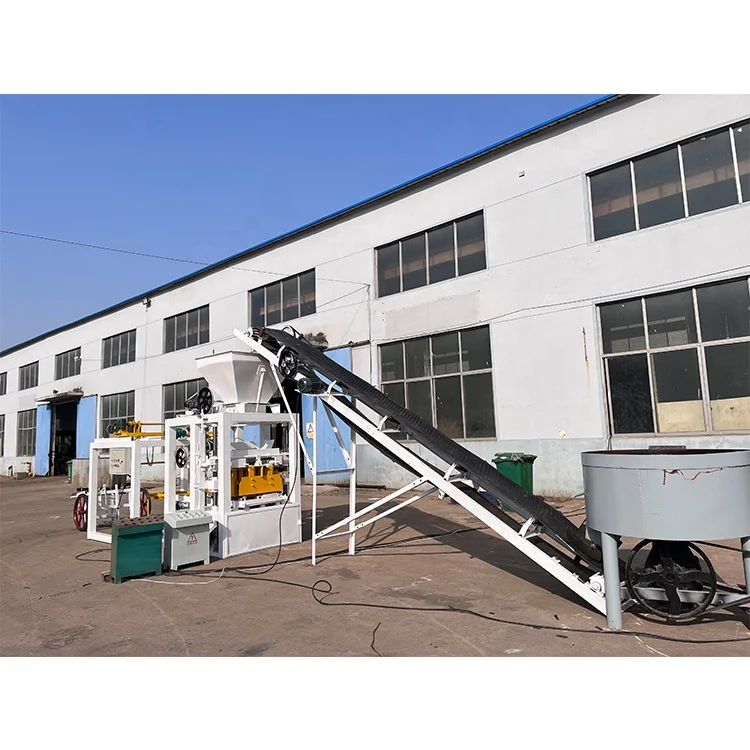
Pallet flow and cycle matching — Every upstream mixer discharge and downstream rack transfer is timed against the 24–26 s press cycle before the line is finalized.
Technical Specifications
| Parameter | Value |
|---|---|
| Model | QTJ4-24 |
| Product Type | Stationary Block Making Machine |
| Overall Dimensions (L×W×H) | 3600 x 1700 x 2560 mm |
| Pallet Size | 850 x 450 mm |
| Molding Cycle | 24–26 s |
| Rated Power | 11.95 kW |
| Vibration Force | 45 kN |
| Net Weight | 2 T |
| Molding Method | Mechanical |
| Vibration Configuration | 2 × 3 kW lower vibrators + 2 × 1.5 kW upper vibrators |
| Mold Lifting Reducer | 350-type |
| Material Distribution | Full-automatic spiral |
| Materials Processed | Cement, sand, stone |
| Voltage & Frequency | To be confirmed before order |
| Control System | To be confirmed (PLC or relay logic) |
| Mould Format Options | Interlocking, hollow, paving, and solid bricks |
| Warranty | 1 year for whole machine (excluding spare parts) |
Application Suitability
| Application | Material or Output |
|---|---|
| Hollow concrete block production | Cement, sand, and crushed stone aggregate |
| Solid concrete brick manufacturing | Cement, natural sand, and fine gravel |
| Interlocking brick making for landscaping | Cement, sand, and stone dust or quarry fines |
| Paving block production for walkways | Cement, coarse sand, and graded stone chips |
| Small-to-medium contractor block plants | On-site batching with locally sourced aggregate |
What "Cycles Per Hour" Leaves Out of a Stationary Block Making Machine Production Line
The press is only as fast as the slowest station around it. A cycle time of 24–26 s gives you a theoretical number on paper, but if the mixer takes 40 s to discharge one batch, or the operator is still pulling a cured pallet by hand when the next wet one needs to land, the press sits idle. The real daily output of a stationary block making machine production line is set by the weakest link in the chain, not the press alone.
I have seen block plants where the buyer paid for a high-spec press and then stacked finished blocks by hand for eight hours straight, because the pallet return loop and curing rack transfer were never included in the original quotation. The press was capable, but the line was not. [NEED_CITE: block plant cycle matching and station balancing principles]
Upstream and Downstream Station Balance
The QTJ4-24 completes a mold cycle every 24–26 s. That means the mixer must deliver a fresh batch of concrete in under 25 s, the pallet feeder must position an empty pallet in the same window, and the operator or stacker must clear the finished pallet before the next cycle starts. If any of these stations lag, the stationary block making machine production line stalls.
Full-automatic spiral material distribution on this press keeps raw mix flowing consistently to the mold box between cycles. That removes one bottleneck, but the mixer discharge rate and the pallet return speed still need to be verified against the press tempo during line design.
Pallet Circuit and Curing Area Integration
Each pallet measures 850 x 450 mm. Before the line is finalized, that pallet size must be cross-checked against the buyer’s existing curing rack dimensions, the spacing between rack levels, and the fork width of the forklift already on site. A mismatch here means pallets jam on the racks or the forklift cannot lift two stacks side by side, slowing the entire downstream flow.
The dual-level vibration system — two 3 kW lower vibrators and two 1.5 kW upper vibrators producing 45 kN of force — compacts the concrete mix tightly enough that freshly pressed blocks can be wheeled straight to the curing racks without manual re-handling or re-stacking. That density matters because every extra touch point on a green block risks edge damage and surface cracking. [NEED_CITE: vibration force and concrete block density standards]
Reading the Specifications for Line Impact
The 11.95 kW rated power tells you the electrical load at the press station; the total connected load for the full line, including mixer, conveyor, and stacker motors, will be higher and must be planned with the buyer’s transformer capacity in mind. The 350-type mold lifting reducer governs how quickly the mold head raises and lowers — a slower reducer adds seconds to every cycle and erodes daily output across thousands of cycles per shift.
Mechanical molding means there is no hydraulic pump station, no oil cooler, and no hydraulic hose maintenance. That simplifies the press station and reduces the utility footprint, but it also means vibration force and mold pressure are fixed by the motor and eccentric weight design rather than adjustable on the fly. The buyer’s mix design must be matched to the 45 kN vibration force before the line is commissioned, not after. [NEED_CITE: mechanical versus hydraulic block press selection criteria]
The Hidden Cost of Ignoring Station Timing
When a line is quoted as a press only, the buyer often discovers after installation that pallets are stacking up on the floor because no return conveyor was specified. Finished blocks sit on pallets in the aisle, blocking the forklift path, and the press operator slows the cycle manually to keep up. Daily output drops to a fraction of what the quotation promised, and the blame cycles between the press supplier and the buyer’s site team.
I have walked onto plants where the curing racks were built to a different pallet width than the one the press uses. Every pallet had to be re-stacked by hand before it could go on the rack, doubling the labor at the most physically demanding station on the line. [NEED_CITE: block plant pallet handling and curing rack design]
Why Source the Full Line from One Supplier
The machine, mold, pallet, and handling equipment are specified as one matched system rather than assembled from separate vendors with mismatched cycle assumptions. The QTJ4-24 is configured against the buyer’s actual mix design and local aggregate, not a catalogue default, so vibration force and mold fill timing align with the material that will actually run.
Mould design covers the formats the buyer’s market sells, including custom drawings for interlocking profiles or non-standard paving shapes. Automation level is selectable — a buyer can start with manual pallet handling and add automatic stacking or cubing later without replacing the press. Installation and commissioning include operator training so the team running the line on day one understands cycle matching, not just button sequences.
Documentation & Verification
- Line layout drawing showing station positions and material flow for the QTJ4-24
- Capacity calculation stating the block format and cycle assumptions used
- Pallet specification sheet matched to buyer’s curing rack and forklift
- Voltage, frequency, and control language confirmation before production
- Factory test record on buyer’s target block format before dispatch
- Wear parts and mould inventory list with first replacement lead times
Installation, Commissioning & Support
- Foundation plan sized for the 3600 x 1700 mm press footprint and vibration load
- Dedicated 11.95 kW circuit for the press, plus mixer and conveyor loads mapped
- Machine shipped partially assembled; mold and hopper bolted on site
- First-run cycle timing verified against mixer discharge and pallet return speed
- Operator training on mold change, spiral feed adjustment, and daily greasing points
- Spare vibrator motor and reducer seals stocked for first-year maintenance
What to Include in Your Inquiry
Send the block formats your market sells, the daily output you need, and the raw materials available locally. Confirm your site voltage, frequency, and the control language your operators will use. If you have existing curing racks or a forklift, share the rack spacing and fork dimensions so the pallet circuit can be designed around them.
Frequently Asked Questions
Q: How is daily output calculated, and which block format is it based on?
A: Daily output depends on the block format, because each mold produces a different number of pieces per cycle. A hollow block mold yields fewer pieces per press stroke than a solid brick mold. The capacity calculation must state the exact block format and the number of operating hours per shift. Without that, any output figure is incomplete.
Q: Which mixer capacity matches the 24–26 s press cycle?
A: The mixer must discharge one full batch in under 25 s to avoid starving the press. A pan mixer or planetary mixer sized to the mold volume per cycle is typical. If the mixer takes longer, the press idles and daily output drops regardless of the press speed rating.
Q: Are pallet handling, stacking, and curing rack transfer included in the line?
A: These stations can be included or excluded depending on the quotation scope. If they are not listed, the buyer will handle pallets and stacking manually. Confirm which stations are in the line layout drawing before placing the order so there are no gaps at installation.
Q: What voltage, frequency, and control language will the line ship with?
A: Voltage, frequency, and the control panel language must be confirmed in writing before production begins. These settings affect motor winding, PLC configuration, and operator interface. Changes after the machine is built cause delays and additional cost.
Q: What does the installation scope cover?
A: Installation covers station positioning per the line layout, electrical and mechanical connection of the press to upstream and downstream equipment, first-run cycle timing verification, and operator training on mold changes and daily maintenance. Foundation work and utility connections are typically the buyer’s responsibility.


