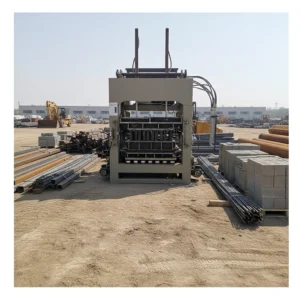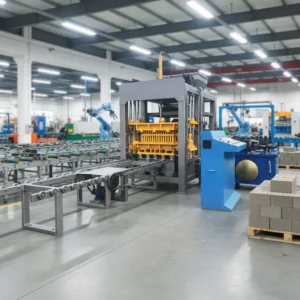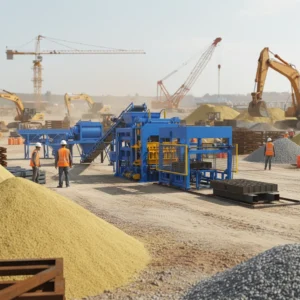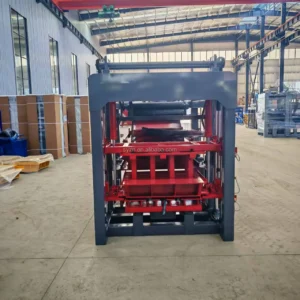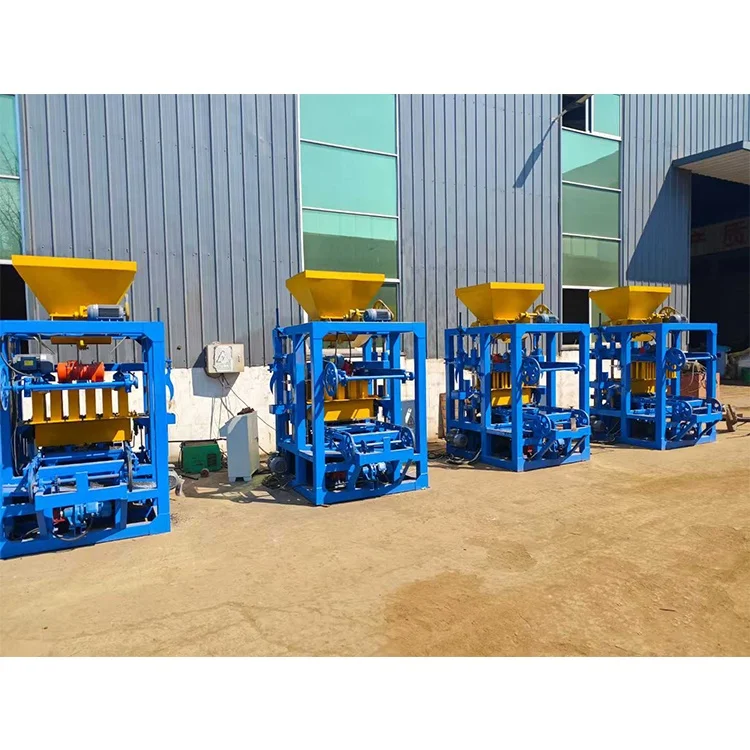
Matched Line Balance — the QTJ4-24 press, JQ350/JQ500 mixer, and belt conveyor are sized as one system so the 24-26s moulding cycle is never starved by an upstream bottleneck or a pallet queue at the discharge end.
Technical Specifications
| Parameter | Value |
|---|---|
| Model | QTJ4-24 |
| Product Type | Semi-Automatic Concrete Block Making Machine |
| Overall Dimensions (L×W×H) | 3600mm × 1700mm × 2560mm |
| Total Mass | 3.5T |
| Main Machine Power | 11.95kW |
| Pallet Size | 900mm × 450mm |
| Moulding Cycle | 24-26s |
| Mould Format (400×200×200mm hollow block) | 4 pcs/mould |
| Mould Format (390×240×190mm hollow block) | 3 pcs/mould |
| Mould Format (390×120×190mm hollow block) | 6 pcs/mould |
| Mould Format (240×115×53mm solid brick) | 21 pcs/mould |
| Automation Level | Semi-automatic (manual feeding, mechanical mould lifting, electrical control with mechanical interworking) |
| Vibration Type | Table vibration feeding, fluctuation vibration molding |
| Feed Method | Manual feeding, two feed ways available |
| Mixer Compatibility | JQ350 or JQ500 vertical mixer |
| Conveyor Compatibility | 6m or 8m belt conveyor (no digging required) |
| General Power Wire Specification | 3×16mm² |
| Main Machine Wire Specification | 3×6mm² |
| Mixer Wire Specification | 3×4mm² |
| Conveyor Wire Specification | 3×2.5mm² |
| Reducer Lubrication (JQ350) | 10kg 35-40# machine oil |
| Reducer Lubrication (JQ500) | 15kg 35-40# machine oil |
| Electrical Safety | Leakage protection circuit breaker required |
| Assembly State | Stationary, requires precast concrete ground with ≤1mm roughness at vibration platform corners |
| Warranty | 1 year (excluding spare parts) |
Application Suitability
| Application | Material or Output |
|---|---|
| Hollow block production | Crushed stone, sand, cement, and fly ash aggregates for 400×200×200mm or 390×120×190mm formats |
| Solid brick production | Fine aggregate and cement mixes for 240×115×53mm standard bricks |
| Paver and multicellular brick | Interlocking and porous formats requiring table vibration compaction |
| Small to medium block plants | Daily volume targets suited to semi-automatic pallet handling and manual stacking |
| On-site construction production | Housing or development projects where a compact line installs without foundation digging |
| First block plant setup | Entrepreneurs starting with a semi-automatic configuration that allows later automation additions |
Why the Mixer and Conveyor Decide Your Real Daily Output
A press cycle of 24-26 seconds only matters if the mixer batch and belt conveyor can deliver material at the same tempo.
On a job in the Gulf region, I watched a semi-automatic line sit idle for most of each shift because the mixer was undersized for the hollow block format the plant was running. The QTJ4-24 would finish a mould, then wait while the JQ350 mixed another batch. By midday, the crew had lost hours to dead time. The same semi-automatic block making machine production line with a JQ500 mixer and an 8m belt conveyor feeding inline kept the press running without interruption [NEED_CITE: block plant throughput dependency on upstream equipment sizing]. When the supporting stations are not calculated against the press cycle, the machine specification sheet becomes a theoretical document rather than a daily production plan.
How the QTJ4-24 Line Stations Connect
The semi-automatic block making machine production line begins with the JQ350 or JQ500 vertical mixer positioned so its discharge feeds directly onto the belt conveyor. The 6m conveyor suits a compact inline layout where the mixer sits close to the press, while the 8m option allows a perpendicular arrangement that fits narrow site footprints. Neither layout requires foundation digging — the conveyor mounts at ground level and the press sits on a precast concrete pad. Material travels from mixer to conveyor to the press hopper, and the operator controls feed timing through the electrical panel with mechanical interworking.
Pallet Flow and the Discharge Bottleneck
Once the QTJ4-24 completes a 24-26s moulding cycle, the formed blocks on the 900×450mm pallet must be moved to the curing area before the next cycle begins. In a semi-automatic configuration, this pallet handling is manual — an operator pulls the finished pallet and slides a fresh one into position. If the curing racks are too far from the press, or if the forklift cannot carry the pallet size specified, the operator spends more time transporting than feeding [NEED_CITE: manual pallet handling impact on semi-automatic block plant cycle continuity]. The line throughput therefore depends not only on the press and mixer but on the distance between the discharge end and the curing area, and on how many pallets are in circulation.
What the Vibration and Moulding Specs Mean for Block Strength
The QTJ4-24 uses table vibration during feeding and fluctuation vibration during moulding. Table vibration settles the aggregate into the mould cavity before the main compaction phase, which reduces voids in hollow blocks and improves face density on solid bricks. The 900×450mm pallet acts as the vibration transfer surface, so its material and flatness directly affect how evenly the force distributes across the mould. A warped or undersized pallet will produce blocks with inconsistent wall thickness and lower compressive strength, even if the machine settings are correct. This is why the pallet specification must be confirmed against the buyer’s curing rack dimensions and forklift capacity before the order is placed — the pallet is not an accessory but a working component of the vibration system.
The Hidden Cost of Skipping Line-Level Specification
When buyers purchase the press alone and source the mixer and conveyor locally, the wire gauges, reducer oil grades, and motor start sequences often do not align. The QTJ4-24 requires a 3×16mm² general power cable and a leakage protection circuit breaker on the main supply — if the local electrician installs a smaller gauge or omits the breaker, the press motor can trip repeatedly or overheat during sustained production. The mixer reducer needs the correct 35-40# machine oil at the specified fill weight; wrong oil viscosity leads to gear wear that surfaces only after weeks of operation [NEED_CITE: industrial equipment warranty exclusions for incorrect lubrication]. These mismatches do not appear in a factory test because the test runs for minutes, not shifts.
Why Procuring the Full Line from One Source Matters
Block machinery as a single focus means the QTJ4-24 press, JQ350 or JQ500 mixer, and 6m or 8m conveyor are specified together with confirmed wire gauges and motor ratings that match. The line layout drawing states which block format each throughput figure assumes, so there is no ambiguity between the 4 pcs/mould hollow block cycle and the 21 pcs/mould solid brick cycle. Mould design covers the formats the buyer’s market actually sells, including custom drawings when standard sizes do not match local building codes. Pallet size and material are confirmed against the buyer’s existing curing area and forklift before production begins. Installation support includes operator training on the specific mixer-press-conveyor sequence, not a generic machine manual.
Documentation & Verification
- Line layout drawing with station positions, conveyor route, and capacity stated per block format
- Machine specification sheet covering press, mixer, and conveyor as one matched system
- Electrical schematic showing 3×16mm² general circuit and leakage breaker requirement
- Mould drawing and format list for the ordered block sizes
- Factory test record run on the buyer’s specified block format before dispatch
- Operation and maintenance manual including reducer lubrication schedule for JQ350 and JQ500
Installation, Commissioning & Support
- Precast concrete ground required with ≤1mm roughness at vibration platform corners for the 3600×1700mm footprint
- General power supply must use 3×16mm² cable with leakage protection circuit breaker installed before commissioning
- Conveyor mounts at ground level with no foundation digging; 6m or 8m length selected during layout planning
- First run includes mixer reducer oil fill verification at 10kg or 15kg depending on JQ350 or JQ500 model
- Operator training covers the manual pallet change sequence timed against the 24-26s moulding cycle
- Wear parts list covers press vibration components and mixer reducer seals for the first replacement cycle
What to Include in Your Inquiry
To receive a line layout that reflects your actual site conditions, share the block formats your market requires, the daily volume you need to hit, and whether you already have a curing area and forklift in place. Include your local voltage and frequency so the motor specifications and wire gauges are set before production [NEED_CITE: voltage and frequency confirmation for exported industrial machinery]. If you have existing equipment such as a batch mixer or pallet racks, note their dimensions so the conveyor length and pallet size can be matched.
Frequently Asked Questions
Q: How is realistic daily output calculated for the full line, not just the press cycle time?
A: The 24-26s moulding cycle is the press-only figure. Daily output depends on mixer batch time, conveyor feed rate, and how quickly the operator changes pallets at the discharge end. A line capacity calculation must state which block format it assumes — 4 pcs per mould for 400×200×200mm hollow blocks produces a different daily total than 21 pcs per mould for solid bricks.
Q: Which mixer size matches my target block format and daily volume?
A: The JQ350 suits lower-volume production and smaller block formats where batch demand is modest. The JQ500 is selected when running larger hollow block formats at higher daily targets, ensuring the mixer discharge keeps pace with the QTJ4-24 press cycle without dead time between moulds.
Q: Can the conveyor be installed without digging, and what are the layout options?
A: Both the 6m and 8m belt conveyors mount at ground level with no foundation excavation required. The 6m version fits a compact inline layout with the mixer close to the press, while the 8m option supports a perpendicular arrangement for narrow site footprints.
Q: What supporting equipment makes the line continuous rather than stop-and-go?
A: Beyond the press, mixer, and conveyor, you need sufficient pallets in circulation to avoid waiting at the discharge end, a curing rack system sized for the 900×450mm pallet, and a forklift or hand cart matched to that pallet dimension. Automatic stacking can be added later.
Q: How do I confirm voltage, wire gauge, and electrical safety before shipment?
A: Provide your site voltage and frequency during the inquiry stage. The QTJ4-24 line requires a 3×16mm² general power cable, 3×6mm² for the main machine, and a leakage protection circuit breaker on the supply. These are confirmed in the electrical schematic before production begins.