
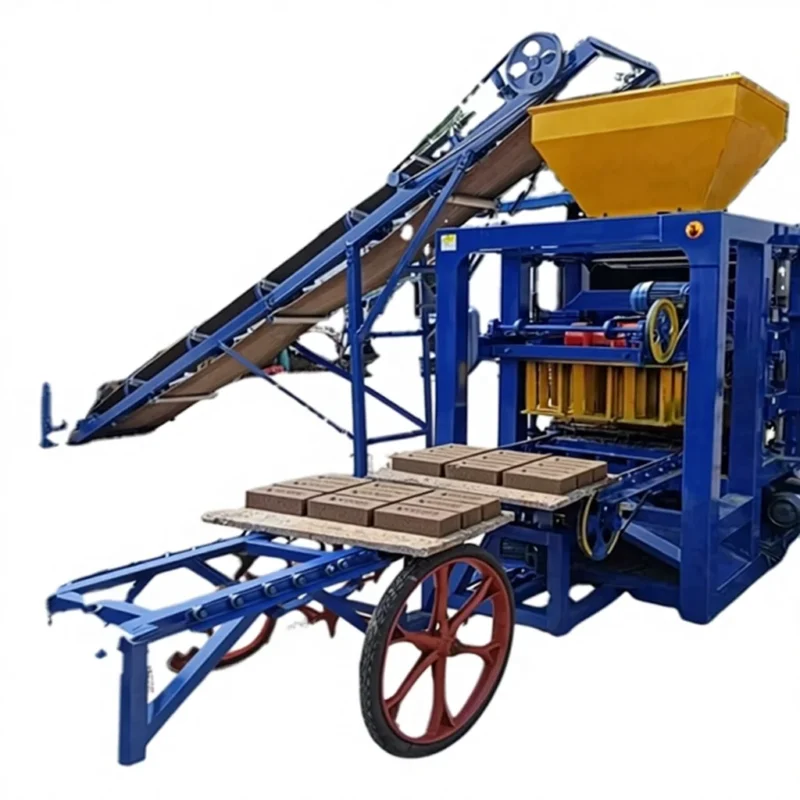
Complete Line Matching — the QTJ4-24 press, mixer, conveyor and optional stacker are specified together so no station outpaces another.
Technical Specifications
| Parameter | Value |
|---|---|
| Model | QTJ4-24 |
| Product Type | Semi-Automatic Concrete Block Making Machine |
| Molding Type | Platform Vibration |
| Overall Dimensions (L×W×H) | 3600 × 1700 × 2560 mm (working state) |
| Total Mass | 1750 kg |
| Pallet Size | 850 × 450 mm |
| Overall Power | 14.25 kW |
| Vibration System | Lower platform (2 × 3 kW motors) + upper platform (1.5 kW attached vibrator) |
| Elevating System | Cone-shape motor with JZQ250 speed reducer, V-belt drive |
| Delivery Device | Cycloidal pin wheel speed reducer, chain and V-belt drive |
| Machine Frame | Gantry style, super steel construction, four wear-resisting vertical guide shafts |
| Control System | Mechanical and electronic combination (basis to be confirmed) |
| Automation Level | Semi-automatic |
| Supporting Equipment | JQ350 pan mixer, 6 m belt conveyor, optional auto stacker (3–6 layers), curing trolley |
| Cycle Time per Format | (basis to be confirmed) |
| Output Capacity | (basis to be confirmed) |
| Voltage & Frequency | (basis to be confirmed) |
| Mould Formats | 390 × 190 × 190 mm (4 pcs/mould); 240 × 115 × 53 mm (21 pcs/mould) |
Application Suitability
| Application | Material or Output |
|---|---|
| Small-scale hollow block production | 390 × 190 × 190 mm blocks from crushed stone, sand and cement |
| Solid brick manufacturing | 240 × 115 × 53 mm bricks from local aggregate and cement |
| On-site contractor production | Workshop or project-site block making with low initial investment |
| First-time plant setup | Entrepreneurs entering block production with matched line equipment |
Why the Line Layout Matters More Than the Press Alone
A semi-automatic block machine production line only holds its cycle time when every upstream and downstream station keeps pace.
I once watched a contractor’s line stall because the pan mixer could not feed fast enough for the press cycle, leaving the operator standing idle while the hopper refilled. The press itself was fine. The mismatch was in the stations around it. When buyers quote a press without confirming mixer output, conveyor speed and stacking capacity against the target block format, the daily output falls well short of expectations [NEED_CITE: line balancing principles for block production].
How Each Station Connects on the QTJ4-24 Line
The JQ350 pan mixer feeds the 6 m belt conveyor, which delivers raw material into the QTJ4-24 hopper on a timed cycle. The cycloidal pin wheel delivery device inside the press controls material flow to the mould box, keeping feed timing consistent across cycles. This semi-automatic block machine production line is designed so the mixer batch volume, conveyor throughput and press cycle are calculated together before shipment rather than adjusted by trial and error on site.
Where Bottlenecks Typically Appear
When the curing trolley or manual stacking crew cannot clear pallets fast enough, the press stops because no empty pallet is available. The optional auto stacker handling 3 to 6 layers per pallet removes that constraint by clearing formed blocks at a rate that matches the press output. Buyers who skip this station often find their real daily capacity limited not by the press but by how quickly workers can carry pallets to the curing yard [NEED_CITE: pallet handling impact on block plant throughput].
Reading the Vibration and Frame Specs
The dual 3 kW lower vibration motors and 1.5 kW upper vibrator work together to compact concrete evenly across the 850 × 450 mm pallet. Lower platform vibration settles the mix from beneath while the upper vibrator consolidates the surface, which directly affects block density and demoulding strength. The gantry-style frame with four wear-resisting vertical guide shafts keeps the mould aligned during each vibration cycle, preventing uneven wall thickness on hollow blocks. With a total machine mass of 1750 kg, the frame absorbs vibration energy that would otherwise cause misalignment over thousands of cycles. Overall power draw of 14.25 kW includes all motors on the press, which helps buyers size their electrical supply before the machine arrives.
The Hidden Cost of Leaving Stations Out of the Quotation
When a buyer purchases only the press and sources the mixer, conveyor and stacker locally, each station arrives with its own cycle time and no guarantee they align. The mixer may produce batches faster than the conveyor can carry them, or the conveyor may deliver material quicker than the press can form. The result is a line that runs in stops and starts, wearing out clutches and belts prematurely while daily output stays below what any single station could achieve alone [NEED_CITE: consequences of mismatched line equipment].
Why Sourcing the Full Line Together Changes the Outcome
The QTJ4-24 is supplied with the JQ350 pan mixer and 6 m belt conveyor as standard, so the batch size and feed rate are calculated against the press cycle before production begins. Mould design covers the formats the buyer’s market actually sells, including custom drawings when standard formats do not match local demand. Voltage, frequency and control language are confirmed before the line ships, which avoids a situation where the machine sits unpowered while an electrician rewires the panel. Pallet specification is cross-checked against the buyer’s existing curing area and forklift capacity. The automation level can start semi-automatic and move toward automatic stacking as the plant scales, so the initial investment stays within budget.
Documentation & Verification
- Line layout with capacity calculation stating the block format assumed
- Factory test record covering each station’s cycle time before dispatch
- Pallet specification matched to buyer’s curing area and forklift
- Voltage, frequency and control language confirmation sheet
- Hydraulic and electrical schematic for the complete line
- Operation and maintenance manual with wear parts list
Installation, Commissioning & Support
- Foundation plan sized to the 3600 × 1700 mm working footprint and 1750 kg mass
- Electrical supply matched to confirmed voltage, frequency and 14.25 kW total load
- JQ350 mixer and 6 m conveyor positioned to align with the QTJ4-24 hopper feed height
- First-run parameter setting covering vibration timing, mould fill depth and cycle length
- Operator training on mould change procedure and daily guide shaft lubrication
- Wear parts and mould list provided with recommended reorder intervals
What to Include in Your Inquiry
Send us your target block format, daily output requirement and the raw materials available locally so the mixer and press can be configured around your actual mix design. Confirm your site voltage, frequency and preferred control display language to prevent commissioning delays. Let us know your curing yard dimensions and existing forklift capacity so the 850 × 450 mm pallet specification is validated before production.
Frequently Asked Questions
Q: What is the realistic daily output of the QTJ4-24 line for hollow blocks versus solid bricks?
A: Output depends on the block format, mix design and curing method. The 390 × 190 × 190 mm hollow block mould produces 4 pieces per cycle while the 240 × 115 × 53 mm solid brick mould produces 21. We calculate daily capacity based on your confirmed block format and local aggregate before quotation, not from a generic catalogue figure.
Q: How do the mixer, conveyor and press cycle times align?
A: The JQ350 pan mixer batch volume and 6 m belt conveyor speed are specified against the QTJ4-24 press cycle so material arrives at the hopper at a steady rate. If any station runs faster or slower, the line layout is adjusted before shipment to prevent bottlenecks or idle time.
Q: Is the 850 × 450 mm pallet compatible with my existing curing yard?
A: We cross-check the pallet dimensions against your curing area layout and forklift capacity before production. If your yard uses a different pallet size or material, we adjust the specification so pallets move smoothly from press to curing rack without manual rehandling.
Q: Is the auto stacker included or optional on this line?
A: The auto stacker is optional and handles 3 to 6 layers per pallet. Including it reduces the manual labour needed to clear formed blocks from the press area. We confirm whether your operation requires it based on your daily output target and available workforce.
Q: What electrical details must be confirmed before the line ships?
A: Your site voltage, frequency and preferred control display language must be confirmed so the electrical panel and PLC or MCC are built to match. Without this step, the machine may require rewiring or component replacement after arrival, delaying commissioning.


