
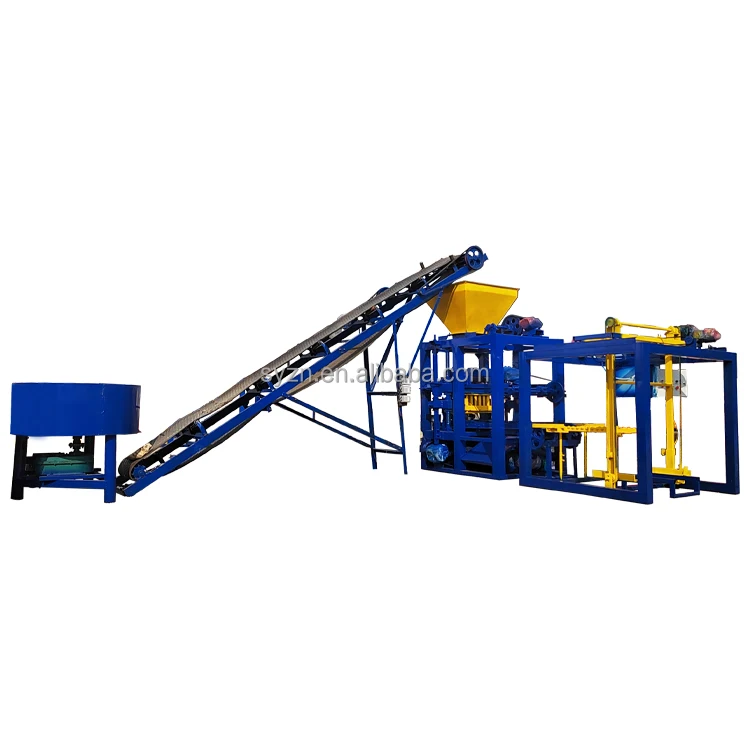
Single Focus on Block Lines — the QTJ4-24 press is specified together with its mixer, pallet feeder, stacker and curing rack handling so no station waits on another during continuous production.
Technical Specifications
| Parameter | Value |
|---|---|
| Model | QTJ4-24 |
| Product Type | Stationary Block Making Machine |
| Overall Dimensions (L×W×H) | 3600 x 1700 x 2560 mm |
| Pallet Size | 850 x 450 mm |
| Molding Cycle | 24–26 s (basis not stated in source — confirm block format and material) |
| Overall Power | 11.95 kW |
| Vibration Force | 45 kN |
| Vibrator Configuration | 2 × 3 kW lower vibrators + 2 × 1.5 kW upper vibrators |
| Net Weight | 2 T |
| Molding Method | Mechanical |
| Material Distribution | Full-automatic spiral |
| Reducer for Mold Lifting | 350-type |
| Raw Materials | Cement, sand, stone |
| Control System | PLC |
| Automation Level | Semi-automatic (mechanical molding with spiral feeding) |
| Block Formats | Hollow blocks (other formats subject to mould compatibility) |
| Voltage & Frequency | Configurable to buyer site supply (to be confirmed before production) |
| Key Features | PLC control, dual upper/lower vibration, spiral material feeding, mechanical mold lifting |
Application Suitability
| Application | Material or Output |
|---|---|
| Small-to-medium block plant operations | Hollow block production from cement, sand and crushed stone aggregate |
| On-site block manufacturing for building contractors | Hollow blocks produced locally using available site aggregates and cement |
| First block plant setup by entrepreneurs | Hollow block output for local building material distribution |
| Existing block plants adding format capacity | Hollow blocks integrated into an existing pallet circulation and curing system |
What the Press Cycle Time Does Not Tell You About Daily Output
Real line throughput depends on pallet return speed, stacking cadence and curing rack turnover — not just the 24–26 s cycle printed on the QTJ4-24 nameplate.
When buyers look at a stationary block making machine with supporting equipment, the first number they see is cycles per hour. That figure assumes an uninterrupted pallet supply, instant stacking downstream and a curing rack system that clears fast enough to keep empty pallets flowing back. In practice, a bottleneck at any of those stations forces the press to idle. I have watched lines stall because the pallet return conveyor was sized for a shorter run, or because the curing area could not absorb a full shift of output [NEED_CITE: common causes of block line downtime in semi-automatic plants]. The block production line QTJ4-24 must be laid out so every station — mixer, pallet feeder, press, stacker and curing rack handler — matches the press cadence rather than fighting it.
Matching Every Station to the Press Cadence
The QTJ4-24 is one station in a sequence, and its 11.95 kW power draw influences the motor sizing of every feeder, mixer and conveyor connected to it. When the mixer batch size does not align with the spiral feed rate, the press runs starved for material part of the cycle. A block production line QTJ4-24 layout drawing must show conveyor lengths, transfer points and buffer positions so the press never waits on upstream supply or downstream pallet clearance.
Pallet Circulation as the Hidden Bottleneck
The 850 x 450 mm pallet must travel from the feeder through the press, into the stacker, onto the curing rack and back. If the curing rack slot pitch does not accept that pallet dimension, or if the forklift tine width on site cannot handle the loaded weight, pallets pile up and the line stops. Specifying pallet material, rack geometry and forklift capacity alongside the press prevents a mismatch that no amount of operator effort can fix during a shift [NEED_CITE: pallet handling mismatches in block plant operations].
Reading the Specifications Beyond the Press
The 45 kN vibration force, generated by two 3 kW lower vibrators and two 1.5 kW upper vibrators, determines how densely the mix is compacted in the mold. With the QTJ4-24, that dual configuration allows adjustment of upper and lower amplitude independently, which matters when switching between a coarse aggregate mix for structural hollow blocks and a finer sand-rich mix for smoother faces. The mechanical molding method and 350-type reducer for mold lifting mean the machine relies on consistent mechanical timing rather than hydraulic cushioning — a factor that affects how quickly the mold opens and how cleanly the green block releases. The full-automatic spiral material distribution keeps the mold cavity filled between cycles, but the actual fill uniformity depends on the mix moisture and aggregate grading arriving from the mixer station. Semi-automatic operation means pallets are loaded by the feeder but may require manual intervention at the stacking or curing end, depending on how the rest of the line is configured.
The Cost of Skipping Line-Level Specification
Leaving pallet handling, stacking and curing out of the initial quotation creates a line where daily output is stacked by hand and real throughput falls well below what the press cycle time suggests. Buyers who specify the press alone often discover during commissioning that the mixer output does not keep pace, the pallet return loop is too slow, or the curing racks were never designed for the 850 x 450 mm pallet format. Rectifying these gaps on site costs more in lost production days than including them in the original layout would have [NEED_CITE: cost of post-installation line modifications in block plants].
Why This Line Is Specified as One System
Block machinery is the single focus here, so the QTJ4-24 press, its mold, pallets and handling equipment are specified as one matched system rather than assembled from separate suppliers. Configuration is set against the buyer’s actual mix design, local aggregate and target block format — not a catalogue default. The line layout states capacity per block format, not just press cycles per hour. Automation level is selectable, allowing a buyer to start semi-automatic and add automatic stacking or curing rack handling later. Mould design covers the formats the buyer’s market actually sells, and custom drawings are available when standard moulds do not match. Installation and commissioning include operator training on the full line, not just the press in isolation.
Documentation & Verification
- Line layout drawing showing feeder, mixer, pallet feeder, press, stacker and curing rack positions with conveyor lengths
- Capacity calculation stated per hollow block format with pallet cycle time included
- Pallet specification matched to 850 x 450 mm dimension and curing rack slot pitch
- Voltage, frequency and PLC display language confirmation sheet before shipment
- Factory test record on buyer-specified mix design and block format
- Operation and maintenance manual covering all stations in the line
Installation, Commissioning & Support
- Foundation plan sized to the 3600 x 1700 mm footprint with anchor bolt positions for the 2 T machine weight
- Dedicated power circuit for the 11.95 kW total draw, with voltage and frequency confirmed before wiring
- Pallet feeder alignment checked against 850 x 450 mm pallet stock and curing rack entry geometry
- Vibration parameters tuned to buyer’s local aggregate during on-site commissioning of the 45 kN system
- PLC display language and control logic verified with operators before first production run
- Wear parts list for vibrator mounts, spiral feeder flights and 350-type reducer supplied at handover
What We Need to Scope Your Line
To lay out a block production line QTJ4-24 that matches your site, we need the hollow block format and wall thickness you plan to produce, your local aggregate type and grading, and the daily output target stated in blocks rather than press cycles. Please also confirm your existing curing area dimensions, forklift capacity and the voltage and frequency available at the installation point so every station is specified correctly before production begins.
Frequently Asked Questions
Q: How is daily output calculated across the full line, not just the press cycle time?
A: Daily output for the QTJ4-24 line is calculated per block format, factoring in the 24–26 s molding cycle alongside pallet return speed, stacking station cadence and curing rack turnover rate. The figure accounts for every station in the sequence, not just the press, so the stated throughput reflects what actually leaves the curing area at the end of a shift.
Q: What pallet size and material are specified, and how do they match my existing setup?
A: The standard pallet for this line is 850 x 450 mm. Before final specification, we cross-check that dimension against your curing rack slot pitch, rack loading capacity and the forklift tine width already on site. Pallet material is selected based on the curing environment and expected handling frequency to avoid premature warping or breakage.
Q: Which supporting stations are included in the quotation?
A: A complete quotation covers the raw material feeder, mixer, pallet feeder, the QTJ4-24 press, stacker and curing rack handling equipment. Each station is listed with its own specification so you can see exactly what is included and where conveyor lengths and transfer points connect across the layout.
Q: How do I confirm voltage, frequency and control language before the machine ships?
A: We send a confirmation sheet listing the required voltage, frequency and PLC display language for your site. You sign off before production begins so the electrical cabinet and control interface arrive ready for commissioning, avoiding delays that typically arise when these details are settled after delivery.
Q: What is the lead time for the complete line including all supporting equipment?
A: Lead time covers production and factory testing of the QTJ4-24 press along with every supporting station in the line. The timeline is quoted upfront once the full layout is confirmed, including container loading plans and any machine dismantling required for shipment to your destination.


