
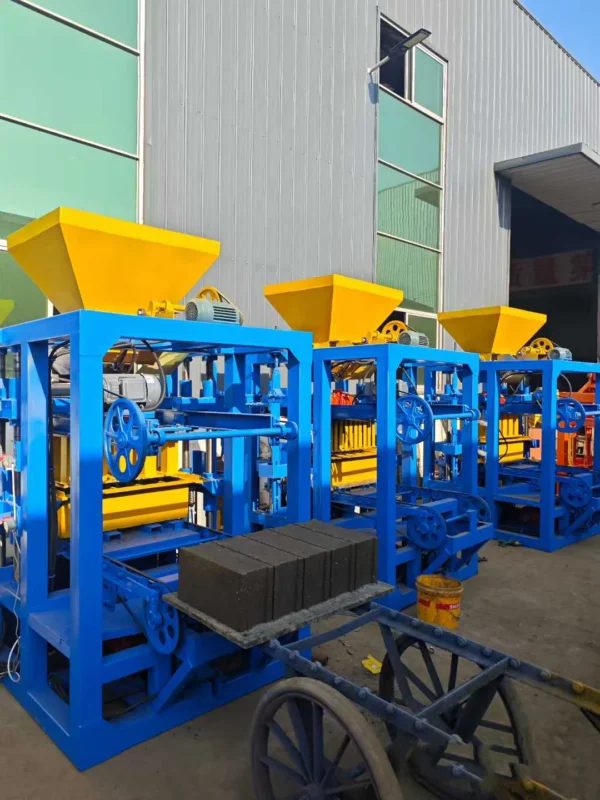
Line-matched system integration — Every QTJ4-24 configuration is balanced against upstream mixing output and downstream pallet return speed before the proposal is finalized.
Technical Specifications
| Parameter | Value |
|---|---|
| Model | QTJ4-24 |
| Product Type | Automatic Hydraulic Cement Hollow Block Making Machine |
| Overall Dimensions (L×W×H) | 3600×1700×2560mm |
| Pallet Size | 850×450mm |
| Molding Cycle | 24–26s (basis not stated in source) |
| Overall Power | 11.95kW |
| Vibration Force | 45kN |
| Total Mass | 2T |
| Vibration Configuration | 2×3kW lower vibrators + 2×1.5kW upper vibrators |
| Molding Method | Mechanical |
| Reducer | 350-type for mould lifting |
| Material Distribution | Full-automatic spiral |
| Control System | PLC |
| Automation Level | Automatic |
| Compatible Materials | Cement, sand, stone |
| Warranty | 1 year for the whole machine (excluding spare parts) |
Application Suitability
| Application | Material or Output |
|---|---|
| Hollow block production plants | Cement, crushed stone, and sand mixes |
| On-site block production for construction contractors | Local aggregate with cement binder |
| First block plant for entrepreneurs | Standard masonry formats using regional raw materials |
| Interlocking brick and paving brick runs | Compatible mould formats with adjusted mix proportions |
What a Turnkey Block Plant Actually Means Beyond the Press
A block machine is only as productive as the slowest station surrounding it.
When a buyer quotes a block making machine production line based on press cycle time alone, the gap between brochure numbers and real output can be significant. I once configured a QTJ4-24 for a site where the mixer discharge rate could not keep pace with the 24–26 second mould cycle, and the press sat idle for seconds every round. The buyer saw daily volumes fall well short of expectation and initially blamed the machine itself. The problem was the line, not the press. [NEED_CITE: production line bottleneck analysis in concrete block manufacturing]
Raw Material Feeding and Mixing Station Alignment
The full-automatic spiral material distribution on the QTJ4-24 moves mix into the mould cavity uniformly, but it depends on a steady supply from the mixer. If the mixer batch size and discharge interval do not match the press cycle, the spiral runs dry or the hopper overflows. A turnkey block plant proposal must state the mixer capacity and batching interval assumed, so the buyer can verify against their local material supply rate.
Pallet Circulation and Return Speed
With an 850×450mm pallet format, each completed block set rides out on a pallet that must be cured, stripped, cleaned, and returned before the next cycle. The pallet return conveyor speed must match the 24–26 second press cadence. If pallets accumulate at the curing rack or the return belt is undersized, the press waits — and a block making machine production line rated at a certain cycle time never achieves it. [NEED_CITE: pallet circulation requirements in stationary block plants]
Stacking Station and Output Handling
The QTJ4-24 produces blocks that must be moved from the press exit to the curing area. Whether this is done by manual handling, a chain conveyor, or an automatic stacker, the station must accept output at the rate the press delivers. A line where stacking is an afterthought forces workers to pull blocks by hand, introducing delays and breakage that the press specification sheet never mentions.
Vibration Force, Pressure, and Mix Design Matching
The 45kN total vibration force from four vibrators — two 3kW units below and two 1.5kW units above — compacts the mix inside the mould cavity. This force must be matched to the buyer’s specific aggregate grading and cement ratio. A mix with coarse local stone requires different vibration characteristics than a fine sand mix, and using a catalogue default setting risks inconsistent block density across the production run.
Reading the Specs That Matter on the Shop Floor
The 350-type reducer driving the mould lifting mechanism carries the full weight of the mould assembly through thousands of cycles per shift. A reducer undersized for this duty wears prematurely and causes unplanned line stops that halt the entire block making machine production line, not just the press. The 11.95kW total power draw across all vibrators, distribution, and control systems dictates the electrical supply requirement and must be confirmed against the site’s available capacity before the machine ships. The PLC control governs cycle timing and station sequencing, but its display language and voltage configuration must be set before commissioning — a machine arriving with the wrong language on the HMI wastes the first days of installation in translation rather than production. [NEED_CITE: industrial PLC language and voltage configuration for export machinery]
The Cost of Skipping Line-Level Configuration
When pallet size is chosen without checking the buyer’s existing curing rack spacing or forklift fork width, pallets may not fit the racks already on site. When voltage and frequency are assumed rather than confirmed, the control panel may not power up on arrival, delaying commissioning by weeks while components are sourced. When the quotation covers the press alone and pallet handling is left to the buyer, the actual labor cost on the shop floor rises sharply against what was budgeted. These are not machine defects — they are specification gaps that a turnkey block plant approach is designed to close before production begins. [NEED_CITE: common specification gaps in imported concrete block machinery]
Why Source the QTJ4-24 Through a Line-Integrated Approach
Block machinery is our single focus, which means the QTJ4-24 is specified alongside its mould, pallet, and handling equipment as one matched system rather than assembled from separate suppliers. Configuration is set against the buyer’s actual mix design, local aggregate, and target block format — not a catalogue default. Mould design covers the formats the buyer’s market sells, with custom drawings where needed. Automation level is selectable so a buyer can start with the core press and add pallet circulation or stacking later. Installation support includes operator training on the full line, not just the press controls.
Documentation & Verification
- Line layout and capacity calculation stating the block format assumed for the QTJ4-24 cycle time
- Pallet specification sheet matched to buyer’s curing area dimensions and forklift capacity
- Hydraulic and electrical schematic covering the complete line, not the press alone
- Voltage, frequency, and PLC display language confirmation signed before production
- Factory test record run on the buyer’s target block format before dispatch
Installation, Commissioning & Support
- Foundation plan sized to the QTJ4-24 footprint of 3600×1700mm with vibration isolation requirements
- Electrical supply confirmed against 11.95kW total draw including dedicated circuit for the 45kN vibration system
- Machine shipped in dismantled modules with reassembly sequence documented for site crews
- First-run commissioning includes cycle timing verification across all line stations, not just the press
- Operator training covers PLC interface, mould change procedure, and daily maintenance checkpoints
- Wear parts list covering the 350-type reducer, vibrator motors, and mould surfaces
What to Include with Your Inquiry
A meaningful turnkey block plant proposal for the QTJ4-24 requires more than a machine request. Share your target block format and daily output goal, the local aggregate and cement type available at your site, and your existing curing area dimensions. Include your site voltage and frequency, preferred PLC display language, and whether pallet handling or stacking equipment is already in place or needs to be part of the scope.
Frequently Asked Questions
Q: How is the 24–26 second molding cycle verified against actual block format?
A: The stated cycle time depends on the block format, wall thickness, and mix composition used during testing. Before quotation, we calculate realistic daily output based on your specific target format and confirm it in the line layout document so the capacity figure you plan against reflects your actual product.
Q: How do upstream and downstream stations stay synchronized with the press?
A: The mixer discharge rate, pallet return conveyor speed, and stacking station cadence are each sized against the QTJ4-24 cycle time. The line proposal includes a station-by-station timing breakdown so no single point becomes a bottleneck that holds up the press.
Q: How is vibration force matched to local raw materials?
A: The 45kN vibration system is configured after reviewing your aggregate grading and cement ratio. Coarse stone and fine sand require different amplitude and frequency balance, and the setting is documented so your team can replicate it across production batches.
Q: What is the total line footprint beyond the press dimensions?
A: The QTJ4-24 occupies 3600×1700mm, but the full line includes raw material storage, mixer placement, pallet circulation path, curing rack area, and stacking zone. The layout drawing provided with the proposal shows the complete footprint so you can verify against your available workshop space before ordering.


