
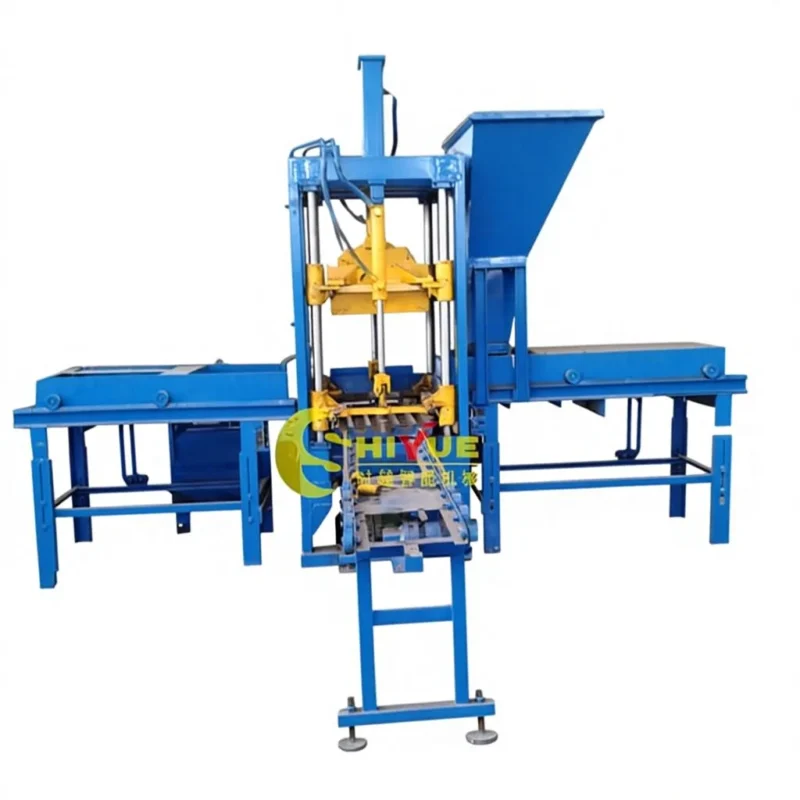
Matched Line Integration — The QTF3-20 stationary block machine is specified as a coordinated production line where each supporting station is sized to the press cycle, so no upstream feeder or downstream conveyor limits the host machine’s output potential.
Technical Specifications
| Parameter | Value |
|---|---|
| Model | QTF3-20 |
| Product Type | Stationary Block Making Machine |
| Total Power | 17.5 kW |
| Control System | Semi-Automatic |
| Overall Dimensions (L×W×H) | 4000×3500×2300 mm |
| Total Mass | 2870 kg |
| Vibration Form | Platform Vibration |
| Output Capacity | 4320 pcs/day (basis not stated in source — confirm block format / material / thickness) |
| Hydraulic System | Applied to drive, no-contact proximity switch monitoring |
| Material Feeding | Double layer (raw material and color surface material) |
| Host Machine Structure | Overall frame structure, #12 U-bar welding |
| Compatible Mixer | JQ350 mixer with 8 meters conveyor belt |
| Line Configuration | Host machine, material feeding machine, color material machine, pallet feeder, block conveyor, hydraulic station, electricity box |
| Electrical & Hydraulic Components | Imported from Germany or Chinese famous brand (source value — verify against manufacturer catalog) |
Application Suitability
| Application | Material or Output |
|---|---|
| Hollow block production | Cement, sand, coarse aggregate |
| Interlock brick production | Cement, fly ash, slag |
| Color paver production | Cement, sand with color surface layer |
| Porous brick production | Cement, fly ash, slag |
| Environmental brick production | Cement, sand, construction waste aggregate |
| Park grass brick production | Cement, sand, coarse aggregate |
| Standard solid brick production | Cement, sand, fly ash |
| Slope protection brick production | Cement, coarse aggregate, slag |
What "4,320 Pieces per Day" Leaves Out on a Stationary Block Making Machine Production Line
Capacity figures only hold meaning when tied to a specific block format, wall thickness, and curing cycle.
I have seen buyers receive a stationary block making machine production line expecting the brochure number, only to find that 4,320 pieces assumed a thin paver format while their market needed 200mm hollow blocks — where actual throughput dropped significantly. The daily output changes depending on whether you run solid bricks, interlock pavers, or hollow blocks, and the mix design affects how quickly each cycle completes. [NEED_CITE: block format impact on cycle time in concrete block production]
How Each Station Feeds the Next
A stationary block making machine production line lives or dies by station-to-station synchronization. The QTF3-20 line pairs the host press with a JQ350 mixer feeding through an 8-meter conveyor belt, a double-layer material feeding station for both base mix and color surface material, a pallet feeder, and a block conveyor. Each of these stations must deliver on time, because if the mixer batch is not ready when the press completes its cycle, the entire line sits idle. The no-contact proximity switches across the line monitor station positions so that the press does not fire until material, pallet, and color layer are confirmed in place.
Line Balance Over Individual Station Speed
Specifying the fastest press available means nothing when the pallet feeder cannot keep up or the conveyor backs up cured blocks at the stacking end. The QTF3-20 configuration treats the line as one system: the material feeding machine, color material machine, and pallet feeder are all matched to the press cycle time so that no station forces the others to wait. This is where a stationary block making machine production line earns its throughput — not at any single station, but at the handoff points between them. [NEED_CITE: production line bottleneck analysis in concrete block manufacturing]
Reading the Specs That Matter for Your Plant
The 17.5 kW total power rating tells you the electrical supply requirement you need to provision before the line arrives — a detail I now confirm with a photo of the buyer’s distribution panel before we start building. The platform vibration system works together with hydraulic pressure to compact the mix, and the balance between vibration force and hydraulic tonnage must match your local aggregate gradation and cement ratio. The #12 U-bar welded frame provides the rigidity needed to absorb repeated vibration cycles without structural fatigue over years of operation. The double-layer feeding system means you can produce color pavers and standard blocks on the same line without a separate color station purchase later.
The Cost of Skipping Line Integration
When a buyer sources the press from one supplier, the mixer from another, and pallets from a third, the result is often a line where stations do not communicate. Pallets arrive too early or too late. The color feeder drops material before the base layer is compacted. Proximity switches from different brands use incompatible signal protocols. These mismatches do not show up in individual equipment quotations — they appear on the first day of commissioning, when the line stalls repeatedly and the operator spends the shift resetting sensors. [NEED_CITE: equipment interoperability issues in multi-supplier production lines]
Why Source the Full Line From One Configuration Point
The QTF3-20 is not quoted as a standalone press. The line configuration — host machine, material feeding machine, color material machine, pallet feeder, block conveyor, hydraulic station, and electricity box — is specified as a matched set against your target block format and local raw materials. The mixer and conveyor length are defined so material arrives at the press at the correct rate. Voltage, frequency, and control language are confirmed before production begins, not discovered at the job site. Electrical and hydraulic schematics show how each station interlocks with the others, so your maintenance team understands the line logic. Pallet size is selected to match your existing curing area and forklift capacity, not chosen from a default catalog entry.
Documentation & Verification
- Line layout drawing showing each station footprint and conveyor routing for the QTF3-20
- Capacity calculation sheet stating the block format and wall thickness assumed
- Voltage, frequency, and PLC display language confirmation signed before production
- Hydraulic and electrical schematics showing station interlock logic
- Factory test record with the press running your target block format
- Pallet specification matched to your curing rack dimensions and forklift
Installation, Commissioning & Support
- Foundation plan based on the 4000×3500 mm footprint and 2870 kg mass distribution
- Electrical supply verification for 17.5 kW total load on dedicated circuit at confirmed voltage
- Station-by-station commissioning sequence following the proximity switch synchronization logic
- Operator training on double-layer feeding changeover between color pavers and standard blocks
- Hydraulic station pressure setting matched to your local aggregate and mix design
- Wear parts list covering hydraulic seals, vibration springs, and proximity switches
Before You Request a Quote
Send us your target block formats with dimensions, the daily volume you need for each format, and a photo of your site’s electrical distribution panel showing voltage and frequency. If you already have a curing area or forklift, tell us the pallet dimensions they accommodate. This information lets us configure the stationary block making machine production line around what you will actually produce, rather than quoting a default layout that may not match your plant conditions.
Frequently Asked Questions
Q: How is the 4,320 pcs/day capacity verified, and which block format does it assume?
A: That figure comes from the source data without a stated block format, material mix, or shift length. Before we quote, we calculate daily output based on your specific block dimensions, wall thickness, and available production hours. A thin paver and a 200mm hollow block produce very different numbers from the same press cycle.
Q: Which supporting stations are included in the quotation and which are optional?
A: The standard QTF3-20 line includes the host machine, material feeding machine, color material machine, pallet feeder, block conveyor, hydraulic station, and electricity box. Additional stations like automatic stackers or curing rack systems can be added depending on your automation preference and budget.
Q: How do cycle times at the mixer, feeder, and press align to avoid idle time?
A: The JQ350 mixer and 8-meter conveyor are sized so that a fresh batch reaches the feeding station before the press completes its current cycle. The proximity switches confirm each station’s readiness before the press fires, preventing material waste and mechanical misfires.
Q: What voltage and control language are configured for the destination market?
A: We confirm voltage, frequency, and PLC display language before production starts. I ask every buyer for a photo of their distribution panel nameplate so the electrical system matches the site supply. Mismatched voltage has delayed commissioning by weeks on past projects.
Q: What is the pallet size and curing area requirement for the line as configured?
A: Pallet size depends on your block format and the curing rack or floor space you have available. We specify pallets to match your existing forklift and curing layout so that blocks move from the conveyor to the curing area without repalletizing or manual handling.


