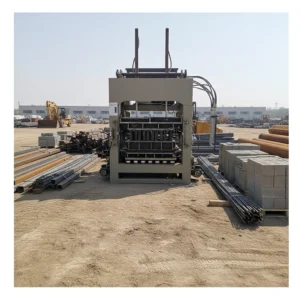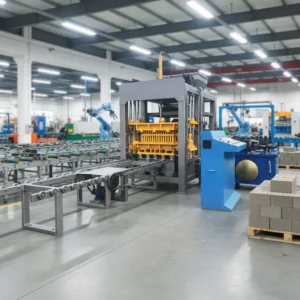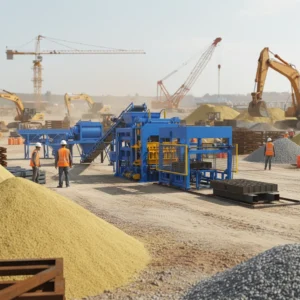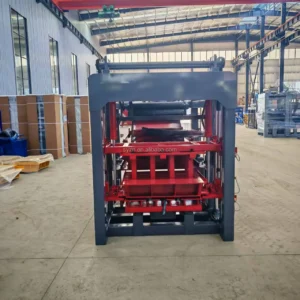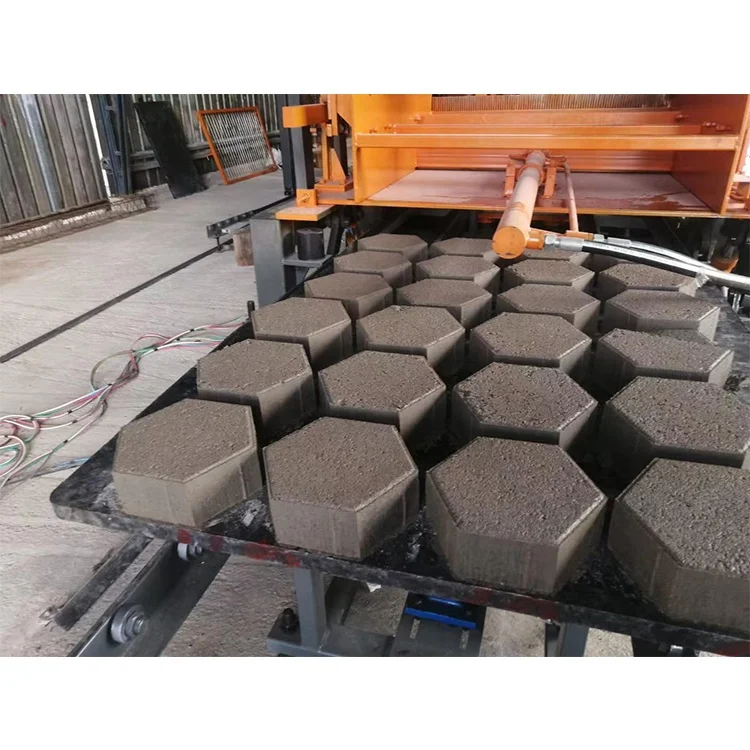
Matched Line Integration — the QT8-15 press is specified alongside raw material feeding, mixing, pallet handling, and stacking so cycle times align across every station.
Technical Specifications
| Parameter | Value |
|---|---|
| Model | QT8-15 |
| Product Type | Hydraulic Concrete Block Making Machine |
| Overall Dimension | 8300 × 1860 × 3000 mm |
| Rated Pressure | 21 MPa |
| Main Vibration Form | Platform Vibration |
| Vibration Frequency | 2800–4500 r/min |
| Vibration Force | 45 kN |
| Pallet Size | 950 × 900 mm |
| Molding Cycle | 15–20 s (basis to be confirmed with block format and mix design) |
| Overall Power | 55.5 kW |
| Total Mass | 8 T |
| Demolding Method | Hydraulic |
| Applied Products | Hollow blocks, solid blocks, pavers, interlocking blocks, curbstones, colored pavers |
| Raw Materials | Crushed stone, sand, cement, fly ash, gravel, slag |
| Factory Area | 300 m² |
| Control System | Available with PLC or MCC control, language configurable |
| Voltage & Frequency | Configurable to site requirements, confirm before commissioning |
Application Suitability
| Application | Material or Output |
|---|---|
| Hollow block production for wall construction | Crushed stone, sand, cement, fly ash blends |
| Solid block manufacturing for load-bearing walls | Gravel, cement, and slag mixes |
| Interlocking paver production for driveways and walkways | Colored concrete with fine aggregate |
| Curbstone forming for road and pavement edging | Coarse aggregate with high cement content |
| Porous block production for permeable paving | Open-graded aggregate with controlled cement ratio |
Why a 15-Second Cycle Time Does Not Tell You Daily Output
The press cycle is only one station — upstream feeding, pallet supply, and downstream stacking must all match that rhythm, or the line stalls.
I have stood on a factory floor watching a block press sit idle for twenty minutes every hour because the pallet feeder could not keep up and the mixer was undersized. The quoted cycles per hour looked strong on paper, but real daily output fell far short because nobody calculated line-level throughput. When you evaluate a QT8-15 block machine production line, the molding cycle must be checked against every other station’s speed [NEED_CITE: line-level throughput calculation methods for concrete block plants]. The press, mixer, pallet return conveyor, and stacker either run as a synchronized system or they create bottlenecks that cost you shifts of lost production.
Station Matching Across the Full Concrete Block Making Line
A concrete block making line supporting equipment setup begins at the raw material intake. The batching and mixing station must deliver a consistent volume of mixed material to the press hopper within the 15–20 second molding window. If the mixer discharges too slowly, the press waits and cycle counts drop.
Downstream, the pallet return system must clear cured blocks and present a fresh pallet to the press table before the next cycle begins. A pallet conveyor that runs slower than the press cycle creates a queue that backs the entire line up. Every piece of concrete block making line supporting equipment must be sized to the press rhythm, not selected independently from a catalogue.
Pallet, Curing, and Stacking Station Synchronization
The 950 × 900 mm pallet size on the QT8-15 determines how many blocks sit on each board and how those boards move through the curing racks. If the curing rack dimensions or the forklift capacity on site were not considered when the pallet size was chosen, boards pile up on the floor and block strength suffers from uneven curing [NEED_CITE: concrete block curing temperature and time standards].
Automatic stacking and cubing at the end of the line must also match press output. A stacker rated for a slower throughput than the press creates the same bottleneck as an undersized mixer — the line is only as fast as its slowest station.
How Hydraulic Pressure and Vibration Shape Block Density
The 21 MPa rated hydraulic pressure works together with the 45 kN vibration force at 2800–4500 r/min to compact the concrete mix into the mould cavity. Higher vibration frequency settles fine particles into voids while hydraulic pressure holds the mould closed against that force. If the vibration force is too low for the aggregate size in the mix, the block surface shows honeycombing and compressive strength drops.
The platform vibration form means the vibration energy is applied through the pallet rather than the mould walls, which suits the 950 × 900 mm pallet format and produces consistent density across the block face. The hydraulic demolding method lifts the mould box cleanly away from the compacted block, reducing surface damage on hollow and interlocking formats. Total connected power of 55.5 kW must be matched to the site transformer capacity and dedicated circuit rating before the line is wired [NEED_CITE: industrial motor starting current and circuit sizing standards]. The 8-tonne machine mass provides a stable base that absorbs vibration reaction forces without transmitting them into the factory floor structure.
What Happens When Line Stations Are Not Balanced
When a plant owner orders the press alone and sources the mixer, pallet feeder, and stacker separately, the result is often a line where one station is always waiting for another. The press may be rated for a short cycle, but if pallets arrive late or the stacker cannot clear boards fast enough, operators stand idle while the line corrects itself.
I once spent four days on a site re-sequencing a line where the mixer capacity was never matched to the press throughput — the owner had purchased each station on its own spec sheet without checking that the discharge rate, pallet speed, and stacking cycle all aligned. The curing racks sat half-empty and the plant never reached the daily volume that justified the investment [NEED_CITE: common causes of throughput loss in concrete block production].
Why Source the Full Line From One Supplier
The QT8-15 is specified as part of a matched line, so the mixer discharge rate, pallet conveyor speed, and stacker cycle are all calculated against the press molding time before the quotation is issued.
Pallet size and material are confirmed against the buyer’s existing curing area dimensions and forklift capacity, not selected from a standard list. Voltage, frequency, and PLC display language are confirmed for every station on the line before production begins, preventing commissioning delays on site.
The line layout drawing shows capacity calculations stated per block format at each station, so the buyer sees realistic daily output rather than a press-only cycle figure. Mould design covers the specific formats the buyer’s market sells, including custom drawings, and the automation level is selectable station by station so a buyer can start with semi-automatic pallet handling and add automatic stacking later.
Documentation & Verification
- Line layout drawing with capacity calculation stated per block format at each station
- Machine specification sheet covering press, mixer, pallet system, and stacker
- Pallet specification matched to curing rack dimensions and forklift rating
- Voltage, frequency, and PLC language confirmation for every line station
- Factory test record covering the full line run, not the press alone
- Hydraulic and electrical schematic for all connected stations
Installation, Commissioning & Support
- Foundation plan based on the 8300 × 1860 mm press footprint and 8-tonne operating mass
- Electrical supply sizing for the 55.5 kW total connected load across all line stations
- Machine dismantling and container loading plan with reassembly sequence on site
- Full line commissioning including mixer discharge timing, pallet conveyor speed, and stacker cycle alignment
- Operator training covering mould change procedure, PLC navigation, and daily maintenance checks
- Wear parts list covering hydraulic seals, vibration springs, and mould liner plates
What to Prepare Before Requesting a Quotation
To specify a QT8-15 block machine production line accurately, share the target block formats, required daily output, and the raw materials available locally including aggregate grading. Provide the factory floor area, ceiling height, and existing curing rack dimensions so pallet and conveyor layout can be matched. Confirm the local voltage, frequency, and preferred control language so all stations are configured before dispatch.
Frequently Asked Questions
Q: How is line-level daily output calculated versus press-only cycles per hour?
A: Line-level output starts with the press molding cycle but must account for pallet feeding time, mixer discharge rate, and stacker clearing speed. The slowest station sets the real throughput. We calculate daily output per block format across all stations and state that figure in the line layout, so the number reflects actual production conditions, not a press-only theoretical maximum.
Q: How must upstream mixer capacity and downstream pallet feeding match the QT8-15 cycle?
A: The mixer must discharge a full batch within the press molding window so the hopper never runs empty. The pallet return conveyor must clear the cured board and present a fresh pallet before the next cycle starts. Both speeds are calculated against the 15–20 second press cycle and confirmed in the line layout drawing before the equipment is built.
Q: What pallet size and material are recommended for my curing area and forklift?
A: The standard 950 × 900 mm pallet must be checked against your curing rack slot width and your forklift tine spacing. If your racks or forklift were already purchased, share those dimensions so pallet size and material — wood, bamboo, or composite — are chosen to fit your existing infrastructure rather than forcing a costly replacement.
Q: Can automation be selected station by station on the line?
A: Yes. A buyer can start with a semi-automatic press and manual pallet handling, then add automatic stacking and cubing later. Each station’s automation level is specified independently in the line layout, so the upgrade path is defined before the first station is shipped, and mechanical interfaces for future automation are built in from the start.
Q: What installation support covers the full line and not just the press?
A: Commissioning covers every station — mixer discharge timing, pallet conveyor speed synchronization, stacker cycle alignment, and PLC language setup across all controllers. Operator training includes the full line sequence from raw material feeding through block cubing, and the factory test record documents a continuous run of all connected stations before the equipment is packed for shipment.